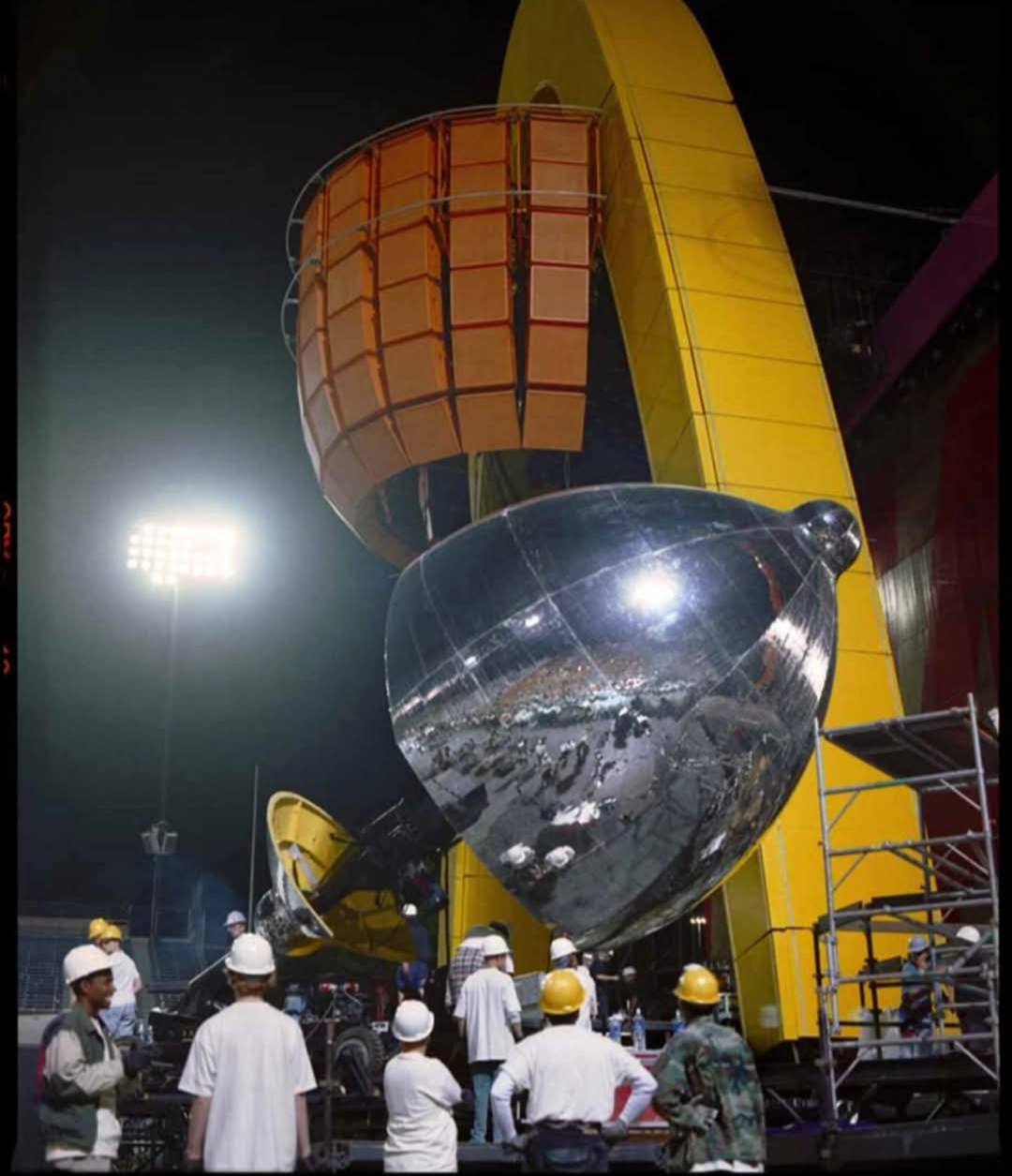
The story of U2’s giant motorized lemon, which the band used as a dramatic entrance vehicle during the encore section of their 1997–1998 PopMart Tour, has grown into one of the most memorable, bizarre, and symbolically rich moments in the band’s long history. While for many casual observers it may appear to have been nothing more than a flashy gimmick or a humorous stage prop that went occasionally and embarrassingly wrong, the lemon was in fact the result of a layered artistic intention spearheaded by Bono and supported by a tour concept built entirely around satire, spectacle, and a deliberate confrontation with late-20th-century consumer culture. To understand why U2 built a 12-meter mirrored fruit on wheels and risked getting trapped in it in front of tens of thousands of fans, one has to look back at the ideas that shaped Pop, Zooropa, and an entire era of experimentation for the band.
U2 in the 1990s was far removed from the earnest, politically charged image that had defined them in the 1980s. After Achtung Baby, the group embraced irony, theatricality, and a level of visual flamboyance that would have been unimaginable just a few years earlier. This evolution continued with Zooropa in 1993, an album drenched in themes of technology, advertising, memory, identity distortion, and the emotional disorientation of the modern world. Among its tracks was “Lemon,” a shimmering, dance-inflected song characterized by falsetto vocals, looping beats, and an atmosphere halfway between nostalgia and surrealism. While on the surface “Lemon” seemed playful and unusual even for U2, its inspiration was personal: Bono had found a homemade video of his late mother wearing a lemon-colored dress, and watching her through the graininess of old film triggered reflections on how memory, technology, and human storytelling can simultaneously preserve and distort reality. The song floated between tenderness and artificiality, using the lemon both as an object from memory and as a symbol of the filtered, synthetic way we sometimes cling to the past.
This symbolic resonance would later help shape the PopMart Tour. By the time U2 emerged from the studio with their album Pop in 1997, they were intentionally diving deep into a hyper-stylized world of neon textures, electronic rhythms, and exaggerated commentary on the culture of consumption. The tour that followed would amplify those themes to outrageous proportions. PopMart became one of the largest stage spectacles ever attempted: a gigantic LED screen, a towering golden arch reminiscent of the McDonald’s logo, a 30-foot cocktail stick spearing a massive green olive, and a bright industrial color palette that clashed with the seriousness traditionally associated with rock concerts. U2 was not merely staging a show; they were staging criticism, parody, and reflection on what the rock industry had become—glitz without content, neon without meaning, a shopping mall masquerading as authenticity. In this environment, a giant lemon did not feel out of place. It felt essential.
Bono, always attracted to theatrical, symbolic, and humorous performance choices, proposed the idea of using a large lemon early in the tour-design process. The fruit fit neatly into the PopMart aesthetic: it was an everyday supermarket item, ordinary yet vibrantly commercial, silly yet instantly recognizable. It evoked the bright artificiality of plastic supermarket displays, the mass-produced cheerfulness of global advertising, and the kind of cartoonish kitsch that the tour sought to exaggerate until audiences were forced to recognize the satire embedded inside it. If the stage boasted a fast-food golden arch and an olive on a giant cocktail stick, then a lemon on wheels was almost a logical extension of that world. But Bono’s idea went beyond visual humor. He imagined the lemon as a show vehicle—an actual moving structure with mirrored surfaces, inside which U2 could travel from the main stage to a smaller Stage B. In Bono’s mind, it could function as a contemporary, pop-culture reinterpretation of the mothership used by Parliament-Funkadelic, a band whose blend of funk, sci-fi, humor, and theatricality had greatly influenced his thinking about performance. While Parliament descended from the sky in a spaceship that blended mythology with funk spectacle, U2 would emerge from a citrus fruit, transforming spectacle into satire.
The mirrored exterior served multiple purposes. Aesthetically, it reflected the stage lights and created dazzling visual effects, amplifying the futuristic absurdity of the moment. Symbolically, it played into PopMart’s commentary on self-image, reflection, and distorted identity under mass media. Functionally, the mirrors reinforced the lemon’s role as a traveling enclosure, concealing the band as they prepared for their entrance on Stage B during encores like “Discothèque” and “Mofo.” The idea may have seemed outlandish, but it was built upon a decade-long artistic evolution that had pushed U2 toward blending conceptual depth with theatrical exaggeration.
Yet for all the planning behind it, the lemon became infamous for one reason: technical failure. The structure, weighing several tons and measuring about 12 meters (40 feet) in height, was a complex piece of machinery. It needed to open smoothly, roll reliably, rotate correctly, and coordinate with the timing of the music, lighting, and crew movement. PopMart was a massive touring operation with hundreds of workers, but even so, the lemon frequently malfunctioned. There were nights when it refused to roll forward, nights when its doors jammed, and several shows where the band ended up stuck inside the giant fruit, waiting awkwardly for technicians to open it manually. In one particularly memorable incident, the lemon remained completely sealed, and the members of U2 had to shout from within to alert the crew. The audience, unaware of the mechanical chaos unfolding inside the mirrored citrus shell, witnessed long, strange pauses and sometimes improvisational transitions as the band scrambled to salvage the moment.
These repeated mishaps turned the lemon into a kind of legend—part punchline, part cautionary tale, part symbol of the tour’s audacity. While it certainly contributed to the image of PopMart as a flawed but ambitious project, the band never fully distanced themselves from the concept. Instead, Bono later described the entire idea, Lemon included, as “beautiful,” psychedelic, bold, and artistically necessary. His defense rested on the argument that PopMart was not designed to be flawless; it was designed to push boundaries. It was a parody of modern spectacle that purposely inflated the ridiculousness of stadium culture. The lemon, even when unreliable, fit that mission perfectly. Its failures made it even more human—and, in some ways, even more meaningful—because they exposed the awkwardness, vulnerability, and unpredictability behind high-concept art.
For some fans, especially those who longed for the more serious and stripped-down U2 of earlier decades, the lemon symbolized everything that felt too strange or too excessive about the band’s 1990s persona. It was viewed as over-the-top, as a gimmick that detracted from the music, as a representation of a band temporarily lost in spectacle. But for others—and, importantly, for U2 themselves—it became a beloved oddity, the kind of bold creative risk that only a confident, curious, and evolving band could attempt. No other major rock group at the time would have dared build a giant fruit as a transport device, let alone use it nightly as part of a psychological, musical, and cultural statement. It was absurd, yes, but its absurdity was deliberate, layered, and central to the tour’s message.
Looking back today, the lemon feels emblematic of PopMart as a whole. The tour was a sprawling, neon-soaked commentary on the consumerist era, filled with contradictions—critical yet celebratory, mocking yet sincere, flashy yet meaningful. The fruit encapsulated these tensions perfectly. It referenced a deeply personal song rooted in Bono’s memory of his mother, yet it was also a mass-produced supermarket symbol. It aimed to dazzle with technology and mobility, yet it often failed in ways that undercut its intended grandeur. It was both funny and profound, both a joke and a metaphor. Few bands could transform a malfunctioning prop into a cultural icon, but U2 managed exactly that, without losing sight of the artistic intentions that drove its creation.