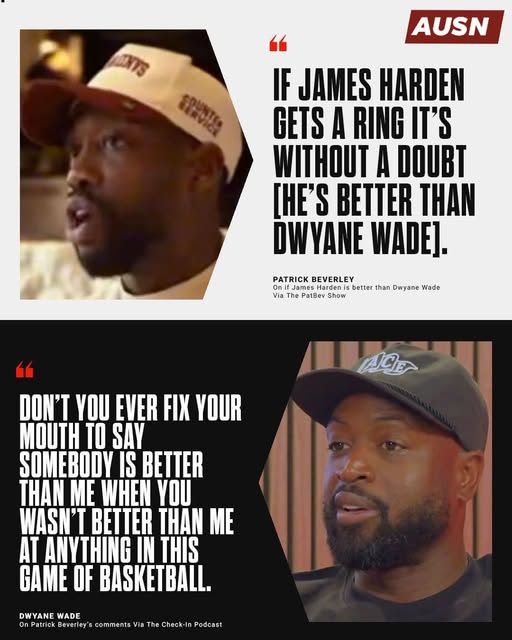
The idea of comparing great players across eras and styles is one of the NBA’s most enduring conversations, and when someone like Patrick Beverley steps in with a strong opinion—this time suggesting that James Harden ranks above Dwyane Wade—it’s almost guaranteed to spark a response. Not because controversy is the goal, but because the comparison itself touches on legacy, context, and what people value most in a basketball player. Wade’s reaction, whether direct or implied through interviews, social media tone, or past commentary, carries weight because he doesn’t just represent his own résumé; he represents a standard for what a complete, winning guard looks like.
What makes this particular debate interesting is that it isn’t built on a simple statistical disagreement. Harden’s numbers are undeniable. His scoring titles, MVP season, and offensive innovations have reshaped how the game is played. He has been one of the most dominant offensive engines the league has ever seen, capable of controlling tempo, generating efficient scoring opportunities, and carrying teams through regular seasons with a level of production that few players in history can match. From a purely analytical standpoint, there’s a compelling argument to be made for his greatness, and that’s likely where Beverley’s perspective originates. Having shared the court with Harden, he has firsthand experience of what that level of offensive brilliance looks like up close.
But Wade’s career invites a different kind of evaluation, one that goes beyond box scores and into the fabric of winning basketball. He wasn’t just a scorer; he was a two-way force, a leader, and a player whose impact often peaked in the most critical moments. His 2006 Finals performance alone stands as one of the most dominant championship series in NBA history, a stretch where he didn’t just perform well—he imposed his will on the game. That ability to elevate under pressure becomes a central pillar in any argument that places him above Harden, whose postseason résumé, while strong in many respects, has faced more scrutiny.
If Wade were to respond directly to Beverley’s claim, it likely wouldn’t come across as defensive or dismissive. Throughout his post-playing career, he has shown a willingness to engage with debates while maintaining a level of perspective. He understands how narratives are shaped, how different eras emphasize different skills, and how players are often judged through the lens of what the game values at a given time. Rather than outright rejecting the comparison, his response would probably reframe it, emphasizing the elements of the game that defined his career: defense, sacrifice, and the ability to adapt within a team structure.
One of the key distinctions between Wade and Harden lies in their approach to the game. Harden’s style is built around control—he dictates pace, orchestrates offense, and leverages spacing to maximize efficiency. His step-back three, his ability to draw fouls, and his vision as a passer make him a uniquely modern player. Wade, on the other hand, thrived in a more physical era, where spacing was tighter and defenses were more aggressive. His game was built on slashing, mid-range scoring, and defensive intensity. He didn’t rely on volume three-point shooting; instead, he attacked the rim relentlessly, absorbing contact and finishing through it.
That contrast isn’t just stylistic—it influences how each player’s greatness is perceived. In today’s NBA, Harden’s skill set aligns perfectly with the league’s emphasis on spacing and efficiency. In Wade’s era, his ability to dominate without relying on the three-point shot made him exceptional. When Wade reflects on comparisons like this, he likely considers not just what each player accomplished, but how they accomplished it within their respective contexts.
Another layer to this discussion is the concept of sacrifice. Wade’s career arc includes a period where he willingly adjusted his role to accommodate LeBron James during their time with the Miami Heat. That decision wasn’t about individual accolades; it was about maximizing the team’s chances of winning championships. It’s a dimension of greatness that doesn’t always show up in statistical comparisons but carries significant weight in legacy discussions. Harden, for much of his prime, operated as the focal point of his teams, with systems built around his strengths. That doesn’t diminish his accomplishments, but it highlights a difference in circumstances and responsibilities.
When Wade responds—whether directly or indirectly—he’s also speaking to a broader audience that includes fans, analysts, and players who interpret these debates in different ways. Some prioritize individual dominance, others prioritize team success, and many try to balance the two. Wade’s perspective naturally leans toward a holistic view of the game, one that values defense, leadership, and the ability to perform in high-stakes situations. It’s not that he dismisses Harden’s achievements; it’s that he frames the conversation in a way that emphasizes the qualities he believes define true greatness.
There’s also an element of respect that underpins these exchanges. NBA players, especially those who have reached the level of Wade and Harden, understand the difficulty of sustaining excellence over time. Even in disagreement, there’s an acknowledgment of what it takes to achieve that level of success. Wade’s response would likely reflect that, recognizing Harden’s brilliance while still asserting his own place in the conversation. It’s less about tearing down another player and more about clarifying what he brings to the table.
The role of media and fan discourse cannot be ignored in shaping how these debates unfold. Beverley’s comment becomes a catalyst, but the reaction it generates is amplified by the platforms through which it spreads. Social media, television segments, and online discussions all contribute to a narrative that can sometimes oversimplify complex comparisons. Wade, having navigated the media landscape throughout his career, is well aware of this dynamic. His response, therefore, would likely aim to add nuance rather than fuel the fire.
In evaluating whether Harden is “better” than Wade, the question itself becomes somewhat limiting. It suggests a binary outcome in a discussion that is inherently multifaceted. What does “better” mean in this context? Is it about peak performance, longevity, championships, individual accolades, or overall impact on the game? Different answers to that question will yield different conclusions. Wade’s response would likely challenge the premise, encouraging a more nuanced evaluation that considers multiple dimensions of greatness.
There’s also a generational aspect to consider. Fans who grew up watching Wade may prioritize his style and achievements, while those who have followed Harden’s career may see his offensive dominance as more impressive. These perspectives are shaped by exposure, context, and personal preference. Wade, in responding, would be aware of this divide and might use it as an opportunity to bridge the gap, highlighting the evolution of the game and how different players have excelled within it.
Ultimately, Wade’s response to Beverley’s claim isn’t just about defending his legacy; it’s about contributing to an ongoing conversation about what makes a player truly great. It’s about reminding people that basketball is not just a game of numbers, but a game of moments, decisions, and impact. His career is defined by a combination of skill, resilience, and an ability to rise to the occasion when it mattered most. Those qualities may not always be captured in statistical comparisons, but they resonate deeply in discussions of legacy.
At the same time, Harden’s place in that conversation is secure. His influence on the game, his scoring ability, and his role in shaping modern offensive strategies ensure that he will be remembered as one of the greats. The debate between him and Wade is less about diminishing one in favor of the other and more about appreciating the different ways greatness can manifest.
In the end, Wade’s response—whether spoken or implied—serves as a reminder that legacy is not defined by a single comparison or a single opinion. It’s built over time, through performances, achievements, and the respect of peers. Dwyane Wade doesn’t need to argue loudly to assert his place in history; his career speaks for itself. And while Patrick Beverley may have sparked the conversation by elevating James Harden in his view, the resulting dialogue ultimately highlights the richness of the game and the many ways greatness can be understood.