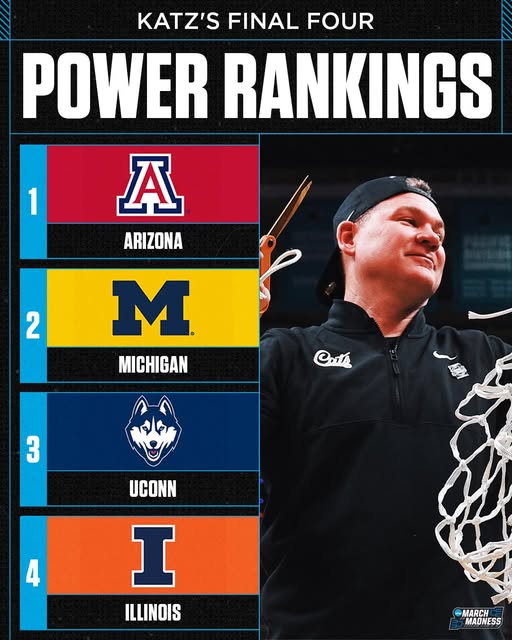
As we near the 2026 NCAA Men’s Final Four, Andy Katz’s power rankings have been one of the best barometers of who’s been elite all season and who’s peaking at the right time. Katz, a veteran college hoops analyst and senior correspondent for NCAA.com with decades of March Madness coverage, has used his weekly Power 37 (a top‑37 ranking tied to the number of at‑large bids) to evaluate teams based on résumé, performance, strength of schedule, metrics like adjusted efficiency, and how well they’re trending as the season closes before Selection Sunday. (NCAA.com)
Earlier in March, Katz had Duke Blue Devils at the top of his Power 37 heading into the final stretch of the regular season. They were followed closely by programs such as Arizona Wildcats, Michigan Wolverines, and UConn Huskies, who all stood out as elite teams with strong overall resumes. (NCAA.com)
Those rankings were the product of a season full of storylines: Duke’s explosive roster led many of his lists, Michigan’s shift to the No. 1 spot after toppling rivals showed their consistency and balance, and Arizona’s sustained excellence put them in everyone’s championship conversation early on. (NCAA.com)
By the time tournament time came, these top teams weren’t just favored on paper — they had the bodies of work to back it up. As March Madness unfolded, Michigan steamrolled through the Midwest region, and UConn hit a dramatic buzzer‑beater late in the East region to punch its ticket to Indianapolis. (Kaxe)
What made Katz’s Power Rankings useful heading into the Final Four isn’t just who was actually ranked highest, but how those teams performed when faced with their toughest tests. Michigan’s strength, Arizona’s offensive balance, and UConn’s resilience all matched what Katz’s rankings anticipated — elite programs capable of deep tournament runs. And Illinois, while perhaps a bit under the radar early in Katz’s season rankings, proved its mettle by advancing to its first Final Four in decades. (CBS Sports)
Katz’s consistent placement of Duke, Arizona, Michigan, and UConn near the very top heading into March wasn’t just prediction — it was a reflection of a season in which those teams produced real, quality wins and sustained excellence. That’s why all four ended up deep in the bracket when the stakes were highest, even if Duke ultimately fell just short in the Elite Eight. (KIRO 7 News Seattle)
In many ways, Katz’s Power 37 rankings have helped set expectations for how the Final Four would shape up well before Selection Sunday: programs with elite balance, clutch performers, and depth across offensive and defensive efficiency usually find themselves in this phase of the tournament. Katz’s prior rankings often lined up with NCAA Tournament success — because they’re rooted in a combination of analytics and narrative, not just reputation. (NCAA.com)
At this point — with the Final Four locked in — the implicit “power rankings” based on Katz’s season of analysis looks something like this: the top tier consists of Michigan and Arizona as favorites with balanced rosters and strong metrics; UConn as a gritty, battle‑tested contender; and Illinois as the surprise package that has seized momentum and opportunity. These aren’t official rankings from Katz himself, but this hierarchy mirrors how his Power 37 and bracket predictions played out once the tournament started. (CBS Sports)
What Katz’s work has shown this season is that while regular‑season rankings matter, what matters more is peaking at the right time. Teams that climb his Power 37 toward the end — with wins over quality opponents and strong efficiency numbers — tend to emerge in the later rounds of March Madness. That explains why teams like Illinois (who may have started lower but rose by beating top competition) and UConn (who showed resilience) are sitting in Final Four matchups despite their mixed early season results. (Kaxe)
Throughout March, analysts, fans, and bracketologists alike have leaned on Katz’s Power 37 as the tournament progressed because those rankings offered context beyond seeding. They made clearer which teams were battle‑tested, well‑rounded, and capable of adapting to March pressure — all key predictors of NCAA Tournament success. (NCAA.com)
So as the Final Four approaches — with Michigan vs. Arizona and UConn vs. Illinois set to play for a championship berth — Katz’s power rankings have essentially tracked the teams most prepared for this moment. His analysis, built up over weeks of the Power 37 cycle, has shown how the most consistent teams in the regular season tend to be the most dangerous in March — yet also how a well‑timed surge can elevate a team like Illinois into the spotlight. (CBS Sports)
In short, Katz’s power rankings have not just predicted bracket success — they’ve articulated which teams have the qualities that matter most in March: depth, resiliency, balance, efficiency, and the ability to withstand adversity under pressure. And that’s precisely why the current Final Four reflects the teams he’s been spotlighting all season long. (NCAA.com)