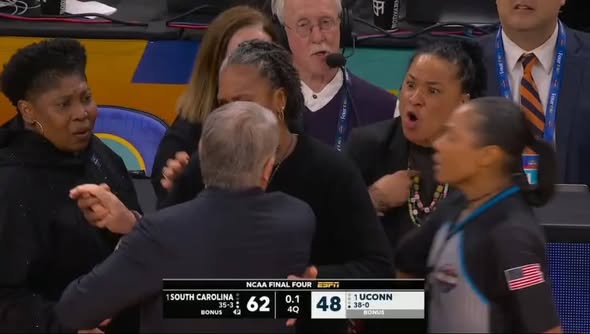
The closing seconds of the Final Four clash between the South Carolina Gamecocks women’s basketball and the UConn Huskies women’s basketball were always destined to carry tension, but few could have anticipated just how emotionally charged the moment would become. What had already been a fiercely contested, high-stakes battle between two of the most dominant programs in women’s college basketball escalated into a sideline confrontation that instantly became one of the defining images of the tournament. At the center of it all were two of the sport’s most respected—and competitive—figures: Dawn Staley and Geno Auriemma.
With the game slipping away and the outcome all but sealed, emotions that had been simmering beneath the surface throughout the night finally boiled over. South Carolina had executed its game plan with precision, relying on defensive discipline, rebounding dominance, and timely scoring to put UConn in an increasingly difficult position. On the opposite sideline, Auriemma’s frustration was evident, his team struggling to generate consistent offense against a relentless Gamecocks defense that seemed to anticipate every move.
The final minute of play brought a sequence that would ultimately spark the confrontation. A physical exchange under the basket led to a whistle that drew immediate reaction from the UConn bench. Auriemma, never one to shy away from voicing his opinion, stepped toward the officials with visible agitation. His gestures were sharp, his words animated, and the intensity of his protest caught the attention of everyone in the arena.
Staley, meanwhile, was locked into the moment, focused on ensuring her team closed out the game without unnecessary mistakes. But as the stoppage extended and Auriemma’s frustration lingered, the tension began to spill beyond the officiating crew. What started as a disagreement over a call quickly turned into something more personal—or at least more direct.
Witnesses near the scorer’s table described a brief but unmistakable exchange between the two coaches. Auriemma appeared to direct a comment across the floor, his tone unmistakably heated. Staley, known for her composure but equally for her willingness to stand her ground, responded immediately. She stepped forward, her expression firm, her message clear: her team had earned its position, and she would not allow the moment to be overshadowed or questioned.
Players on both sides sensed the shift instantly. South Carolina’s bench rose to its feet, some in celebration, others in defense of their coach. UConn players, equally protective of their program’s legacy, moved closer to their sideline, watching the interaction unfold with a mix of concern and intensity. Officials and assistants quickly intervened, positioning themselves between the two coaches to prevent the situation from escalating further.
The exchange itself lasted only a matter of seconds, but its impact lingered long after the final buzzer sounded. Cameras captured the moment from multiple angles, and within minutes, clips began circulating across social media, fueling debate and analysis. Was it simply a case of competitive fire reaching its peak? Or did it reflect a deeper rivalry between two programs that have repeatedly found themselves on the sport’s biggest stage?
To understand the weight of the moment, one must consider the history behind it. Auriemma has long been the standard-bearer in women’s college basketball, building UConn into a dynasty defined by championships, consistency, and an uncompromising approach to excellence. His fiery demeanor on the sidelines is as much a part of his identity as his tactical brilliance, and his willingness to challenge officials—and occasionally opponents—is well documented.
Staley, on the other hand, represents a newer but equally formidable force. Since taking over at South Carolina, she has transformed the program into a powerhouse capable of going toe-to-toe with anyone, including UConn. Her teams are known for their toughness, cohesion, and defensive intensity, reflecting her own playing career and coaching philosophy. More importantly, she has embraced the role of competitor without apology, unafraid to push back when she feels her team is being disrespected.
Their paths have crossed multiple times in recent years, each meeting adding another layer to an evolving rivalry. While both coaches have maintained public respect for one another, there has always been an undercurrent of competition that goes beyond wins and losses. Each game carries implications not just for rankings or championships, but for the broader narrative of power within women’s college basketball.
That context made the Final Four stage the perfect—and perhaps inevitable—setting for a moment like this. With everything on the line, the stakes amplified every call, every possession, and every interaction. By the time the game reached its closing moments, the emotional margin for error had all but disappeared.
After the game, both coaches addressed the incident, though in measured tones that suggested a desire to move forward rather than dwell on the confrontation. Auriemma acknowledged his frustration, emphasizing the intensity of the moment and the difficulty of watching a season’s work come to an end. He stopped short of elaborating on the exchange itself, instead focusing on his team’s effort and the challenges they faced throughout the game.
Staley, for her part, struck a similarly composed note. She praised her players for their resilience and execution, highlighting the significance of the win in the context of their season. When asked about the sideline interaction, she framed it as a byproduct of competition, noting that emotions run high in games of that magnitude. At the same time, her tone carried an unmistakable edge—an implicit reminder that her program expects respect commensurate with its achievements.
For players, the moment served as both a distraction and a rallying point. South Carolina’s roster embraced the energy, using it to fuel their closing push and celebrate a victory that secured their place in the national championship game. UConn’s players, meanwhile, were left to process both the loss and the emotional aftermath, a difficult combination for any team, particularly one accustomed to competing for titles.
Beyond the immediate participants, the incident sparked broader conversation within the basketball community. Analysts debated whether such exchanges are a natural part of high-level competition or something that detracts from the game’s integrity. Former players weighed in on social media, many expressing understanding of the emotions involved while also emphasizing the importance of maintaining composure.
Fans, as expected, were divided. Some viewed the confrontation as a refreshing display of passion, evidence that the game continues to grow in intensity and visibility. Others questioned whether it crossed a line, particularly given the visibility of the Final Four stage and the example set for younger players watching at home.
What remains undeniable is that the moment captured attention in a way few others could. In an era where women’s college basketball is experiencing unprecedented growth, moments like this—however controversial—underscore the stakes and the personalities driving the sport forward. The rivalry between South Carolina and UConn, and between Staley and Auriemma, has become a central narrative, one that continues to evolve with each meeting.
Looking ahead, the implications of the game—and the confrontation—extend beyond a single result. For South Carolina, the victory reinforces its position at the forefront of the sport, a program capable of not only competing with but surpassing the traditional powers. For UConn, the loss serves as both a setback and a motivator, a reminder that maintaining dominance requires constant adaptation and resilience.
As for Staley and Auriemma, their relationship will likely continue to be defined by moments like this—intense, competitive, and occasionally combustible. Yet beneath the surface, there remains a shared commitment to excellence and a mutual understanding of what it takes to succeed at the highest level. That balance—between rivalry and respect—is what ultimately defines the best matchups in sports.
In the end, the heated exchange in the final seconds will be remembered not as an isolated incident, but as part of a larger story. A story of two programs pushing each other to new heights, of two coaches unwilling to back down, and of a sport that continues to captivate audiences with its intensity and drama.