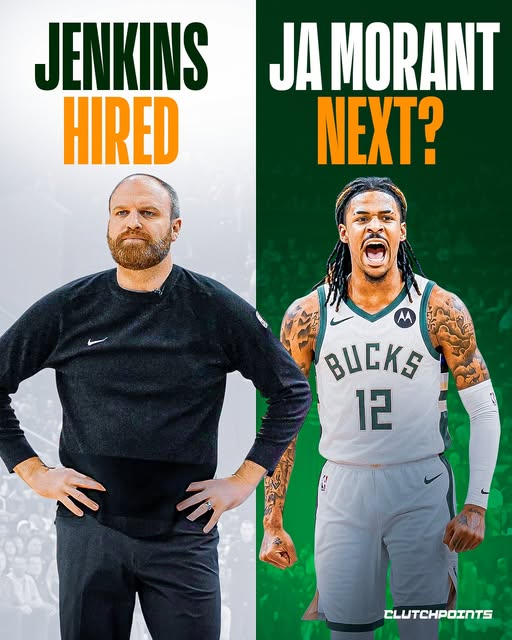
The recent decision by the Milwaukee Bucks to bring in Taylor Jenkins has quickly shifted from a straightforward coaching move into something far more intriguing, as speculation begins to ripple across the league about what it could mean for Ja Morant and his long-term future with the Memphis Grizzlies. While no official discussions or trade talks have surfaced publicly, the connective thread between Jenkins and Morant is strong enough that observers are beginning to read between the lines, questioning whether this hire could eventually set the stage for a high-profile reunion.
Jenkins and Morant are not just coach and player who happened to cross paths; their relationship is foundational to the Grizzlies’ rise over the past several seasons. When Jenkins took over in Memphis, the franchise was in the early stages of a rebuild, still searching for a defining identity. Morant’s arrival shortly thereafter accelerated that process, and under Jenkins’ guidance, he evolved from an electrifying rookie into one of the most dynamic guards in the league. Their partnership wasn’t merely about system fit or statistical output—it was rooted in trust, freedom, and a shared belief in playing fast, aggressive basketball.
That context is what makes the Bucks’ move so interesting. On the surface, Milwaukee’s decision to hire Jenkins can be explained by basketball logic alone. The team has been navigating a transitional phase, trying to maximize its championship window while adapting to an increasingly competitive Eastern Conference. Bringing in a coach known for player development, offensive creativity, and adaptability fits that agenda. Jenkins has a reputation for empowering his players, encouraging pace, and building cohesive locker rooms—traits that align well with a roster anchored by a superstar like Giannis Antetokounmpo.
Yet the NBA rarely operates in a vacuum. Coaching hires often carry secondary implications, especially when they involve figures closely tied to elite players. Morant’s situation in Memphis, while still stable on paper, has shown flashes of uncertainty. Injuries, suspensions, and inconsistent team performance have complicated what once looked like a straightforward trajectory toward perennial contention. While the Grizzlies remain committed to Morant as their franchise cornerstone, the reality of the modern NBA is that timelines can shift quickly, and relationships—no matter how strong—can be tested.
This is where speculation begins to gain traction. If Morant were ever to find himself reassessing his future in Memphis, the presence of Jenkins in Milwaukee could become a meaningful factor. Familiarity matters at that level. Players often gravitate toward environments where they feel understood and supported, and Jenkins has already proven he can build a system that amplifies Morant’s strengths. The idea of reuniting in a new setting, particularly with a team that already boasts championship aspirations, is naturally compelling to fans and analysts alike.
However, it’s important to separate plausibility from probability. There are significant hurdles that would stand in the way of any potential reunion. For one, Morant is under contract, and the Grizzlies have little incentive to move a player of his caliber unless circumstances drastically change. Even if Memphis were to consider such a move, the cost for acquiring a player like Morant would be enormous, likely requiring a combination of elite talent, draft capital, and financial maneuvering that could reshape Milwaukee’s roster entirely.
Additionally, the Bucks’ current structure is built around Antetokounmpo, and any major acquisition would need to complement rather than disrupt that foundation. Pairing Morant with Giannis is an enticing basketball concept—two relentless attackers capable of overwhelming defenses—but it also raises questions about spacing, ball dominance, and overall roster balance. Jenkins, having coached Morant before, would theoretically be well-positioned to manage those dynamics, but the practical challenges remain significant.
There’s also the broader context of the league to consider. The NBA is in a period defined by parity and rapid change, where teams are constantly recalibrating in response to injuries, contract situations, and shifting competitive landscapes. In that environment, speculation often outpaces reality. A coaching hire can spark a chain reaction of hypothetical scenarios, many of which never come close to materializing. The connection between Jenkins and Morant is real, but turning that connection into an actual reunion would require alignment across multiple fronts—organizational, financial, and personal.
Still, the intrigue persists because it taps into something fundamental about how the NBA operates. Relationships matter. Players and coaches build bonds that extend beyond individual seasons, and those bonds can influence decisions in subtle but meaningful ways. Jenkins’ understanding of Morant’s game—his ability to harness his explosiveness while encouraging growth as a playmaker—was a key factor in Morant’s development. Recreating that dynamic elsewhere, especially on a bigger stage, is the kind of storyline that captures the imagination.
For the Grizzlies, the situation underscores the importance of stability and forward momentum. Keeping Morant engaged and committed means continuing to build a roster capable of competing at the highest level, while also fostering an environment where he can thrive both on and off the court. Any perception of uncertainty, even if exaggerated, can become a narrative that the organization has to manage carefully.
For the Bucks, the focus remains on the present. Hiring Jenkins is about optimizing their current roster, maximizing their chances of contending, and creating a sustainable identity moving forward. If that decision also opens the door to future possibilities, that’s a secondary benefit rather than the primary objective. Teams rarely make moves based solely on hypothetical scenarios, but they are always aware of the broader implications.
In the end, the speculation surrounding a potential reunion between Jenkins and Morant says as much about the NBA’s storytelling culture as it does about the actual likelihood of such a move. Fans and analysts are drawn to connections, to the idea that past relationships can resurface in new and unexpected ways. It’s a narrative that blends basketball logic with a touch of imagination, creating a storyline that lingers even in the absence of concrete evidence.
Whether anything ultimately comes of it remains to be seen. For now, the hiring of Taylor Jenkins by the Milwaukee Bucks stands as a significant move in its own right, one that could shape the team’s trajectory in meaningful ways. The added layer of intrigue involving Ja Morant simply ensures that the conversation will continue, fueled by the ever-present possibility that in the NBA, today’s speculation can sometimes become tomorrow’s reality.