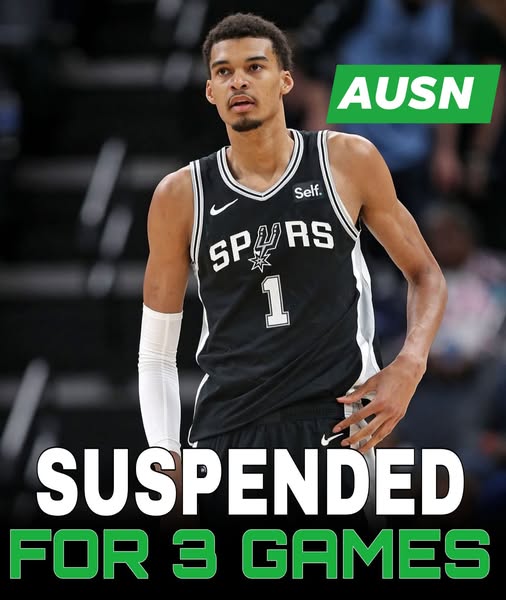
The NBA world exploded the second the whistle blew. One moment, Victor Wembanyama was battling in the paint trying to keep the San Antonio Spurs alive against the Minnesota Timberwolves, and the next moment social media was flooded with slow-motion clips, outrage, memes, and panic after his elbow connected with Naz Reid during Game 4. The officials immediately reviewed the play before upgrading it to a Flagrant 2 foul, ejecting Wembanyama from one of the biggest games of his young career. Now the conversation has shifted from the game itself to what comes next, because league sources are indicating the NBA is strongly considering either a three-game suspension or removing him for the rest of the series entirely.
If that happens, it changes everything.
The timing could not be worse for San Antonio. Wembanyama has become the center of the franchise, the identity of the roster, and arguably the most important young player in basketball. Every possession runs through his gravity. His defense changes how teams attack. His length alters shots that never even appear in the box score. Even when he is not scoring, opponents are constantly aware of where he is standing. Losing him in a playoff series against a physical, confident Timberwolves squad would be devastating.
The actual play itself is already dividing fans. Some people believe the elbow was intentional, pointing to the way Wembanyama turned his shoulder and followed through upward into Reid’s head area. Others argue it was the result of playoff physicality, saying players fight for position every possession and that this looked worse in slow motion than it did in real time. The NBA, however, has always judged these moments primarily on impact and danger, not just intent. Contact to the head almost automatically increases the severity of discipline discussions, especially in the postseason where emotions and physicality are already heightened.
What makes this even more dramatic is the image of Wembanyama himself. Around the league he has largely been viewed as a calm, composed superstar with elite basketball instincts rather than a reckless player. He is not known for dirty plays. He is not somebody constantly involved in altercations. That reputation matters because it makes this moment feel shocking. Fans are used to seeing him dominate with skill, touch, timing, and impossible defensive recoveries. Seeing him tossed from a playoff game after a dangerous elbow completely changes the tone surrounding him for the first time in his NBA career.
For Minnesota, though, this moment may become the turning point of the entire series. The Timberwolves have embraced a bruising defensive identity all season, and players like Naz Reid thrive in chaotic, emotional playoff environments. Reid has become one of the most respected role players in basketball because he brings energy, toughness, shot-making, and confidence every single night. When he got up after the collision, the crowd erupted, and the Timberwolves immediately fed off that energy. Momentum shifted instantly.
The psychological impact matters just as much as the basketball side. A suspension would not only remove San Antonio’s best player, it would also place immense pressure on everyone else in the rotation. Suddenly younger players are asked to create offense in playoff possessions against one of the league’s best defenses. Suddenly the Spurs lose their safety net at the rim. Suddenly Minnesota can attack the paint without worrying about a seven-foot-four alien rotating over to erase shots.
That is terrifying if you are a Spurs fan.
At the same time, there is going to be an enormous debate over consistency. NBA fans never agree on suspension standards because every incident feels unique depending on the players involved, the intensity of the game, and the stakes of the series. Some fans are already comparing this to previous postseason incidents where stars either avoided suspension or received lighter punishment. Others believe the league has no choice but to come down hard because player safety has to remain the priority regardless of who committed the foul.
And honestly, the NBA hates situations like this because there is no winning outcome. If the league suspends Wembanyama for multiple games, fans will accuse them of ruining a playoff series and overreacting to one emotional moment. If they avoid a serious punishment, critics will say the NBA protects stars and fails to properly address dangerous contact. Either way, the discourse becomes massive.
What also makes this fascinating is how quickly playoff narratives change. Before this incident, much of the basketball conversation around Wembanyama centered on his rise into superstardom. Analysts were discussing his ceiling, his defensive dominance, and whether the Spurs were ahead of schedule in their rebuild. He looked like the future face of the league. Now, for at least a moment, the conversation shifts toward discipline, composure, and emotional control under postseason pressure.
That is part of becoming a superstar too.
Every great player eventually faces a moment where emotions boil over under the spotlight. We have seen legends lose control in playoff games before. The pressure is different in the postseason because every possession feels life-or-death. Opponents target weaknesses relentlessly. Physicality increases. Trash talk intensifies. Fatigue accumulates. Young stars have to learn how to navigate all of it while still carrying enormous expectations.
Wembanyama is still incredibly young, which is easy to forget because he already looks capable of dominating the sport for the next decade. But moments like this remind everyone that development is not only about skill. Emotional maturity matters too. Learning how to respond when teams attack you physically is part of the playoff journey.
Meanwhile, Minnesota suddenly smells blood.
The Timberwolves already believed they could win this series through toughness and defensive pressure. If Wembanyama misses time, their confidence is going to skyrocket. Players like Anthony Edwards thrive in emotional environments, and the Wolves crowd will become even more intense if they feel the series momentum has fully shifted. Minnesota’s defense is already built to overwhelm teams physically. Removing the Spurs’ best offensive and defensive weapon would dramatically tilt the matchup.
Strategically, the Spurs would need a near-perfect response. They would likely have to speed the game up more offensively, rely heavily on perimeter shooting, and create chaos defensively through aggressive rotations and transition opportunities. But replacing Wembanyama’s impact is impossible. There is no tactical adjustment for losing a generational rim protector who can also score from anywhere on the floor.
And then there is the media storm.
The clips are everywhere already. Every sports show is replaying the elbow from different angles. Former players are debating intent. Fans are arguing about whether Reid exaggerated the contact. Others are saying Wembanyama deserves the suspension because stars should not receive special treatment. The internet thrives on playoff controversy, and this instantly became one of the biggest moments of the postseason.
You can already see the polarization forming. Spurs fans feel the reaction is excessive and emotional. Timberwolves fans believe the hit crossed the line completely. Neutral fans are split between wanting fairness and wanting the best players available in the playoffs. That tension is exactly why NBA suspensions become cultural flashpoints every postseason.
Another important factor is precedent. The NBA often looks at previous disciplinary decisions when determining punishment. If league officials believe the elbow involved unnecessary and excessive force to the head area, history suggests suspension becomes very possible. The length would likely depend on whether they interpret it as reckless frustration or intentional hostile contact.
The “rest of the series” possibility is especially brutal because playoff suspensions hit differently from regular-season punishments. Missing one random January game is not comparable to potentially losing multiple elimination games in May. The stakes magnify everything. Legacies shift because of playoff moments. Careers are remembered through postseason narratives.
For Wembanyama personally, this could become a defining learning experience. Superstars are often shaped as much by adversity as success. How he responds publicly matters. Does he apologize? Does he defend himself? Does he channel the frustration into maturity and focus moving forward? Fans and analysts will watch every reaction closely because the NBA spotlight is ruthless when it comes to rising icons.
At the same time, nobody should lose sight of the fact that playoff basketball is emotional warfare. Players are constantly battling through contact, pressure, exhaustion, and adrenaline. Split-second decisions happen at full speed. While the replay looks ugly, only Wembanyama truly knows what was going through his head during that moment. The league office now has to determine whether the act crossed the threshold from reckless playoff intensity into suspendable behavior.
And until that official ruling comes down, the entire basketball world is going to be refreshing timelines nonstop.
Because if Victor Wembanyama is suspended for three games or the rest of the series, the balance of power may have completely changed overnight.