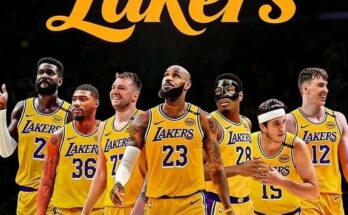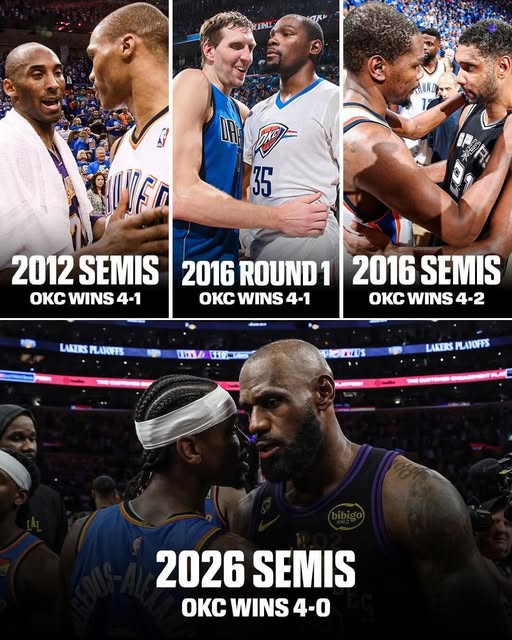
There’s something strangely poetic about the Oklahoma City Thunder becoming the final postseason checkpoint for some of the greatest legends the NBA has ever seen. Kobe Bryant, Tim Duncan, and Dirk Nowitzki — three icons who defined an era of basketball excellence — all saw their playoff journeys end against the same franchise. Now, with LeBron James nearing the twilight of his own legendary career and the Thunder once again emerging as a powerhouse in the Western Conference, basketball fans can’t help but wonder whether history is preparing to repeat itself one more time.
The connection feels almost symbolic. The Thunder have quietly become a bridge between generations, a franchise that has witnessed the decline of old dynasties while simultaneously building new ones. For nearly two decades, Oklahoma City has occupied this fascinating role in NBA history: young enough to represent the future, talented enough to challenge the present, and relentless enough to force aging legends to confront the reality that time eventually catches everyone.
Kobe Bryant’s final playoff game came in 2012 when the Los Angeles Lakers were eliminated by the Thunder in five games during the Western Conference Semifinals. At the time, the Thunder were ascending rapidly behind Kevin Durant, Russell Westbrook, and James Harden. They were young, explosive, fearless, and hungry. Kobe was still brilliant, still capable of unforgettable moments, but the balance of power in the Western Conference was shifting. The Lakers represented the old guard — battle-tested champions who had dominated the previous decade — while Oklahoma City represented basketball’s next era. Watching that series unfold felt like witnessing a symbolic passing of the torch.
What made it more emotional in retrospect was that nobody realized it would be Kobe’s final playoff appearance. Injuries would soon begin to take their toll, especially the devastating Achilles tear in 2013. Bryant would never return to postseason basketball again. His last playoff memory became a loss to a rising Thunder team that embodied youth, athleticism, and the future of the league.
Then came Tim Duncan. Few players in NBA history have aged more gracefully than Duncan did with the San Antonio Spurs. His game was never built entirely on athleticism, which allowed him to remain effective deep into his late thirties. But even greatness has an expiration date in sports. In 2016, the Spurs won 67 games and looked capable of another championship run. Yet the Thunder, powered by Durant and Westbrook at their peak together, overwhelmed San Antonio in the second round. Duncan’s final NBA game ended in silence on his home floor as Oklahoma City celebrated.
That series was especially significant because Duncan had spent nearly two decades terrorizing the Western Conference with unmatched consistency. He had survived multiple eras, defeated countless stars, and adapted to every evolution of the game. But against the Thunder, age finally became impossible to ignore. Oklahoma City’s speed and energy exposed the reality that the Spurs dynasty was nearing its conclusion. Duncan retired shortly afterward, ending one of the greatest careers basketball has ever seen.
Dirk Nowitzki joined the list a few years later, though his situation was slightly different. His final playoff game came in 2016 as the Dallas Mavericks were eliminated by — once again — the Thunder. Dirk, much like Kobe and Duncan, had spent years carrying the Western Conference on his shoulders. He revolutionized the power forward position with his shooting ability and changed how big men played the game forever. But by the time Dallas met Oklahoma City in the playoffs, Dirk was nearing the end. The Mavericks fought hard, but the Thunder’s superior athleticism and star power proved too much.
What’s remarkable is how each of these legends represented something unique about basketball history. Kobe symbolized relentless competitiveness and obsession with greatness. Duncan represented discipline, stability, and winning at the highest level. Dirk embodied loyalty, innovation, and international influence. Despite their different paths, all three careers intersected with Oklahoma City at the same final playoff stop.
Now the basketball world is asking whether LeBron James could become the next name on that list.
It’s a fascinating possibility because LeBron’s career has already connected multiple NBA generations together. He entered the league in 2003, before the Thunder even existed in Oklahoma City. He has faced countless stars across different eras, adapted his game repeatedly, and remained elite longer than almost anyone thought possible. At 40 years old, he is still producing performances that would be impressive for players ten years younger. Yet the reality of time lingers around him more heavily with every season.
The Thunder, meanwhile, are once again rising into contention with a new core led by Shai Gilgeous-Alexander, Chet Holmgren, and Jalen Williams. The parallels to the Durant-Westbrook era are impossible to ignore. Oklahoma City has rebuilt itself into one of the league’s most exciting teams through patience, smart drafting, and fearless development. They are young, energetic, versatile, and dangerous — exactly the kind of team that historically becomes a nightmare matchup for aging superstars.
If the Lakers and Thunder meet in the playoffs this season, the emotional weight surrounding the matchup would be enormous. On one side stands LeBron James, arguably the greatest player ever depending on who you ask, still fighting against time and refusing to surrender relevance. On the other side stands a Thunder team representing the future once again, eager to establish its own era of dominance.
The possibility becomes even more intriguing when considering how LeBron’s career has always been measured against legends like Kobe, Duncan, and Dirk. Every milestone he reaches inevitably gets compared to theirs. Every chapter of his career gets analyzed through the lens of NBA history. Ending his playoff career against the same franchise as those icons would create another eerie historical connection that fans and analysts would discuss for decades.
Of course, LeBron is not finished yet. Unlike Kobe, Duncan, or Dirk at the time of their final playoff exits, James still appears capable of dominating stretches of games. He can still control tempo, overpower defenders, and orchestrate offenses at an elite level. His basketball IQ remains unmatched, and his ability to adapt has prolonged his career in ways previously unimaginable. Betting against LeBron has always been dangerous because he has built an entire legacy around defying expectations.
Yet there are undeniable signs that the end is approaching. The physical burden of twenty-plus NBA seasons accumulates no matter how disciplined an athlete may be. Recovery becomes harder. Injuries linger longer. The margin for error shrinks. Even LeBron’s greatness cannot completely escape biology.
What makes this potential scenario so compelling is the symbolism attached to the Thunder themselves. Oklahoma City has almost become a rite of passage in NBA history. They are the storm that arrives when one era fades and another begins. They don’t just eliminate teams; they often represent transition points for the league itself.
When Kobe lost to the Thunder, the NBA was shifting toward younger, faster, more athletic teams. When Duncan lost to them, it marked the end of perhaps the greatest dynasty of the modern era. When Dirk lost, it reinforced that the league was moving away from the old generation of superstar-led teams toward a new style centered on versatility and pace.
If LeBron’s final playoff game were also to come against Oklahoma City, it would complete a remarkable historical pattern. Four all-time legends, all connected by one franchise at the end of their postseason journeys. It would almost feel scripted, as though the Thunder were destined to stand at the crossroads between basketball eras.
There’s also something fitting about the current Thunder potentially playing this role again because they embody many qualities that define modern basketball. They are positionless, adaptable, fast, and incredibly skilled. Their roster construction reflects where the NBA has evolved strategically. In many ways, they represent the future in the same way Durant and Westbrook’s Thunder once did.
LeBron, meanwhile, represents longevity unlike anything basketball has ever seen. His career has stretched so far across NBA history that he has played against multiple generations of stars. He faced Duncan in the Finals. He battled Kobe during the late 2000s. He competed against Dirk during Dallas’s unforgettable championship run in 2011. Now he finds himself sharing a possible historical connection with them once more.
Whether it actually happens remains uncertain. The Lakers could avoid Oklahoma City in the playoffs altogether. LeBron could continue playing for several more years. Another team could ultimately end his postseason career. Basketball rarely follows perfect narratives, even when fans desperately want it to.
But the possibility alone captures the imagination because sports are built on these strange coincidences and symbolic moments. Fans love patterns. They love connections between generations. They love the idea that history sometimes echoes itself in unexpected ways.
And if LeBron James were to walk off the court after a playoff loss to the Thunder for the final time in his career, it would instantly become one of those unforgettable NBA trivia facts that carries deeper meaning than statistics alone. It would link him forever to Kobe Bryant, Tim Duncan, and Dirk Nowitzki in yet another chapter of basketball mythology.
Maybe it’s coincidence. Maybe it’s destiny. Maybe it’s simply the natural cycle of the NBA, where young contenders eventually rise to replace aging legends. Whatever the explanation, the Thunder’s role in these endings has become impossible to ignore.
Now the basketball world waits to see whether LeBron James will become the next legend added to the list.