Every college basketball season comes with the same cycle. Fans spend the offseason hyping up transfer classes, arguing over recruiting rankings, pretending a freshman who averaged 19 against suburban sophomores is immediately ready for Cameron or the Dean Dome, and trying to convince everybody their team’s November schedule is either a brutal test of character or a criminal act of cowardice depending entirely on which shade of blue they wear. And nowhere is that more obvious than with UNC fans talking about Duke scheduling.
Because somehow, every single year, the same UNC fans who will stare directly into a non-conference slate loaded with buy games, neutral-site branding exercises, and one or two respectable matchups and scream “that’s a gauntlet” are also the loudest people alive when it comes to accusing Duke of ducking competition. It’s genuinely impressive. The standards shift in real time depending on who they’re defending.
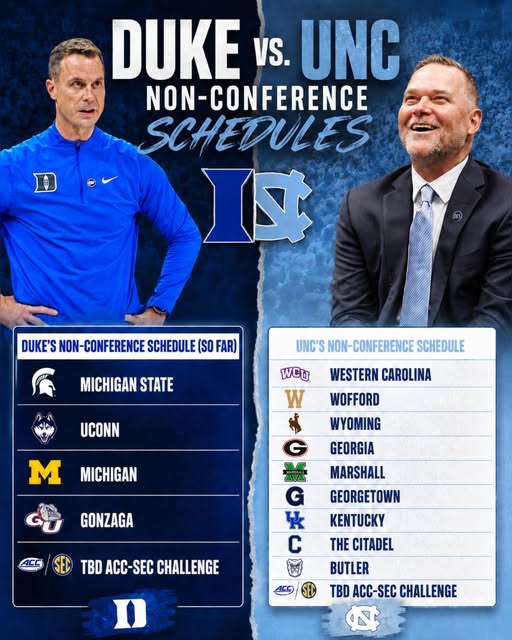
UNC opens a season against three teams projected to finish 14th in their conferences, plays a neutral-site game against a ranked team in a made-for-TV event sponsored by a telecommunications company, then schedules another “challenge” game against a middling Big Ten team that hasn’t made a Sweet Sixteen since Vine was popular, and suddenly it’s “Hubert has these boys battle-tested.” It becomes this heroic journey through adversity. Analysts start talking about toughness and resilience like the Tar Heels just fought through the Pacific theater.
But if Duke schedules literally the exact same structure — a couple warmups, a marquee neutral-site game, an ACC/SEC challenge matchup, and a respected mid-major — then suddenly the conversation changes completely. Now it’s all “they don’t wanna play true road games,” “Jon Scheyer is protecting the freshmen,” “that program scared of real environments.” Same schedule format. Same level of opponents. Entirely different spin because fandom has melted people’s brains.
The funniest part is UNC fans love pretending they’re the blue-collar truth-tellers of the rivalry. Duke gets painted as the privileged villain while Carolina fans act like they’re some persecuted grassroots movement despite being one of the biggest brands in the history of college basketball. This is North Carolina basketball we’re talking about, not a startup nonprofit trying to survive. But they’ve convinced themselves they’re uniquely authentic, so every criticism they make feels morally righteous in their heads.
And the scheduling discourse is where that self-delusion reaches peak comedy.
UNC fans will pound the table about playing “real basketball schools” because they had a neutral-site game against Kentucky in Atlanta. Meanwhile the rest of the non-con consists of schools whose arenas look like high school graduation venues. Then they’ll turn around and say Duke is avoiding smoke because the Blue Devils played Arizona in Madison Square Garden instead of going to Tucson. Apparently crossing the country to play a top-ten opponent only counts if you also agree to let students scream at you from six feet away.
The obsession with true road games is especially hilarious because fans only care about them selectively. If Duke loses a road game in a hostile environment, the reaction is “see, they can’t handle pressure.” If Duke chooses a neutral court against elite competition, the reaction becomes “they’re scared.” There’s no winning because the criticism was never about consistency in the first place. It’s rivalry hatred dressed up as analysis.
And look, rivalry hatred is fine. That’s sports. Nobody expects UNC and Duke fans to evaluate each other objectively. But at least stand on the hatred honestly. Just say you don’t like Duke. Say seeing that jersey irritates your soul. Say the sight of Cameron Indoor makes your blood pressure rise. That’s real rivalry energy. What gets annoying is pretending there’s some grand ethical difference in scheduling philosophy when both programs are basically operating from the same modern blueprint every power program uses.
Because the truth is everybody protects themselves now.
Kansas does it.
Kentucky does it.
Michigan State does it.
UConn does it.
UNC absolutely does it.
Duke definitely does it.
The days of elite programs loading up ten true losable games before January are mostly gone because the sport changed. Metrics changed. Tournament selection changed. Coaches understand risk management now. One ugly November loss can hang around your résumé for four months, while a quality neutral-site win gets replayed on ESPN every twelve minutes. Everybody is optimizing.
But UNC fans talk like Carolina courageously storms Normandy every November while Duke hides in a bunker counting recruiting stars.
And the selective memory is outrageous too. Carolina fans love bringing up years where Duke’s schedule looked lighter while completely ignoring seasons where UNC scheduled absolute pastry lineups themselves. Every fanbase remembers its own ambitious games and forgets the filler. Suddenly people act like every Roy Williams schedule featured twelve straight bloodbath games against national contenders. No, man. Roy was playing Coastal Whoever on a Tuesday too. Everybody does it.
What really fuels this conversation is insecurity about perception. UNC fans hate that Duke often gets framed nationally as more modern, more disciplined, more NBA-connected, more analytically sharp. So whenever there’s an opportunity to frame Carolina as tougher or more authentic, they sprint toward it. Scheduling becomes cultural warfare. It’s not enough for UNC to be good; Duke has to be portrayed as fraudulent.
That’s why a Duke neutral-site game gets interpreted differently from a Carolina neutral-site game even if the caliber of opponent is identical. UNC fans see their own scheduling as strategic while Duke’s is soft. Same action, different moral framing.
And social media made this ten times worse because now every schedule release gets treated like political propaganda. Fans zoom in on one missing opponent and act like they uncovered corruption. “Oh, Duke didn’t schedule a road game at Arkansas? Guess they scared.” Meanwhile Carolina just played half the MEAC and somehow that gets marketed as “smart roster development.”
There’s also this weird refusal to acknowledge that Duke actually does play major games constantly. Duke is almost always in marquee matchups because networks want ratings. Champions Classic. ACC/SEC Challenge. Early-season invitationals. Neutral-site spectacles against blue bloods. You can criticize the locations if you want, but acting like they never face elite competition is objectively ridiculous.
What UNC fans really mean is they want Duke to voluntarily accept additional disadvantages beyond already playing elite opponents. They don’t just want Duke to play strong teams. They want Duke to walk into every hostile arena imaginable carrying a blindfold while Dick Vitale screams in surround sound.
And when Duke doesn’t do that enough to satisfy them, the “ducking smoke” accusations begin.
Meanwhile Carolina fans will gas up games against teams projected to finish seventh in the AAC because “they play hard.” Every decent mid-major suddenly becomes evidence of bravery if UNC scheduled them. It’s all branding.
The funniest examples come when UNC and Duke schedule common opponents. If Carolina beats that opponent first, then it was a dangerous trap game against a gritty squad nobody wants to face. If Duke schedules the exact same team later, now they’re stat-padding against nobodies. It’s genuinely performance art at this point.
And to be fair, Duke fans do the same thing in reverse sometimes. Rivalries are built on hypocrisy. But UNC fans specifically love acting above it all, like they alone are guardians of basketball purity. That’s what makes the scheduling discourse so unbearable. There’s this constant air of moral superiority attached to arguments that completely collapse under basic comparison.
Another thing nobody wants to admit is that fanbases often confuse atmosphere with quality. UNC fans will praise a true road game against an unranked SEC team because the crowd was loud and everybody wore matching shirts. But if Duke schedules a top-five opponent on a neutral floor, somehow that’s less impressive because the arena wasn’t hostile enough. Since when did arena acoustics become more important than opponent strength?
And then if Duke actually wins those games, the goalposts move again. Suddenly neutral courts are “sterile environments” that don’t prepare teams for March, which is especially funny because the NCAA Tournament itself is played on neutral courts. You know, the thing every team is supposedly preparing for.
The entire argument falls apart the second consistency enters the room.
What’s really happening is simpler than all the fake analysis. UNC fans desperately want Duke to look less tough than Carolina because toughness matters in rivalry identity. Carolina fans pride themselves on emotion, grit, tradition, and swagger. Duke gets associated with precision, structure, and polish. So accusing Duke of avoiding difficult environments reinforces the stereotype UNC fans already want to believe.
It’s mythology maintenance.
But modern college basketball scheduling is mostly driven by television contracts, event partnerships, NIL visibility, recruiting exposure, travel management, and résumé engineering. It’s business. Every elite coach is balancing risk versus reward. Nobody at that level is waking up saying, “How can I prove my masculinity through road scheduling?”
They’re trying to win enough games to secure favorable seeding while keeping freshmen alive through February.
And honestly, if UNC fans were truly committed to the “play anybody anywhere” mentality they romanticize, they’d be demanding home-and-homes with Gonzaga in Spokane, Houston at Fertitta Center, Auburn at Neville Arena, and UConn at Gampel every year. But somehow the “gauntlet” usually still includes six guaranteed wins against schools people only learn about from conference tournament upsets.
Again: everybody does this.
That’s why the Duke accusations ring hollow.
Especially because Duke lives under a microscope no matter who they schedule. Every loss becomes national content. Every freshman slump becomes debate television. Every early exit gets replayed for months. The pressure level around that program is already absurd. Yet people still talk like they’re maneuvering in darkness avoiding accountability.
Meanwhile UNC can spend half a season looking completely disorganized, then beat one ranked team and suddenly everybody starts talking about “Carolina basketball finding itself.” Different expectations. Different narratives.
And none of this even touches on the fact that scheduling availability itself is complicated. Elite teams can’t magically force every desired matchup into existence. Contracts, television rights, event obligations, conference expansions, travel concerns, and future scheduling commitments all shape these calendars years in advance. Fans talk like coaches are sitting at a menu choosing opponents based purely on courage.
Reality is way less cinematic.
But rivalry discourse doesn’t care about reality. It cares about ammunition.
So UNC fans will continue calling their own schedules gauntlets while accusing Duke of ducking smoke because the contradiction itself isn’t the point. The point is preserving the emotional hierarchy they prefer: Carolina as fearless and authentic, Duke as curated and protected.
Never mind that both schools are billionaire-level basketball brands playing nationally televised games against elite recruits in front of packed arenas every week. Never mind that both fanbases would immediately defend identical scheduling choices if the logos were swapped. Never mind that half the “soft” games everybody complains about are standard practice across the entire sport.
Logic has never mattered in rivalry propaganda.
All that matters is who gets to claim superiority between November and March before reality eventually settles things on the court.
And that’s why the discourse never changes.
Because if UNC fans ever admitted Duke schedules basically the same way every modern powerhouse does, they’d lose one of their favorite talking points. And rivalry culture survives on recycled outrage. So every season the script resets. Carolina schedules three cupcakes and a showcase event? “Gauntlet.” Duke schedules three cupcakes and a showcase event? “Ducking smoke.”
Same ingredients. Different spin. Same hypocrisy. Different year.