THE BUZZER ROBBERY: Inside the 1980 ACC Tournament No-Call Maryland Fans Still Call the Greatest “Rip-Off” in League History
In the annals of Atlantic Coast Conference basketball, few moments ignite as much enduring passion, bitterness, and debate as the final seconds of the 1980 ACC Tournament championship game. On March 1, 1980, at the Greensboro Coliseum in Greensboro, North Carolina, the Duke Blue Devils edged the Maryland Terrapins 73-72 in a contest that went down to the wire amid a freak snowstorm that blanketed the region. The game itself was a gritty, low-scoring battle between two talented squads, but what lingers in memory—especially among Maryland faithful—is the controversial no-call in the dying moments that denied the Terps a potential game-winning tip-in and handed Duke the title.
Maryland fans have long dubbed it the “Buzzer Robbery” or the “greatest ref rip-off in ACC history,” a moment that cemented perceptions of “Tobacco Road bias” and the infamous “Duke whistle.” Even decades later, clips and discussions resurface on social media, forums, and retrospectives, with Terps supporters insisting their team was robbed of an ACC championship. Duke partisans counter that the play was clean defense or incidental contact, but the controversy refuses to die.
Setting the Stage: A Snowy Tournament and Rising Tensions
The 1980 ACC Tournament unfolded under unusual circumstances. A major snowstorm hit the Piedmont Triad on Leap Day (February 29), dumping heavy accumulations and forcing the semifinals to proceed amid treacherous conditions. By championship Saturday, roads were impassable for many, yet the ACC opened the Greensboro Coliseum to any fans who could make it—around 7,000 braved the elements for the title game, creating an intimate, almost surreal atmosphere in the cavernous arena.
Duke, coached by Bill Foster, entered as the underdog after a solid but not dominant regular season. The Blue Devils featured big man Mike Gminski (a future NBA standout), versatile forward Kenny Dennard, and guards like Vince Taylor and Jim Spanarkel. They had upset North Carolina in the semifinals 75-61, setting up the final against Maryland.
The Terrapins, under legendary coach Lefty Driesell, were loaded with talent. Led by sophomore sensation Albert King (the tournament MVP despite the loss—the last player to earn that honor on a losing team), forward Buck Williams (a future NBA All-Star and rebounding machine), and guards like Ernest Graham and Greg Manning, Maryland had been a force all season. They boasted size, athleticism, and scoring punch, and many viewed them as the better team heading into the final.
The game was tight throughout. Duke built early leads with Gminski’s interior presence, but Maryland clawed back with King’s scoring and Williams’ rebounding. It remained a defensive struggle, with neither team pulling away significantly.
The Climactic Sequence: Gminski’s Heroics and the Infamous No-Call
With under a minute remaining, the score was knotted or separated by slim margins. Duke held a precarious 73-72 lead after Gminski’s clutch basket with about 9 seconds left—his go-ahead score that proved decisive. Maryland, trailing by one, had one final possession to win or tie.
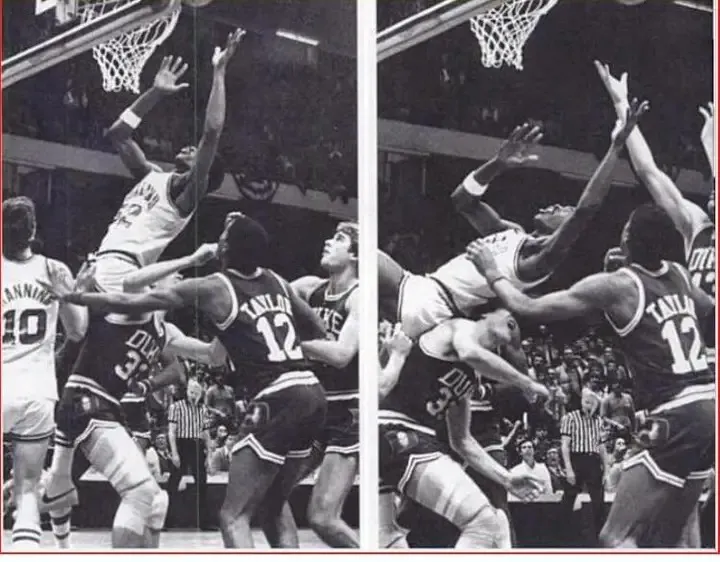
Albert King launched a desperation shot from the perimeter as the clock ticked down. The attempt missed, caroming off the rim. Buck Williams, Maryland’s 6’8″ power forward and one of the conference’s top rebounders, positioned himself perfectly for the tip-in attempt right at the buzzer.
As Williams elevated to tap the ball toward the hoop, Duke’s Kenny Dennard—a rugged 6’6″ forward known for his physical play—moved in to contest. What happened next became the flashpoint: Dennard appeared to get under Williams, potentially undercutting him or making contact that impeded his leap and ability to cleanly tip the ball. Williams’ attempt glanced off the rim harmlessly as time expired. No foul was called. The horn sounded. Duke won 73-72.
Lefty Driesell exploded on the sideline, storming toward the officials in protest. Maryland players and bench were incredulous. The no-call sealed the game, and Duke celebrated a hard-fought ACC title—their first since 1978.
Why the No-Call Stings: Maryland’s Perspective
For Maryland fans and alumni, the play is textbook goaltending interference or a blatant foul. Buck Williams was in prime position to tip the miss, but Dennard’s positioning—getting body-to-body underneath and potentially lifting or blocking Williams’ path—prevented a fair contest for the ball. In an era before widespread instant replay (the ACC didn’t adopt review systems until much later), officials had one look, and they deemed it legal defense.
Driesell was livid postgame, refusing to “cry” about it publicly but making his feelings clear in interviews. He believed the contact warranted a foul, which would have given Maryland free throws with no time left or, at minimum, a chance to inbound after a made basket. Terps supporters point to the “Tobacco Road whistle”—the perceived favoritism toward Duke, UNC, and NC State in close calls during ACC play—as the real culprit. The narrative of biased officiating in rivalry games has persisted, and this moment became Exhibit A.
Social media retrospectives and Facebook groups dedicated to Maryland basketball still post grainy clips of the sequence, captioning them with phrases like “NO CALL by the ‘Duke’ refs,” “robbed of a championship,” and “greatest ref rip-off.” One viral post called it the “Buzzer Robbery,” arguing it cemented Duke’s reputation for getting favorable treatment.
Duke’s Side: Clean Play or Just Good Positioning?
Duke fans and neutral observers often defend the no-call. Dennard boxed out aggressively—a legal basketball fundamental—and any contact was incidental as both players fought for rebound position. Gminski’s bucket had given Duke the lead, and Maryland’s final shot was a low-percentage heave under pressure. The officials, positioned to see the play, saw no foul worthy of whistle. In the pre-replay era, such calls stood, and Duke earned the victory through hustle and execution.
Mike Gminski’s game-winner with 9 seconds left is often highlighted as the true dagger, overshadowing the final sequence for some. Duke’s defense throughout forced Maryland into tough shots, and the Blue Devils’ composure in crunch time prevailed.
Lasting Impact and Legacy
The 1980 ACC title was Duke’s stepping stone under Foster before Mike Krzyzewski took over the following season. For Maryland, the loss stung deeply—Driesell’s program had been building toward sustained excellence, but this near-miss fueled frustrations that carried into future rivalries.
Albert King’s tournament MVP nod remains unique: the only player to win the award on the losing side, a testament to his dominance (he averaged high points across the tourney). Buck Williams went on to a Hall of Fame NBA career, but the no-call became a personal scar for many associated with Maryland.
The moment endures in ACC lore alongside other controversies—like the 2001 “Miracle Minute” comeback or various Duke-UNC dust-ups. It exemplifies why ACC Tournament games from that era feel mythic: high stakes, passionate fanbases, and officials under intense scrutiny with no safety net of replay.
YouTube searches for “1980 ACC Championship final seconds” yield breakdowns and clips that still spark heated debates. Maryland fans share side-by-side comparisons showing Dennard’s positioning; Duke supporters counter with angles emphasizing legal boxing out.
Forty-six years later (as of 2026), the “Buzzer Robbery” remains a sore spot for Terps Nation and a point of pride for Duke’s faithful. It underscores the raw emotion of college basketball rivalries—where one whistle, or lack thereof, can define legacies and fuel grudges for generations. In the Tobacco Road pantheon of controversial endings, few burn as hot as this one.