The debate over the greatest games in college basketball history often circles back to two iconic matchups involving Duke: the 1992 East Regional Final against Kentucky and the 2001 Final Four semifinal against Maryland. These contests stand out not just for their drama, high stakes, and elite talent, but for how they captured the essence of March Madness—unpredictable momentum shifts, clutch performances, and moments that transcend the sport. While fans endlessly argue which one reigns supreme, both remain etched in lore as perhaps the pinnacle of college hoops showdowns.
The 1992 Duke-Kentucky Epic: “The Shot” That Defined an Era
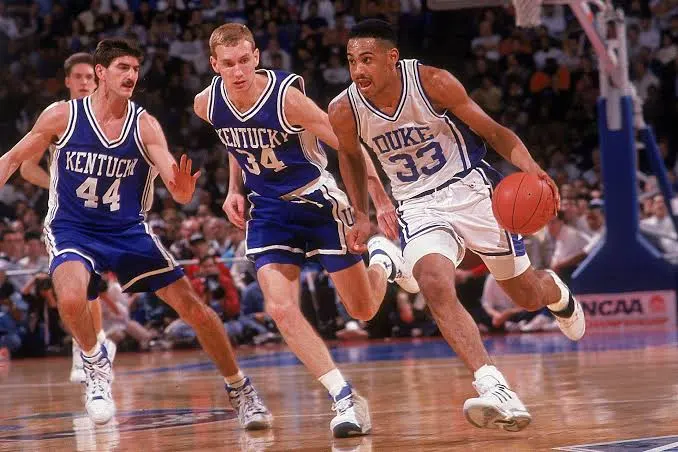
On March 28, 1992, at The Spectrum in Philadelphia, top-seeded Duke (defending national champions) faced second-seeded Kentucky in the East Regional Final for a Final Four berth. The game unfolded as a back-and-forth masterpiece, with both teams trading leads in a contest that felt like a heavyweight fight.
Duke, coached by Mike Krzyzewski, featured stars like Christian Laettner (a senior All-American) and Grant Hill (a future NBA legend). Kentucky, under Rick Pitino, countered with a talented squad led by players like Jamal Mashburn. The score seesawed throughout regulation, with Duke holding a slim halftime edge (50-45) before Kentucky rallied.
In overtime, the intensity peaked. With 2.1 seconds left and Duke trailing 103-102 after a Kentucky free throw, the Blue Devils inbounded from the baseline. Grant Hill launched a perfect three-quarter-court pass that sailed into Laettner’s hands at the opposite foul line. Laettner caught it cleanly, faked right to create space over defender Deron Feldhaus, took one dribble, pivoted left, and rose for a 17-foot turnaround jumper that swished as time expired. Final score: Duke 104, Kentucky 103 (OT).
Laettner was flawless, going 10-for-10 from the field (including a three) and 9-for-9 from the line for 31 points. The game is legendary for its sustained excellence—neither team led by more than a handful of points for long stretches—and that iconic closing sequence. Sports Illustrated called it the greatest college basketball game ever in 2004, and USA Today ranked it No. 1 among NCAA Tournament games in 2002. ESPN placed the moment high on its lists of top sports highlights. The play, often simply called “The Shot,” symbolizes perfection under pressure and helped propel Duke to a second straight national title.
The game’s aura endures because it combined elite competition, a buzzer-beater for the ages, and historical context: Duke was chasing a repeat championship, a rarity in the modern era. For Kentucky fans, it remains a painful “what-if,” but even many neutrals hail it as the gold standard for tournament drama.
The 2001 Duke-Maryland Clash: The Greatest Comeback in Final Four History
Fast-forward to March 31, 2001, in the Metrodome for the national semifinals. Duke, the No. 1 overall seed and eventual champion, met Maryland in a rematch of intense ACC battles. The Terps, coached by Gary Williams, boasted stars like Juan Dixon, Lonny Baxter, and Steve Blake, while Duke featured Jason Williams, Shane Battier, Mike Dunleavy, and Carlos Boozer.
Maryland exploded early, building a massive 22-point lead in the first half (peaking around 39-17 or similar margins in recollections). Duke looked shell-shocked, trailing 49-38 at halftime. The second half started slowly for the Blue Devils, but momentum shifted dramatically late.
The true magic happened in the closing minutes. Maryland led by 12 with under two minutes left, but Duke unleashed a furious rally. Jason Williams sparked it with clutch plays, including a layup after a reviewed clock call gave Duke extra time. Shane Battier was immense defensively and offensively, hitting key threes and free throws. In one stretch, Duke chipped away with steals, blocks, and made shots, tying or taking leads in a blur of action.
Duke ultimately prevailed 95-84, erasing that 22-point deficit—the largest comeback in Final Four history. Battier finished with strong contributions, and the win sent Duke to the title game (where they beat Arizona). Earlier in 2001, Duke had another miracle against Maryland on January 27 at Cole Field House: trailing by 10 with 55 seconds left in regulation, they tied it and won 98-96 in OT, dubbed the “Miracle Minute.”
These games highlighted the rivalry’s peak intensity in the early 2000s, with high-level talent, emotional stakes, and improbable heroics. The Final Four comeback showcased resilience and poise under national spotlight pressure.
Why These Two Stand Above the Rest — And Why the Debate Rages On
Both games feature elite programs, future pros, and Coach K’s mastery. The 1992 contest excels in pure drama: perfect shooting from Laettner, the length-of-the-court pass, and a game-winning shot at the buzzer in overtime. It’s often called “the greatest game ever” for its end-to-end quality and that singular, replayed moment.
The 2001 matchup shines through sheer improbability: overcoming a 22-point hole in the Final Four, plus the earlier “Miracle Minute” rally. It represents the ultimate comeback story, with waves of momentum and team-wide contributions rather than one hero.
Fans debate endlessly because they appeal to different tastes. Do you prefer a flawless, poetic buzzer-beater (1992) or a gritty, team-fueled resurrection (2001)? The 1992 game gets more universal acclaim in all-time lists for its tournament stage and iconic finish, while 2001’s comeback adds emotional weight from the rivalry’s ferocity.
Ultimately, picking just one is impossible—they represent different facets of what makes college basketball magical: individual brilliance versus collective will, sudden ecstasy versus sustained fightback. Together, they remind us why March endures as the most thrilling time in sports.