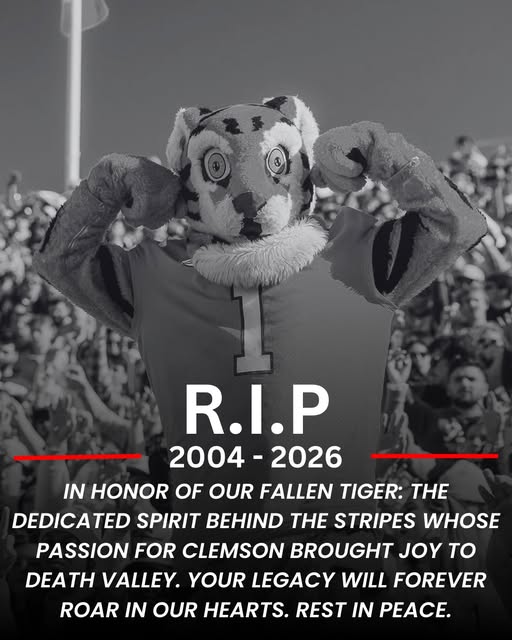
The campus of Clemson University is known for its deep traditions, spirited game days, and an unmistakable sense of family that binds students, alumni, and fans together across generations. This week, however, that spirit has been tempered by grief. The university community is mourning the sudden and tragic loss of the student who had only recently taken on one of the institution’s most visible and cherished roles: performing as The Tiger, the beloved mascot who symbolizes pride, resilience, and unity for the Clemson faithful.
The loss comes just one month after the young performer was introduced as the newest embodiment of The Tiger, stepping into oversized paws and a larger-than-life personality that has long electrified crowds at football games, basketball matchups, community events, and campus celebrations. For many, the news feels surreal. A role that is so often associated with joy, laughter, and unbridled enthusiasm is now linked to heartbreak.
University officials confirmed the student’s passing in a statement released late Tuesday evening, describing the individual as “a vibrant member of our campus community whose energy, kindness, and commitment to Clemson traditions left an immediate and lasting impression.” The statement emphasized that counseling services would be made available to students, faculty, and staff, and that plans were underway to honor the performer’s memory in a way befitting the significance of the role.
Though the identity of the student has not been widely publicized out of respect for the family’s wishes, those who knew them have shared stories that paint a picture of someone uniquely suited to carry forward the legacy of The Tiger. Friends described a tireless work ethic and a genuine love for the university. One classmate recalled how the student spoke about auditioning for the role as a lifelong dream, having grown up attending games and watching the mascot lead cheers from the sidelines.
“Being The Tiger wasn’t just about putting on a costume,” the classmate said. “It was about representing everything good about Clemson—sportsmanship, unity, heart. They understood that.”
The Tiger has long been a central figure in Clemson athletics, particularly during football season when the mascot sprints across Memorial Stadium, leads the team onto the field, and engages thousands of fans in synchronized chants. The pageantry surrounding the Clemson Tigers is steeped in tradition, and the mascot’s presence is woven into nearly every aspect of that experience. From posing for photos with children to visiting local schools and hospitals, The Tiger serves as both entertainer and ambassador.
In the weeks since stepping into the role, the new performer had already made an impression. Students recall seeing The Tiger dancing in the stands during a late-summer scrimmage, hyping up first-year students during orientation events, and surprising campus tour groups with playful antics. The performer’s boundless energy seemed to reflect the optimism of a new academic year.
Now, orange and purple ribbons have begun appearing on trees and lampposts around campus. A makeshift memorial has grown near the entrance to the athletic facilities, with flowers, handwritten notes, and small stuffed tigers placed carefully at its base. Messages scrawled in marker on poster board read, “Forever Our Tiger,” and “Once a Tiger, Always a Tiger,” echoing a phrase often repeated within the Clemson family.
In the city of Clemson, the sense of loss extends beyond campus boundaries. Local business owners who frequently welcomed the mascot for promotional events or community gatherings expressed shock at the news. One café owner recalled the performer stopping by in costume just days earlier, posing for photos with children and gamely attempting to sip a milkshake through the costume’s oversized headpiece. “They brought so much light wherever they went,” she said. “It’s hard to imagine our events without that spark.”
For many alumni, the role of The Tiger carries deep emotional resonance. Former mascot performers often describe the experience as transformative, teaching lessons in leadership, teamwork, and humility. The costume, while concealing the individual inside, requires complete dedication to the collective spirit it represents. There are no personal accolades or public recognition; the focus remains entirely on the university and its community.
One former Tiger, who performed more than a decade ago, spoke about the unique bond shared by those who have worn the suit. “You’re part of a legacy that stretches back generations,” he said. “When you put that head on, you’re not yourself anymore. You’re every Tiger who came before you and every fan in the stands. It’s an honor, and it’s a responsibility.”
He described reaching out to other former performers in the hours after learning of the tragedy. “We’re a small family within a big family,” he said. “This one hits close to home.”
University administrators have not released details surrounding the circumstances of the student’s death, citing respect for privacy. What they have emphasized, however, is the importance of leaning on one another during this time. In a campus-wide email, the university’s president noted that grief can manifest in different ways and encouraged students to check in on friends, attend scheduled remembrance gatherings, and utilize available mental health resources.
At a candlelight vigil held on Bowman Field, hundreds gathered as the sun dipped below the horizon. Students stood shoulder to shoulder, many wearing Clemson apparel, some holding battery-operated candles that flickered against the darkening sky. A moment of silence was observed, followed by the singing of the alma mater. The absence of The Tiger at the front of the crowd was palpable.
Speakers at the vigil reflected not only on the individual’s short time in the role but also on the broader meaning of community. A student government representative spoke about how the performer had approached the responsibility with humility and gratitude. “They knew they were part of something bigger than themselves,” she said. “And in just one month, they reminded us what that ‘something bigger’ truly is—connection, compassion, and pride.”
The tragedy has also prompted renewed conversations about the pressures faced by students balancing academics, extracurricular commitments, and personal responsibilities. Performing as a mascot at a major university demands physical stamina and emotional resilience. Rehearsals, appearances, and game-day obligations can stretch long into the night, layered on top of coursework and other activities. Friends say the student handled those demands with determination, often downplaying their own exhaustion in favor of ensuring every event was a success.
In the broader context of South Carolina, Clemson’s traditions occupy a special place. The university’s athletic successes and storied history have made The Tiger an instantly recognizable symbol throughout the state and beyond. Flags bearing the Tiger paw logo fly from porches and storefronts. Children grow up dreaming of running down the hill at Memorial Stadium or one day donning the mascot suit themselves.
That shared symbolism has amplified the impact of this loss. Social media has been flooded with tributes from fans across the country, many posting photos taken with The Tiger at recent games. Messages of condolence have come from rival schools as well, underscoring a common understanding that some moments transcend competition.
As the university looks ahead, questions naturally arise about how and when the role of The Tiger will be filled again. Officials have indicated that any decisions will be made with care and in consultation with the mascot program and the student’s family. For now, the focus remains squarely on remembrance.
Plans are reportedly underway to incorporate a tribute into the next home athletic event. While details have not been finalized, those involved say it will likely include a video montage, a moment of silence, and perhaps a symbolic gesture on the field. Some students have suggested retiring a specific costume accessory or placing a commemorative patch on future mascot uniforms.
Grief counselors note that public rituals can play a powerful role in collective healing. By gathering together, sharing stories, and honoring the life of the student behind the mask, the Clemson community is beginning the slow process of reconciling joy with sorrow. The Tiger has always represented exuberance and school pride; now, that symbol also carries a reminder of vulnerability and the preciousness of life.
In quiet corners of campus, friends continue to swap memories—of late-night study sessions, inside jokes, and the nervous excitement that preceded the student’s first official appearance as The Tiger. They speak of someone who embraced the chance to make others smile, who understood that even small gestures—an exaggerated wave, a playful high-five—could brighten a child’s day.
As one professor put it during the vigil, “The measure of a life is not its length, but its impact. In one month, this student made an impact that will be felt for years.”
The coming weeks will undoubtedly be difficult. There will be games played, classes attended, and traditions upheld. The Tiger will once again bound across the field, drawing cheers from the stands. But for many, there will always be a moment of remembrance woven into that spectacle—a recognition of the young person who so recently took on the mantle and left an indelible mark.
In the face of tragedy, the Clemson community has rallied in the way it knows best: together. Arms linked, voices raised in song, orange candles glowing against the night, they are holding fast to the belief that the spirit embodied by The Tiger endures. It lives on in shared memories, in acts of kindness, and in the enduring bonds that define what it means to be part of the Clemson family.