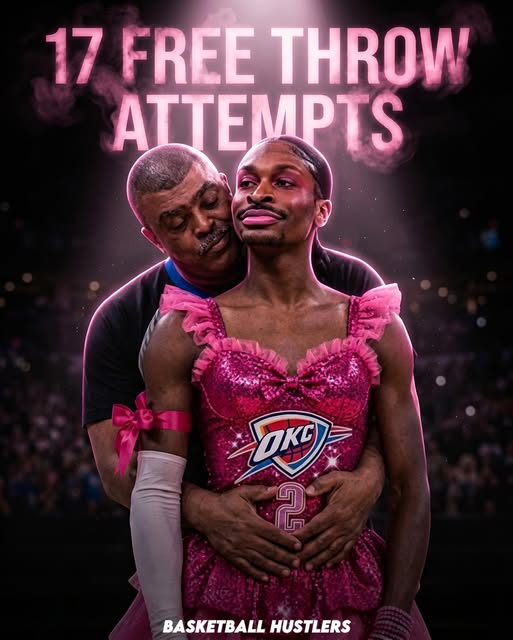
Shai Gilgeous-Alexander putting up 32 points while going 16-for-17 from the free-throw line is always going to start debates about officiating, especially in a playoff environment where every whistle feels magnified. When a player scores half of his points from the stripe, fans immediately begin questioning whether the defense was genuinely that undisciplined or whether the referees gave that player a softer whistle than everyone else on the floor. That is exactly what happened after this Game 5 performance. Social media exploded with complaints about the officiating, accusations that the refs were “showing love” to SGA, and arguments that the game’s rhythm tilted heavily in his favor because of how often he got to the line. Whether someone agrees with that take or not, it is understandable why people reacted that way after seeing 17 free-throw attempts attached to a 32-point night.
Part of the frustration comes from the way Shai plays the game. He is not the kind of scorer who relies mostly on catch-and-shoot threes or transition dunks. His entire offensive identity is built around pressure. He attacks defenders off the dribble, snakes through traffic, changes pace constantly, and forces defenders to react to him instead of the other way around. That style naturally creates contact. Defenders reach because they think he is about to pull up. They bump him because he changes direction at awkward moments. They swipe down because his handle keeps the ball exposed just long enough to tempt defenders into gambling. SGA has mastered the art of making defenders uncomfortable, and uncomfortable defenders foul more often than disciplined ones.
Still, there is a difference between drawing legitimate contact and benefiting from a whistle that fans perceive as overly generous. That is where the controversy really starts. Some viewers feel that SGA gets calls other stars simply do not receive. They believe minimal contact against him becomes a foul while similar physicality on the other end gets ignored. This perception has followed him throughout the season. Every time he has a high free-throw game, the conversation returns. Is he truly impossible to guard without fouling, or has the league unconsciously rewarded his style of play more than others? That question is now attached to almost every big playoff performance he has.
The emotional side of basketball also matters here. Fans want playoff games to feel earned through shot-making, defense, toughness, and momentum swings. When whistles dominate stretches of the game, viewers feel pulled out of the intensity. Frequent trips to the line slow everything down. They interrupt runs. They reduce physical defensive pressure because defenders become afraid of picking up fouls. So even if every foul call is technically correct, fans can still leave the game frustrated because the overall experience feels overly controlled by officiating rather than pure competition.
In SGA’s case, the optics become even stronger because of how calm and methodical he looks while getting those calls. He rarely appears out of control. He does not crash wildly into defenders the way some foul-drawing guards historically have. Instead, he manipulates angles. He gets defenders on his hip. He pauses unexpectedly. He extends possessions just long enough for contact to occur. That subtlety can make the fouls look weak in real time because there is rarely dramatic collision. One fan sees smart basketball IQ. Another sees a superstar whistle. Both interpretations can exist simultaneously.
Comparisons to James Harden are unavoidable because Harden became the symbol of modern foul manipulation during his peak years. Defenders hated guarding him because he knew every trick in the book. He hooked arms, stopped suddenly in transition, leaned into contests, and baited defenders into mistakes. Critics said the game became ugly because too much offense depended on officiating. Supporters argued that defenders simply needed to stop fouling. SGA’s game is stylistically smoother and less theatrical, but the same debate follows him. Elite scorers who constantly pressure the rim are always going to live at the free-throw line, and fans are always going to question whether every whistle is deserved.
What makes SGA particularly dangerous is that he does not even need the free throws to dominate. He is an elite midrange scorer, a crafty finisher, and one of the most patient guards in the league. The free throws are almost an extension of his control over the game. Defenders know he can score from everywhere, which makes them hesitate. That hesitation creates the split-second windows he exploits. By the fourth quarter, many defenders are mentally exhausted from trying to predict his rhythm. Once fatigue sets in, fouls increase naturally.
But playoff basketball changes how people evaluate officiating. During the regular season, fans may shrug at a star getting 15 free throws. In the playoffs, every possession feels historic. Every whistle gets replayed endlessly online. Fans freeze-frame clips, compare calls possession by possession, and build narratives around referee favoritism. If a fan already dislikes a player’s style, a high free-throw total confirms their belief. If they support that player, they view the whistles as proof the defense could not contain him legally. Rarely does anyone stay neutral.
Another factor is star treatment. The NBA has always had it. Superstars historically receive the benefit of the doubt more often than role players. Michael Jordan got calls. Kobe Bryant got calls. LeBron James gets calls, though some argue he actually receives fewer than expected given how much contact he absorbs. Officials are human beings. Reputation influences perception. When a known scorer attacks the basket, refs may anticipate illegal contact before it fully develops. That split-second anticipation can shape whistle timing. SGA has now entered the level of superstardom where he benefits from that reputation effect.
At the same time, critics should acknowledge that defenders often guard SGA poorly because they become impatient. His pace is deceptive. He is not overwhelmingly explosive like prime Russell Westbrook or overwhelmingly powerful like Giannis Antetokounmpo. Instead, he relies on rhythm disruption. Defenders expect one move and get another. They think he is slowing down, then he accelerates. They think he is driving, then he spins into a fadeaway. This unpredictability creates sloppy defense. Many of the fouls he draws are technically legitimate because defenders are reacting late.
The larger issue may not even be SGA specifically. It may be the way modern NBA officiating rewards offensive initiation. Offensive players today understand exactly how referees interpret contact. They know when to gather into a defender, when to stop abruptly, when to exaggerate balance loss, and when to extend through contact. The league has tried adjusting rules over the years to reduce obvious foul baiting, but elite scorers always adapt. SGA has adapted better than most. He has found the perfect balance between genuine scoring aggression and strategic foul generation.
Fans opposing him often argue that playoff basketball should allow more physicality. They want fewer touch fouls and more freedom for defenders to compete. Historically, many fans romanticize older eras where hard contact was common and free throws were supposedly harder to earn. Whether that nostalgia is fully accurate is debatable, but the emotional preference remains. Seeing a player shoot 17 free throws in a crucial playoff game clashes with that image of rugged postseason basketball.
Supporters counter by saying defenders simply need to stay disciplined. If a player repeatedly gets to the line, maybe the defense deserves blame instead of the refs. That argument gains strength when the same player consistently draws fouls against different opponents. At some point, patterns matter. SGA has been among the league leaders in free throws because his style constantly pressures defenders into compromising positions. It is not random variance anymore. It is part of his offensive genius.
The reality probably sits somewhere in the middle. Some of the fouls are absolutely earned because SGA is elite at forcing defenders into mistakes. Some whistles are probably softer than what role players would receive. Some calls likely should not happen at all. That combination creates the perfect storm for controversy. Fans remember the questionable calls more than the obvious ones, so the perception of favoritism grows stronger every game.
What cannot be denied is the effectiveness. Sixteen made free throws represent efficiency, composure, and consistency under pressure. Missing only one attempt in a high-stakes playoff environment shows remarkable focus. Plenty of players can draw fouls. Fewer can convert nearly every opportunity. SGA punishes teams once they send him to the line, which increases frustration because each whistle almost automatically becomes points.
In many ways, this is the burden of becoming a superstar. Once a player reaches MVP-level status, every success becomes controversial to opposing fans. If he scores efficiently, people question the refs. If he struggles, people say he was exposed. The scrutiny intensifies because expectations rise. SGA is now firmly in that category. He is no longer just a talented young guard surprising people. He is one of the faces of the league, and with that comes nonstop debate about how the game is officiated around him.
After a stat line like 32 points with 16 free throws made, the “refs are showing love” narrative is inevitable. Some fans genuinely believe the officiating tilted the game. Others believe SGA simply mastered the art of offensive pressure. Both sides will spend hours posting clips, arguing over individual possessions, and trying to prove their case. That is modern NBA discourse. Every whistle becomes evidence for somebody’s agenda.
What should not get lost in the debate, though, is how difficult it actually is to control a playoff game offensively the way SGA did. Drawing fouls is a skill. Manipulating defenses is a skill. Remaining efficient while absorbing physicality is a skill. Even players who complain about the whistle often secretly wish their own stars were as effective at generating easy points. Free throws may not be the most exciting way to score, but they remain one of the most valuable weapons in basketball.
So yes, people are going to say the refs showed love to Shai Gilgeous-Alexander after a Game 5 stat line featuring 17 free-throw attempts. The numbers practically invite that reaction. But the bigger truth is that SGA has built a style of play specifically designed to create those situations. Whether fans appreciate it or hate it, he is incredibly good at making defenders foul him, and until opponents figure out how to guard him without reaching, bumping, or overcommitting, these conversations are probably not going away anytime soon.