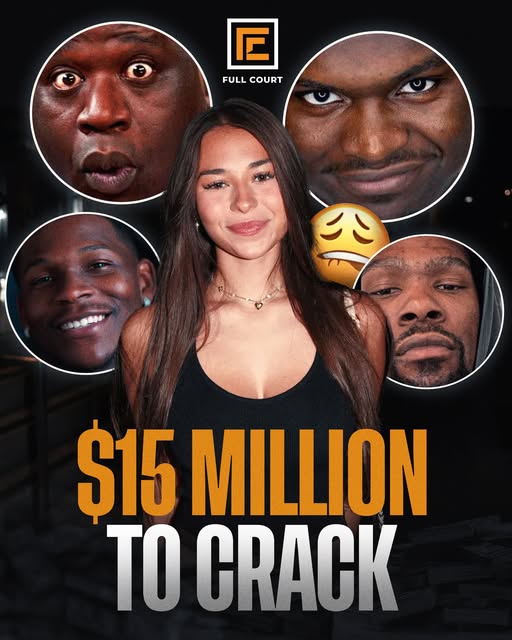
The internet absolutely exploded after Sophie Rain allegedly revealed that multiple NBA players once offered her a jaw-dropping $15 million to take her virginity. The second that clip started circulating online, social media basically turned into a full-time detective agency. Nobody cared whether the story was true, exaggerated, misunderstood, or completely fabricated — people instantly skipped straight to trying to figure out which NBA stars could possibly be behind the alleged offers.
And honestly, that reaction says a lot more about internet culture than it does about the story itself.
The wildest part isn’t even the number. It’s the speed at which people became convinced they already knew the identities of the players involved. Within minutes, timelines were flooded with theories, screenshots, old interviews, podcast clips, “blind item” speculation, and completely unserious investigative threads. Some users were confidently naming superstars with absolutely zero evidence besides “he gives that vibe.” Others were breaking down who supposedly has enough money, who follows certain influencers, who parties in Miami, who’s been linked to models before, and who allegedly has a history of extravagant spending.
The internet turned into NBA TMZ mixed with conspiracy theory Reddit in real time.
And because social media runs entirely on chaos, every new theory somehow became “proof” for another theory. Somebody would post a random clip of an NBA player sitting next to an influencer at a nightclub from three years ago, and suddenly comments would be filled with “YOOO IT ALL MAKES SENSE NOW 😭.” Another person would point out that a certain player liked one of Sophie Rain’s posts months ago, and now people were acting like they cracked a federal case.
That’s the thing about viral stories online now — people don’t wait for confirmation anymore. Speculation itself becomes the entertainment.
The story spread especially fast because it combines three things the internet is completely addicted to: celebrity gossip, absurd amounts of money, and athletes behaving recklessly. The second you put those ingredients together, social media loses its mind. Add NBA players into the mix and it goes nuclear because basketball culture online is already fueled by nonstop memes, rumors, and personality discourse.
NBA Twitter in particular treats every rumor like an offseason trade leak.
What made this even crazier is how believable people found it. Not necessarily because they knew anything factual, but because the modern celebrity world has become so disconnected from normal reality that hearing “multiple athletes offered $15 million for someone’s virginity” somehow doesn’t even sound impossible anymore. People have become desensitized to outrageous stories involving wealth and fame.
When you constantly see stories about celebrities spending six figures in clubs, renting private islands for birthdays, buying luxury cars on impulse, or flying people across the world for one weekend, eventually your brain stops reacting to giant numbers. So instead of saying, “There’s no way this happened,” a lot of people reacted with, “Honestly… I could see it.”
That’s probably the most fascinating part of the entire situation.
The internet’s reaction also revealed how obsessed people are with attaching names to anonymous stories. The moment a celebrity says “an athlete” or “a rapper” or “an actor,” social media immediately begins building a suspect list. It becomes less about the original story and more about solving the mystery. People almost treat it like interactive entertainment.
And once speculation starts, there’s no stopping it.
One viral tweet becomes ten TikToks. Those TikToks become YouTube breakdowns. Then streamers react to the YouTube videos. Then meme pages repost the reactions. Then someone creates a fake “insider source” account pretending they know confidential information. Before long, half the internet believes random guesses are established facts.
Meanwhile, the actual evidence is usually nonexistent.
That’s what makes these situations dangerous too. Real people get dragged into rumors simply because social media thinks it would be funny if they were involved. Fans start analyzing personalities instead of facts. If an NBA player already has a reputation for being flashy, arrogant, or reckless, people immediately assume guilt despite having no information whatsoever.
And the internet loves stereotypes.
If a player is known for dating influencers, he gets added to the suspect list. If a player has a history of wild nightlife stories, people think that confirms it. If a player is rich enough to theoretically afford it, that somehow becomes “evidence” too.
At some point, people stop separating jokes from accusations.
The funniest reactions came from fans trying to calculate how insane $15 million actually is in this context. A huge portion of the internet wasn’t even focused on the celebrity gossip anymore — they were stuck debating whether anybody on earth is worth spending that amount of money on for literally anything. People started posting memes comparing the alleged offer to NBA contracts, endorsement deals, mortgage payments, franchise values, and salary cap numbers.
One tweet basically joked that for $15 million, an NBA player could buy a role player instead.
Another person said if someone has $15 million available for that type of decision-making, they should immediately lose access to financial advisors forever.
Then came the endless “brotherhood” memes.
People online started joking about how no true friend group would allow one of their boys to spend that amount of money under any circumstances. Suddenly timelines were full of fake conversations like:
“Bro don’t do this.”
“You could buy a yacht.”
“You could retire your entire family.”
“You could literally buy a team in another country.”
“Lock his phone immediately.”
And because internet humor has no limits, fans even started comparing hypothetical NBA players’ willingness to spend recklessly based entirely on personality stereotypes. Certain stars got labeled “definitely cheap,” while others were described as “absolutely capable of this behavior.”
It became less of a news story and more of a massive running joke.
Still, underneath all the memes is something interesting about modern fame and influencer culture. Stories like this spread because the line between celebrity and internet celebrity barely exists anymore. Influencers now occupy the same gossip ecosystem as athletes, rappers, actors, and entertainers. They date each other, collaborate, appear at the same parties, and exist inside the same social circles.
So when an influencer says something outrageous involving athletes, people instantly buy in because those worlds already overlap constantly.
Years ago, internet personalities were seen as separate from mainstream celebrity culture. Now they’re fully inside it. Some influencers have larger audiences than traditional celebrities. Some make more money than professional athletes. Some generate more engagement online than entire entertainment companies.
That shift changed how gossip works.
A story involving someone like Sophie Rain doesn’t stay in influencer spaces. It immediately crosses over into sports culture, entertainment blogs, TikTok commentary, reaction streams, and meme accounts all at once. That’s why these stories spread at lightning speed now. Every corner of the internet feeds the others.
The NBA side of the internet especially thrives on narratives like this because basketball fans are obsessed with personality analysis. Fans don’t just discuss stats anymore. They discuss lifestyles, dating histories, fashion choices, social circles, podcast appearances, and club rumors. Athletes today are treated like full-time celebrities beyond sports.
So the second a vague story appears involving unnamed NBA players, people immediately start fantasy-casting the suspects based on public image.
What’s also hilarious is how quickly the internet convinced itself that “everybody already knows who it is.” That happens literally every time a celebrity shares an anonymous story. Social media develops this weird collective confidence where users start acting like they possess secret insider knowledge when really they’re just repeating guesses they saw five minutes earlier.
Eventually the rumor becomes self-sustaining.
One person tweets, “I heard it was Player X.”
Another replies, “Honestly that tracks.”
Then a TikTok creator says, “People are saying it was Player X…”
Then commenters start posting, “We all know who they mean.”
And somehow a completely unverified theory evolves into accepted internet lore.
That cycle is basically modern celebrity gossip in a nutshell.
The entire situation also says something about how entertainment works now. Outrageous claims become content immediately. Whether true or false almost becomes secondary to whether the story is entertaining enough to dominate timelines for 48 hours.
People aren’t even consuming gossip traditionally anymore. They’re participating in it. They make theories, memes, edits, reaction videos, parody investigations, and fake reenactments. Viral stories become collaborative internet events.
That’s why these moments explode so hard.
Everybody wants to contribute the funniest joke, the wildest theory, or the smartest observation. And because the algorithm rewards engagement over accuracy, the most outrageous posts often spread fastest.
In the end, the craziest thing about the Sophie Rain situation might not even be the alleged $15 million offers. It’s how instantly the internet transformed an unverified celebrity story into a full-scale NBA mystery investigation fueled entirely by vibes, memes, assumptions, and collective chaos.
Within hours, social media had already built narratives, assigned suspects, created jokes, produced conspiracy theories, and turned the whole thing into entertainment.
That’s the internet now.
Nobody waits for facts anymore. The rumor is the show.