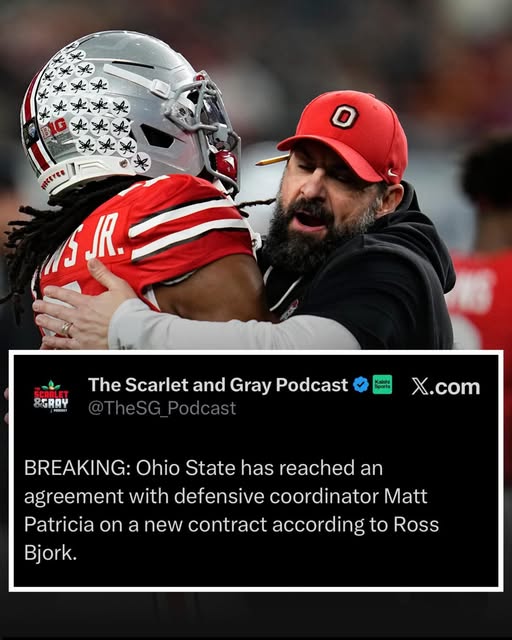
BREAKING: The Ohio State Buckeyes have agreed to a contract extension with Matt Patricia, solidifying him as the program’s long-term defensive coordinator and signaling a powerful commitment to continuity after a historic debut season in Columbus. The move comes after months of speculation about Patricia’s future and interest from both professional and collegiate suitors, but in the end, Ohio State made it clear that its defensive architect was not going anywhere.
For a program with championship expectations every season, stability at the coordinator position is not just a luxury — it is a necessity. Patricia’s arrival last year raised eyebrows across the college football landscape. After spending nearly two decades in the National Football League, including multiple Super Bowl runs, many wondered how quickly he would readjust to the college game. Recruiting, NIL dynamics, transfer portal navigation, and the tempo of modern spread offenses present unique challenges that differ dramatically from Sundays in the pros. Yet in year one, Patricia didn’t just adapt — he elevated.
Ohio State’s defense transformed into one of the most disciplined, versatile, and statistically dominant units in the country. The Buckeyes led the nation in several key defensive categories, including scoring defense and third-down efficiency, while finishing near the top in red-zone stops and total defense. What stood out most was not simply the numbers, but the manner in which they were achieved. Patricia’s system blended pro-level complexity with college speed, disguising coverages, rotating safeties late, and confusing opposing quarterbacks with hybrid fronts that shifted seamlessly between 4-2-5 and three-down looks.
Players consistently praised the clarity of his teaching. One of the hallmarks of Patricia’s coaching style has always been detail — an almost obsessive focus on leverage, alignment, and situational awareness. That reputation was built during his tenure with the New England Patriots under the legendary Bill Belichick, where he helped craft defensive game plans that slowed some of the most explosive offenses of the last two decades. Bringing that championship DNA into a college locker room immediately raised standards.
The transition to Ohio State, however, required more than scheme installation. It demanded relationship building. College athletes respond differently than seasoned professionals, and Patricia quickly learned the importance of connecting on a personal level. By all accounts, he embraced recruiting with surprising energy. High school prospects gravitated toward the opportunity to learn an NFL-style defense from a coach with Super Bowl rings. Parents appreciated the structure and accountability he brought to the program. In living rooms across the country, Patricia sold not just playing time, but preparation for the next level.
The extension reflects more than statistical success; it reflects cultural impact. Ohio State’s defensive identity shifted from reactive to dictatorial. Opponents no longer dictated tempo without resistance. Instead, the Buckeyes forced quarterbacks into uncomfortable windows and turned third-and-short into passing downs through disciplined gap integrity. The defensive line thrived in multiple-front alignments, linebackers played downhill with confidence, and the secondary communicated at an elite level.
In marquee matchups, the defense consistently delivered. Against top-ranked conference rivals, Ohio State held explosive offenses well below their season averages. In one pivotal late-season showdown that effectively decided divisional supremacy in the Big Ten Conference, the Buckeyes allowed fewer than 250 total yards and forced three turnovers, a performance that many analysts described as a masterclass in situational football. That game alone crystallized Patricia’s value to the program.
The ripple effects extended into postseason play. With a berth in the College Football Playoff on the line, Ohio State’s defense once again rose to the occasion, stifling a high-powered attack that had averaged over 40 points per game. The national spotlight amplified what had already become clear: Patricia’s system translated against elite competition. Even in moments when the offense sputtered, the defense provided stability.
From an administrative standpoint, the extension is a proactive measure. College football has become an ecosystem of constant movement. Coordinators leave for head coaching opportunities, the NFL comes calling, and lucrative deals elsewhere can disrupt even the most stable programs. By securing Patricia long term, Ohio State avoids the uncertainty that often accompanies success. It sends a message to recruits and current players alike that the defensive blueprint will remain intact.
Financially, the commitment underscores how much elite defense is valued in today’s game. As offenses continue to evolve with tempo, spacing, and quarterback mobility, defensive coordinators capable of countering those trends are at a premium. Patricia’s NFL background provides a schematic library that many college coaches simply do not possess. His ability to integrate simulated pressures, creepers, and post-snap rotations without sacrificing run integrity has proven invaluable.
There is also the matter of player development. Several Buckeye defenders saw their draft stock skyrocket under Patricia’s guidance. Edge rushers refined their hand usage and pass-rush plans. Linebackers displayed improved diagnostic speed and tackling efficiency. Defensive backs thrived in pattern-matching concepts that mirrored professional schemes. Scouts repeatedly noted how “pro-ready” Ohio State defenders appeared, a testament to the system they were operating within.
The extension ensures continuity for returning starters who have already internalized the playbook. Instead of learning a new terminology or adjusting to a different philosophy, they can build upon an established foundation. That continuity often translates into incremental gains — fewer mental errors, sharper communication, and greater confidence in high-leverage moments.
Critics initially questioned whether Patricia’s previous head coaching stint in the NFL would cast a shadow over his collegiate return. Instead, it appears that experience only sharpened his perspective. Those years navigating adversity at the professional level seem to have instilled patience and adaptability. At Ohio State, he has demonstrated a willingness to adjust midseason, tailoring game plans to personnel strengths rather than rigidly adhering to one scheme.
Head coach Ryan Day’s decision to prioritize this extension also reflects alignment at the top. In modern college football, harmony between head coach and coordinators is critical. Philosophical disagreements can fracture staff cohesion, but by all public accounts, Day and Patricia share a unified vision. The offense continues to chase explosiveness, while the defense anchors the team with calculated aggression.
Looking ahead, expectations will only intensify. Success breeds scrutiny. Opposing coaches will spend the offseason dissecting Patricia’s tendencies, searching for tells in coverage rotations or blitz timings. The true test of a coordinator’s longevity lies in adaptability. Year one provided the blueprint; year two and beyond will demand evolution. If Patricia’s NFL tenure taught him anything, it is that offenses adjust quickly.
Recruiting battles will also serve as a proving ground. Maintaining a pipeline of elite defensive talent is essential to sustaining dominance. With the extension in place, Ohio State can present stability as a recruiting advantage. Prospects now know the architect of this defense will be present throughout their collegiate careers.
For Buckeye fans, the announcement represents reassurance. In a sport defined by turnover and speculation, locking in a coordinator who delivered immediate, historic results feels like a championship-caliber move. It communicates ambition — not just to compete, but to control games defensively at the highest level.
Ultimately, the agreement between Ohio State and Patricia is about more than contracts and headlines. It is about identity. In year one, he restored a defensive swagger that had occasionally wavered in prior seasons. He introduced complexity without chaos, aggression without recklessness. The statistics told one story; the eye test told another. Opponents looked uncomfortable. Quarterbacks hesitated. Offensive coordinators burned timeouts searching for answers.
As the program turns toward another title chase, the extension ensures that the foundation remains intact. In an era where explosive offense often dominates discussion, Ohio State has doubled down on defense — on preparation, precision, and adaptability. If year one was any indication, the Buckeyes believe they have found not just a coordinator, but a long-term steward of their defensive standard.
And in college football, where windows can open and close in a single season, securing that kind of leadership might be the most important victory of all.