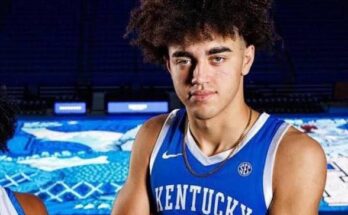
Denzel Aberdeen with the “Big Balls” Celebration After Kentucky’s Clutch Comeback Win Over Tennessee: The True Meaning Of The Big Balls Celebration
In the euphoric aftermath of the Kentucky Wildcats’ thrilling 74-71 comeback victory over No. 25 Tennessee on February 7, 2026, at Rupp Arena, one image captured the raw emotion and unfiltered confidence of the moment: junior guard Denzel Aberdeen unleashing the iconic “big balls” celebration. As the final buzzer sounded and Big Blue Nation erupted, Aberdeen—fresh off sinking two clutch free throws with 3.7 seconds left to seal the win—grabbed the spotlight with the unmistakable gesture: hands cupped low, a confident strut, and a bold declaration of fearlessness.
The celebration, captured in photos shared widely by UK Athletics and fans on social media, quickly went viral across platforms like Facebook, X (formerly Twitter), and Instagram. Posts from accounts like KY Insider and Tristan Pharis (@TristanUda) highlighted Aberdeen’s moment, captioning it “Denzel Aberdeen with the ‘big balls’ celebration after Kentucky’s clutch comeback win over Tennessee. 📸: UK Athletics | #BBN.” It wasn’t just a spontaneous outburst—it was a nod to one of basketball’s most legendary (and controversial) celebrations, perfectly timed after Aberdeen’s heroic second-half performance.
Aberdeen finished with 16 points (5-11 FG, 2-7 3PT), including key contributions in the historic rally from 14 down at halftime. His poise in crunch time—combined with Otega Oweh’s 21 points and Collin Chandler’s go-ahead three—turned a potential loss into the largest second-half comeback in Rupp Arena history. The “big balls” gesture became the exclamation point on a night already loaded with nostalgia (the debut of the 1996 “denim jerseys”) and rivalry intensity.
Origins of the “Big Balls” Celebration: Sam Cassell’s Legendary Move
The “big balls” celebration traces its roots directly to NBA legend Sam Cassell, who popularized it during his playing days in the late 1990s and early 2000s. Cassell, a crafty point guard known for his clutch shooting and trash-talking swagger, first debuted the dance after a big shot while with the Minnesota Timberwolves.
The inspiration came from the 1994 comedy film Major League II, where character Pedro Cerrano (Dennis Haysbert) performs a similar gesture to taunt opponents, symbolizing supreme confidence and “having the guts” to perform under pressure. Cassell, watching the movie, adapted it into his signature move: after draining a dagger three or game-winner—especially on the road—he would cup his hands near his groin, shake side-to-side, and strut, essentially proclaiming, “I’ve got big balls” for stepping up in hostile territory.
Cassell explained the origin in interviews, including on Draymond Green’s podcast: it was a spontaneous response to hitting big shots, but it quickly became his trademark. He used it to fire up crowds, intimidate foes, and celebrate fearlessness. The dance spread across the NBA—players like Kobe Bryant, Caron Butler, Andray Blatche, and even international stars like Marco Belinelli mimicked it in big moments.
However, its overt crudeness drew backlash. The NBA fined Cassell multiple times (once $15,000, reportedly higher than some flopping penalties), and it was effectively “banned” through enforcement as unsportsmanlike conduct. Critics called it obscene; supporters saw it as harmless bravado. Despite the fines, the celebration endured as a symbol of clutch mentality—proving you have the nerve to take and make the big shot when it matters most.
The True Meaning: Confidence, Clutch Gene, and Mental Toughness
At its core, the “big balls” celebration isn’t about vulgarity—it’s a bold metaphor for courage under fire. In sports slang, “having big balls” means possessing unbreakable confidence, ice in your veins, and the willingness to embrace pressure rather than shrink from it. It’s the opposite of choking; it’s thriving when the lights are brightest.
For Aberdeen, the gesture was perfectly fitting. Transferred from Florida, he stepped into an expanded role under Coach Mark Pope and delivered in high-stakes SEC battles. Against Tennessee in Knoxville earlier (an 80-78 road comeback), Aberdeen scored 18 of his 22 points in the second half, controlling the ball for minutes and making every right decision. Pope praised him: “Denzel Aberdeen was ridiculous… putting the ball in his hands and saying, ‘Hey, let’s just extend this thing out and let’s try and you go attack space.’”
In the Rupp rematch, Aberdeen’s free throws iced the game after Chandler’s clutch three. The celebration was his way of saying: “I just did that—on this stage, against this rival, in front of 20,000 screaming fans—and I owned it.” It embodied mental toughness: overcoming a halftime deficit, staying composed amid Tennessee’s early dominance (led by Nate Ament’s 29 points), and delivering when Kentucky needed it most.
In college basketball, where rivalries like UK-Tennessee burn hot, such gestures carry extra weight. It taunts the opponent while energizing teammates and fans—classic gamesmanship. Aberdeen’s version was tame compared to Cassell’s full strut, but the intent was clear: confidence earned through performance.
Impact on the Game, Team, and Fanbase
The moment amplified the win’s emotional high. Kentucky swept Tennessee for the first time in years, boosting their SEC standing (8-3) and NCAA resume (17-7). The denim jersey debut added layers—honoring Pope’s 1996 champs while the current team created new memories.
Fans loved it: social media flooded with memes, GIFs, and praise for Aberdeen’s swagger. It humanized the players, showing personality amid the grind. For Pope, whose emphasis on tradition and toughness defines his tenure, it fit seamlessly—his players weren’t just winning; they were owning the moment with flair.
Broader context: celebrations like this remind us sports are emotional. From Cassell’s fines to modern taunts (e.g., Lamelo Ball’s flair or NFL equivalents), they reflect athletes asserting dominance. In a game of inches and pressure, “big balls” symbolizes the intangible edge—belief in oneself when doubt creeps in.
For Aberdeen, it marked growth. Once in a tough spot post-transfer, he’s proving doubters wrong with second-half heroics. The celebration wasn’t arrogance; it was validation.
In the end, Denzel Aberdeen’s “big balls” moment after Kentucky’s clutch comeback wasn’t just a dance—it was a declaration. In the heat of rivalry, under the Rupp lights, with history in the air, he showed the world: when it mattered most, he had the courage, the poise, and yes—the big balls—to deliver. That’s the true meaning: fearless excellence in the clutch.