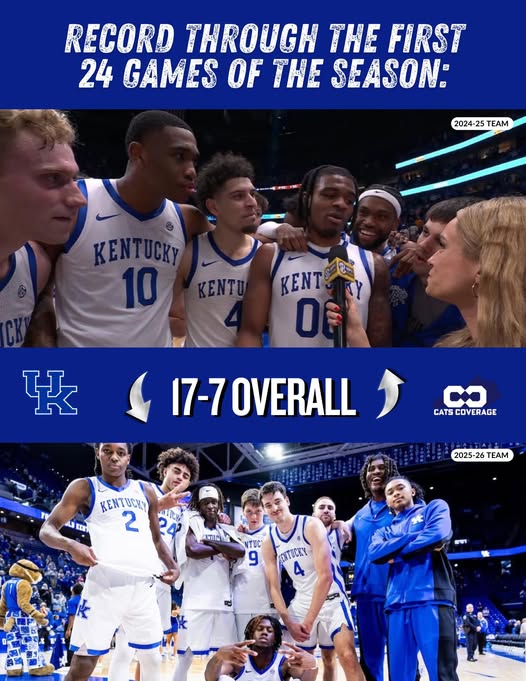
The observation that the current Kentucky Wildcats men’s basketball team (2025-26 season) has the exact same record as last year’s team (2024-25 season) through the first 24 games is indeed an intriguing coincidence, highlighting the unpredictable rhythms of college hoops even under the same head coach.
As of February 10, 2026, the 2025-26 Kentucky team stands at 17-7 overall (8-3 in SEC play). This places them second in the SEC standings behind a strong Florida squad, with a current three-game winning streak and solid metrics: points scored per game around 81.6, allowing about 71.3, a strong strength of schedule (SOS around 10.49), and NET/RPI rankings in the top 30 range. Mark Pope, in his second year, has the team ranked No. 25 in the latest AP poll, reflecting a competitive but not dominant campaign so far in one of the nation’s toughest conferences.
Last season (2024-25), Kentucky finished the full year at 24-12 (10-8 SEC), making the NCAA Tournament as a solid contributor before exiting in the Sweet 16 (regional semifinal loss to Tennessee). To confirm the “through first 24 games” parallel: the 2024-25 squad also reached 17-7 after 24 contests. Schedules vary slightly year-to-year in non-conference and conference pacing, but the win-loss mark aligned precisely at that checkpoint. This mirrors the current 17-7 mark in 2025-26.
What makes this “odd” coincidence noteworthy? College basketball seasons are influenced by roster turnover, injuries, scheduling quirks, and the inherent volatility of the sport—yet here we see identical 17-7 starts despite differences in personnel and context.
Context on the Teams
2024-25 (Pope’s first year): This was a transitional season after John Calipari’s departure to Arkansas. Pope inherited a talented but rebuilding group, emphasizing spacing, shooting, and defensive versatility. The team started strong in non-conference play, notched some big wins (including multiple over top-15 opponents, setting a program record for such victories in a season), but hit bumps in SEC play with inconsistent performances. By the 24-game mark (roughly mid-February 2025), they sat at 17-7, positioning them well for a tournament berth. They ultimately went 7-5 in their remaining regular-season games to finish 24-12, then advanced through the early NCAA rounds before falling short.
Key elements included balanced scoring, strong three-point shooting at times, and resilience in close games. The season showed promise for Pope’s system taking root in Lexington.
2025-26 (current season): With continuity under Pope, the roster features returning pieces like Otega Oweh (a standout scorer and rebounder, often leading in points and boards in big wins), Malachi Moreno (interior presence), Brandon Garrison, Denzel Aberdeen, Jaland Lowe, and others contributing in scoring, rebounding, and facilitation. Newcomers and transfers have blended in, maintaining high offensive efficiency (ORtg around 118) while improving defensively in spots.
The schedule has been brutal again—21 games against prior NCAA Tournament-caliber teams. Non-conference included dominant wins (e.g., 107-59 over Valparaiso) but an early road loss at Louisville (96-88). SEC play has seen highs (wins over ranked Arkansas and Tennessee) and lows (a blowout loss at Vanderbilt, 80-55). The 17-7 mark reflects a team that’s competitive, streaky (recent W3 streak after some setbacks), and poised for a strong finish if they sustain momentum.
Why the Identical Record Feels Eerily Similar
- Schedule Parity: Both seasons featured tough non-conference slates and deep SEC gauntlets. Kentucky often plays 30+ high-major games annually, so hitting 17-7 midway isn’t anomalous but aligning exactly is.
- Coaching Stability: Pope’s philosophy—pace, spacing, player empowerment—has carried over. The system produces similar outputs in efficiency and style, even with roster flux.
- SEC Depth: The conference remains elite, with multiple top-25 teams weekly. Losses often come against quality opponents, capping win totals around this range midseason.
- Volatility Factor: College hoops sees hot/cold streaks, injuries (e.g., limited minutes from some like Jayden Quaintance early this year), and close-game outcomes. Both teams navigated similar turbulence to land at 17-7.
Looking Ahead
With identical 17-7 marks at the 24-game juncture, the paths diverge from here. Last year’s team went 7-5 down the stretch to reach 24-12 and the tournament. This year’s squad, sitting second in the SEC with games left against top foes (e.g., Florida upcoming), could match or exceed that if Oweh’s scoring bursts, interior defense, and three-point volume hold. A deeper NCAA run remains possible, given the talent and experience.
This parallel underscores basketball’s cyclical nature—progress isn’t always linear, but consistency in results can signal foundational strength. For Big Blue Nation, it’s a reminder: the program endures, adapts, and often finds ways to compete at a high level regardless of the year.