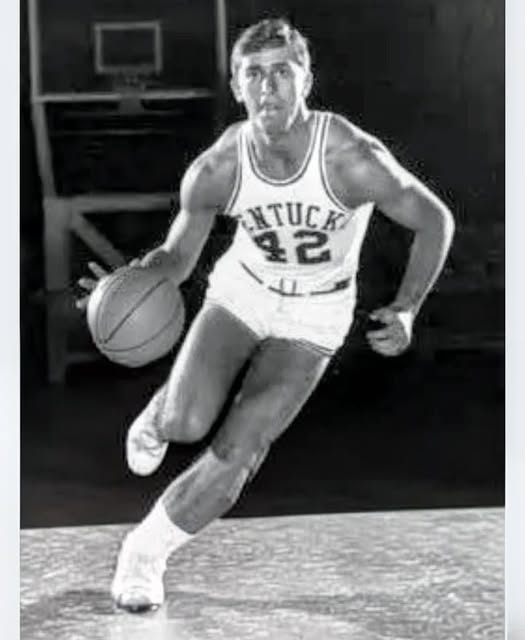
Pat Riley’s junior season at Kentucky in 1965-66 stands as one of the most remarkable individual campaigns in Wildcats history, a year where the Schenectady, New York native erupted into national prominence while guiding Adolph Rupp’s undersized squad—forever immortalized as “Rupp’s Runts”—to the brink of an NCAA championship.
As a 6-4 guard/forward, Riley averaged 22.0 points, 8.9 rebounds, and 2.2 assists per game across 29 contests, shooting an efficient 51.6% from the field and 69.9% from the free-throw line. He led the team in scoring and rebounding, logging heavy minutes at 37.2 per game in an era of fast-paced, physical play. His totals included 637 points (team-high) and 259 rebounds, showcasing his versatility as a scorer who could attack the rim, pull up for mid-range jumpers, and crash the boards despite giving up height to many opponents.
The accolades poured in: First Team All-SEC, SEC Player of the Year (Associated Press), AP Third Team All-American, USBWA First Team All-American (some sources list consensus elements), All-NCAA Tournament Team, and NCAA Regional Most Outstanding Player (Mideast Region). These honors reflected his dominance in the SEC—where Kentucky went 15-1—and his clutch performances in March.
The 1965-66 Kentucky team entered the season with low expectations. No starter stood taller than 6-5, leading skeptics to predict a subpar year for the legendary Coach Rupp, who had never endured a losing season. The core five—seniors Larry Conley (6-3 forward) and Tommy Kron (6-5 guard), juniors Pat Riley (6-4) and Louie Dampier (6-0 guard), and sophomore Thad Jaracz (6-5 forward/center)—formed a scrappy, high-IQ unit reliant on speed, shooting, teamwork, and relentless defense rather than size.
They proved the doubters wrong emphatically. After a slow start, the Wildcats surged, losing only once in the regular season (a road defeat at Tennessee). They claimed the top spot in both major polls by mid-February and finished 27-1 entering the NCAA Tournament, with Dampier (21.1 ppg) and Riley forming one of college basketball’s most potent duos (combined ~43 ppg). The team’s style emphasized perimeter shooting (Dampier was a pioneer three-point threat in an era without the line), ball movement, and tough man-to-man defense.
In the NCAA Tournament (then 23 teams), Kentucky cruised through the Mideast Regional. Riley shone brightly:
- Sweet 16 vs. Dayton: 29 points (11-18 FG, 7-8 FT), 8 rebounds in an 86-79 win.
- Elite Eight vs. Michigan: 29 points (13-27 FG), 5 rebounds in an 84-77 victory.
In the Final Four at College Park, Maryland:
- National Semifinal vs. Duke: 19 points, 8 rebounds, key defensive plays in an 83-79 thriller.
The championship game pitted No. 1 Kentucky against No. 3 Texas Western (now UTEP), an all-Black starting five led by Bobby Joe Hill, David Lattin, and Willie Worsley. In a game later dramatized in the film Glory Road, Texas Western’s athleticism and physicality overwhelmed the smaller Wildcats. Lattin’s early dunk over Jaracz set the tone; Texas Western dominated the boards and tempo, winning 72-65. Riley later reflected emotionally: he felt the Miners were “playing for a hell of a lot more than any NCAA championship,” acknowledging the cultural and racial significance amid the Civil Rights era. Kentucky’s all-white roster (common for Southern schools then) contrasted sharply, and the loss stung deeply—Riley admitted crying on the bench.
Despite the defeat, the season cemented Riley’s legacy at Kentucky. His jersey No. 42 hangs in Rupp Arena rafters, retired alongside other greats. He finished his UK career (1964-67) with 1,464 points (18th all-time at the time), 672 rebounds, and three varsity seasons of excellence, earning All-American nods and helping bridge Rupp’s dynasty to future eras.
Post-college, Riley was selected 7th overall by the San Diego Rockets in 1967, playing nine NBA seasons (including a 1972 title with the Lakers). But his true fame came as a coach: five NBA championships (four with Showtime Lakers, one with Miami Heat), three Coach of the Year awards, and Hall of Fame induction in 2008. His “warrior” mentality—evident in 1965-66—translated to sideline intensity and executive success (two more titles as Heat president).
For Kentucky fans, 1965-66 represents resilience: “Rupp’s Runts” defied odds, achieved near-perfection (27-2 final), and left an indelible mark. Riley’s junior explosion—leading scorer, rebounder, award magnet—symbolized that grit. In a program with eight national titles, this runner-up run endures as one of its proudest, bittersweet chapters, forever linked to a future legend who embodied Big Blue heart.