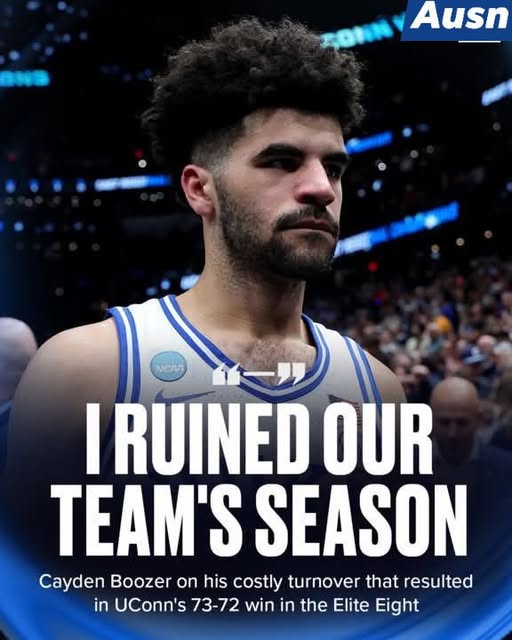
When a single moment in sports transcends the ordinary, it usually involves heartbreak threaded with drama, youth pressed against the unforgiving pressure of a national stage, and a raw human response that echoes far beyond the final buzzer. That’s exactly what unfolded in the Elite Eight of the 2026 NCAA Men’s Basketball Tournament when Duke’s improbable collapse against UConn was sealed by a turnover in the final seconds — a turnover that Boozer himself described after the game with brutal honesty, saying, “I’m going to replay that for the rest of my life.” (Bleacher Report)
From the moment tip‑off began, Duke appeared poised to make a major March run. The Blue Devils, led by a constellation of young talent including freshman standouts, built a commanding lead in the first half — as much as 19 points at one juncture — and looked every bit like a team destined for the Final Four. Among that youthful core was Cayden Boozer, a highly touted five‑star recruit, son of former NBA All‑Star Carlos Boozer, and twin brother to fellow Duke standout Cameron Boozer. Together they had helped anchor one of Duke’s most electrifying offensive displays of the season. (Wikipedia)
What followed, however, was the kind of unnerving late‑game narrative that turns sports into folklore. A team that dominated early saw its advantage whittled away by a resurgent UConn. The Huskies clawed back with perseverance, defense, and opportunistic offense, tightening the score to a single possession game in the closing moments. With the crowd on edge and the clock bleeding away, Duke had a chance to secure the ball, drain crucial seconds, and force UConn into desperation. Instead, with less than ten seconds left and a narrow lead, Boozer tried to make an aggressive pass in the backcourt — a play intended to advance the ball and maintain offensive momentum — but it was tipped away under defensive pressure. That deflected pass ended up in the hands of UConn, leading within seconds to a monumental 35‑foot three‑pointer that took every Duke hope with it when the buzzer sounded. UConn won 73‑72, and Duke’s season ended in stunning fashion. (WV News)
For Boozer, that split‑second decision — the instinct to make something happen in a sport where momentum is everything — became instantly seared into not just a game result but his personal memory. When asked about it postgame, his words were unequivocal in their vulnerability: he said he would “replay that for the rest of my life.” It was not the defiantly stubborn statement of an athlete refusing to move on; it was the honest confession of someone feeling the weight of perceived consequence — the heavy burden of a season’s hopes resting on one miscalculated pass. (Yardbarker)
In that moment, he wasn’t just a 18‑year‑old basketball player. He was the inevitable protagonist in a drama millions watched — and soon dissected endlessly online and in sportsrooms across the country. People have debated endlessly whether Boozer should have held the ball, taken a foul, or run down the clock more conservatively. Some commentators pointed out that fouling was the safer route, that with such little time left the chance of another possession was minimal. Others argued that the coach’s signals may have influenced his decision, pointing out that in the chaos of a heated moment, players sometimes make split‑second choices they later wish they could take back. But for Boozer, it didn’t matter who was “right” or “wrong.” The emotional imprint was already there. (BroBible)
His reaction after the game wasn’t just regret — it was deeply personal accountability. He expressed a sense of having let down his teammates, the fan base, and perhaps most poignantly, his brother Cameron — with whom he might never again share the court at Duke if Cameron opted for the NBA draft next season. “I cost our team our season,” was the blunt sentiment echoing through social media threads and fan discussions — and it underlined how intimately athletes internalize these moments, especially when they come at the end of so much collective effort. (Reddit)
Learning to shoulder that weight is part of growth in competitive sports, yet the emotional toll was visible. Footage from the postgame press conference showed Boozer answering questions with composure, though clearly shaken. Fans and commentators alike noticed his poise under pressure even as the pain was evident — some praised him for facing the media rather than avoiding tough questions, seeing that as a signal of character rather than weakness. Veteran reporter Seth Davis even commented on how rare it is to see young athletes handle such moments with honesty and professionalism. (Athlon Sports)
But public reaction wasn’t uniformly supportive. Like many high‑stakes sports moments, Boozer’s turnover became fodder for endless debate online, where some voices criticized the play and others defended the young star. In fan forums, some expressed sympathy — recognizing that the intense emotional nature of March Madness can amplify a single error into something far larger in perception. Others talked about how this one play would haunt him in future recollections, even as they acknowledged that such judgments often overshadow the reality that his team’s collapse was not the result of a single moment but a combination of second‑half struggles. (Reddit)
A seasoned eye on the matchup would note that Duke’s loss wasn’t solely because of one misplay; the team had coughed up a big lead, committed multiple turnovers, and struggled to adjust defensively. Head coach Jon Scheyer remarked afterwards that it would be simplistic to blame one play when the game was the product of 40 minutes of competition. And indeed, coaches and teammates echoed that sentiment: football and basketball history are filled with countless examples where a collective misstep creates vulnerability toward a dramatic finish. Nonetheless, in the minds of players sitting in that locker room processing disappointment, moments like Boozer’s turnover take on outsized emotional significance. (ABC11 Raleigh-Durham)
There’s also the broader cultural context: March Madness is not just a basketball tournament. It’s a national ritual that drags collegiate athletes — mostly underclassmen — into the spotlight of massive expectation and scrutiny. Every year, there are iconic buzzer‑beaters and heartbreaking collapses that define athletes’ seasons, or even their careers. Boozer’s moment now finds itself in that lineage — alongside unforgettable shots and unforgettable losses. And while he might say he’ll replay that for the rest of his life, there’s also a very human recognition that time will eventually give that phrase a different meaning — not one of endless torment, but of a defining early career moment from which growth emerges. Young athletes carry these memories not as scars but as having shaped their resilience. (Bleacher Report)
For Duke as a program, the loss also raised questions about strategy, coaching decisions, and the balance between youthful exuberance and polished experience. Duke, often lauded for its ability to develop NBA‑caliber talent, had twice now seen a late tournament exit after leading by large margins. Yet within that narrative is also the story of two outstanding twin brothers at the heart of it, carving their own legacy while still early in their college careers. Fans, analysts, and even opposing supporters acknowledged that one play did not define his talent — a point debated heavily online and in the press — and many expect Boozer to return next season with a hunger to build on lessons learned. (New York Post)
Ultimately, Boozer’s words — that he’ll replay the turnover for the rest of his life — resonate because they capture something universal: the sting of regret when we know we could have done things differently, the ache of a moment that didn’t turn out as hoped, and the understandable desire to own up to responsibility even when the broader truth is more complex. In sports and in life, we tend to remember the most dramatic swings — the highs and the lows — and we carry those with us. For Boozer, this will be one such memory, a moment he’ll recall vividly whether he recounts it as a defining lesson, a motivation for future success, or simply a story of the mercurial nature of competition. The pain he expressed is real, but his reaction also reflects a maturity and accountability that many athletes spend years learning to embrace. And in that vulnerability lies a deeper strength, the kind that defines not just seasons but the character of the people who play the game. (Athlon Sports)