When people talk about the great dynasties in men’s college basketball, names like UCLA, Kentucky, North Carolina and even recently UConn are often invoked. But almost always near the very top of conversations about prestige and historical impact is Duke, a program that has been an indelible part of the sport for decades. In the lore of college hoops, Duke conjures images of Cameron Indoor Stadium under Cameron Crazies’ blue‑and‑white thundering, of midnight practices, of legendary coaches, and of a parade of elite players who left college as stars and entered the NBA draft as household names. Yet when you look at the whole story — at the tally of national championships hanging in the rafters — what’s truly fascinating is how Duke’s identity has come to be defined by talent without a proportionate number of championships compared with how much buzz the program generates year after year. This tension between talent and trophies is part of what makes the program so compelling, beloved by some and reviled by others, and an endless subject of conversation in basketball culture.
To put it in context, Duke has won the NCAA Men’s Division I Basketball Championship five times. Those titles came in 1991 and 1992 — back‑to‑back under Coach Mike Krzyzewski, then again in 2001, 2010, and most recently in 2015. (Wikipedia) While five national championships is a remarkable accomplishment and a testament to sustained excellence, when fans or analysts talk about programs with lots of talent and not as many championships as expected, Duke often comes up because of how regularly it attracts elite recruits and how consistently it is competitive. Duke’s championship count is high by most standards, but relative to the sheer volume of talent it’s brought in — year after year, decade after decade — the conversation inevitably focuses on missed opportunities, near‑misses, and the contrast between regular‑season dominance and March’s unpredictable single‑elimination crucible.
There was a time, particularly in the late 1980s and early 1990s, when Duke first crystalized the image of a perennial title contender. Coach Krzyzewski, already becoming one of the most formidable coaches in college basketball history, led Duke to its first championship in 1991. This team was a defining moment in the sport, a squad that finally broke through after years of effort and heartbreak, symbolizing the program’s arrival at the very pinnacle of the game. The very next year, the Blue Devils repeated as champions in 1992, solidifying a dynasty in its infancy and affirming that Duke was not a one‑shot wonder but a sustained force in college hoops. (Wikipedia)
Those early championships were transformative, both for the program and for basketball culture. They weren’t just victories on the court; they were statements about what Duke was becoming — a symbol of excellence, albeit one that also seemed to attract intense emotions from fans of other teams. Even today, some people react to Duke not just as a basketball program but as a cultural force, one that evokes loyalty, frustration, admiration, and even resentment in equal measure. That emotional intensity is part of what makes Duke’s story so intriguing: it’s not merely a statistic; it’s a narrative that captures people’s affections and ire in equal measure, and sometimes all at once.
Following those early championships, the program continued to be elite. There were years when Duke was the consensus No. 1 team in the country, boasting future NBA stars, dazzling athleticism, defensive prowess, and coaching that seemed always a step ahead. Yet as the years progressed from the 1990s through the 2000s and into the 2010s, something curious emerged. Duke teams were often loaded with talent — games full of future professionals, All‑Americans, one‑and‑done phenoms, and players who would go on to be high draft picks in the NBA — but championships didn’t always follow. Even in seasons when expectations were sky‑high, the NCAA Tournament’s brutal single‑elimination format could quickly turn promise into disappointment.
This pattern became something of a meme among college basketball fans: Duke, with elite rosters and star‑studded lineups, would sometimes fall short when it mattered most. A team might coast through the regular season and conference tournament, dominate opponents, and yet be vulnerable in that March crucible where one bad shooting night, one bad matchup, or one untimely turnover could end everything. The heartbreaking nature of the NCAA Tournament means that this dynamic isn’t unique to Duke, but the frequency with which elite Duke teams seemed to fall short of ultimate glory sparked conversation everywhere from sports bars to Reddit threads to national broadcasts. (Reddit)
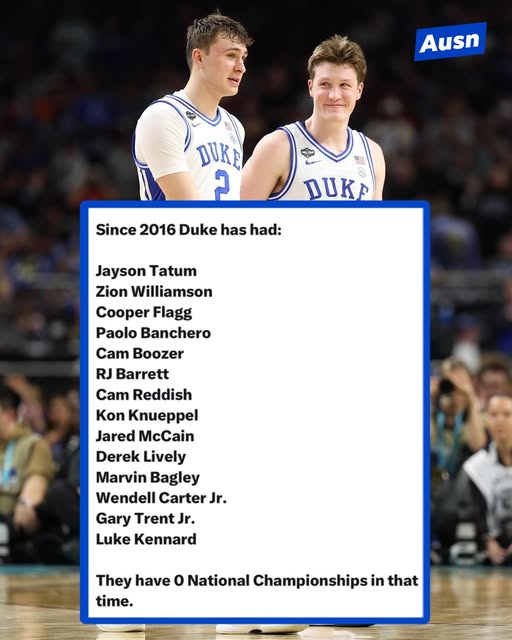
More recent iterations of Duke showcased precisely this pattern. In the late 2010s and early 2020s, the Blue Devils rostered future NBA superstars — players like Jayson Tatum, Zion Williamson, Paolo Banchero, and others whose combination of skill, physical tools, and potential seemed almost destined for championships. On paper, these teams had all the ingredients of a dynasty: elite coaching, athletic excellence, transcendent individual talent, and the intimidating aura of a blue‑blood program. Yet in tournament play, results didn’t always sync with expectations. Postseason exits in the elite rounds or Final Four became talking points rather than national titles, and every spring the conversation would loop back around to the same question: Why, with all that talent, haven’t they matched it with more championships? (Reddit)
This isn’t to say that Duke hasn’t had success. Five national titles are nothing to scoff at. They are part of a legacy that ranks Duke among the most decorated programs in the sport’s history. But when you juxtapose that success with the frequency of seasons loaded with future NBA talent and the high expectations that come with the Duke brand, there’s a conspicuous gap between talent levels and championship outcomes. That gap has fuelled endless debate among fans. Some point to the unforgiving structure of March Madness, where a single off night can derail even the most talented teams. Others highlight how the realities of college basketball — injuries, team chemistry, youth, coaching decisions — matter as much as individual talent. Some argue that the culture of one‑and‑done recruiting, where top players stay only a year before entering the NBA Draft, can be a double‑edged sword: you get elite athletes, but you lose cohesion and experience that older teams might have. (Reddit)
Whatever the explanation, the narrative around Duke has become wonderfully complex. Duke is both celebrated and criticized, loved and vilified, depending on who you ask. For fans of the Blue Devils, the program’s sustained excellence, consistent national prominence, and ability to attract top recruits are a source of pride. For rivals, Duke’s perceived inability to convert elite rosters into more regular championships sometimes feels like evidence that talent alone isn’t everything — that heart, timing, coaching, luck, and intangible chemistry matter just as much. This dual narrative — greatness without as many trophies as expected — enriches college basketball’s storytelling.
The emotional dimension of this story cannot be overstated. Fans invest in teams not just for wins and losses but for the drama of the journey. When a Duke squad is loaded with talent yet fails to cut down the nets when it matters most, it compounds the agony but also deepens the narrative resonance. The heartbreak becomes part of the program’s mythology, a reminder that in sports, nothing is guaranteed. And it creates a cycle: fans return year after year, hopeful that this time the stars align. And every year that the Blue Devils lay claim to another elite young roster, the conversation restarts — the hopes, the expectations, the predictions, and ultimately, the suspense of March Madness.
So when someone says Duke has had “a lot of talent but no championships to show for it,” it’s a sentiment that reflects more than a statistical argument. It encapsulates the emotional investment of fans, the dramatic tension of college basketball, and the peculiar way in which expectations shape our understanding of success. Duke’s five national championships are etched in history — undeniable and impressive — but what makes the program endlessly fascinating isn’t just the trophies they’ve won. It’s the stories they tell: of seasons that promised so much and sometimes delivered heartbreak; of rosters stacked with future stars that fell short; of legendary coaches and unforgettable moments that live on because they were so close to ultimate glory. In that ebb and flow between talent and triumph, Duke’s legacy in college basketball continues to be written, season after season, with all the drama, passion and unpredictability that make this sport so compelling. (Wikipedia)