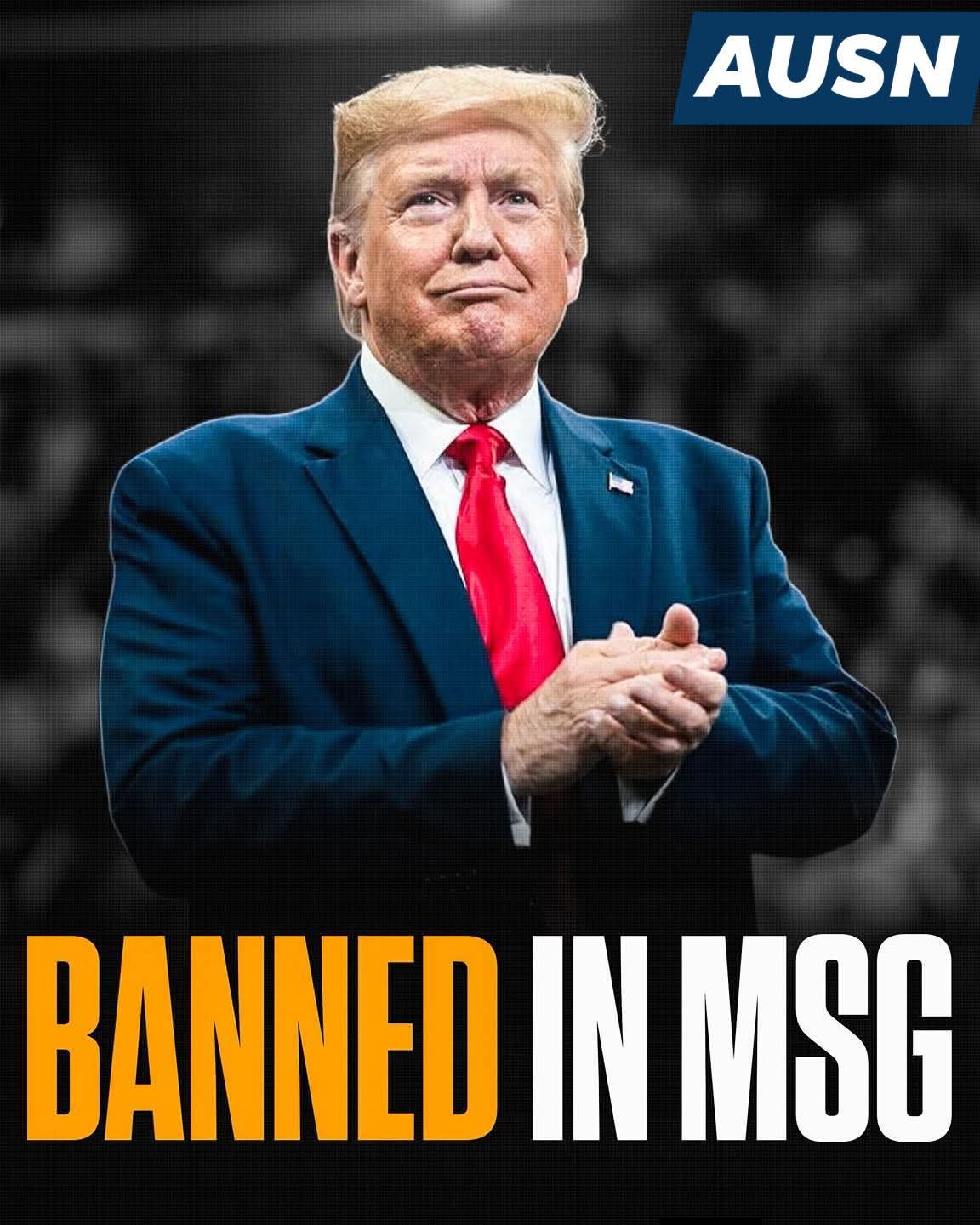
The basketball world was sent into a frenzy after reports emerged claiming that New York Knicks executives had reportedly prohibited President Donald Trump from attending future games at Madison Square Garden following the team’s Game 3 loss in the NBA Finals. According to the report, the decision came shortly after Trump attended the matchup courtside as the Knicks fell to the San Antonio Spurs in a highly anticipated contest.
The report immediately generated widespread discussion across social media, sports television, and political circles, blending two of the most powerful forces in American culture: professional sports and politics. Whether viewed as a serious organizational decision, a reaction to public perception, or simply another chapter in the increasingly dramatic NBA Finals storyline, the news quickly became one of the most talked-about topics surrounding the championship series.
Trump’s appearance at Madison Square Garden for Game 3 had already attracted significant attention before tipoff. As one of the most recognizable figures in the world and the sitting President of the United States, his presence naturally drew cameras and headlines. Spectators inside the arena noticed the increased security measures that typically accompany a presidential visit, while television broadcasts frequently referenced his attendance throughout the evening.
Madison Square Garden has long been known as one of the most iconic venues in sports. Often referred to as “The World’s Most Famous Arena,” it has hosted countless historic basketball games, championship celebrations, concerts, political events, and cultural moments. Whenever a major public figure attends an event at MSG, it tends to become part of the story itself. Trump’s appearance was no exception.
The Game 3 matchup carried enormous significance. The Knicks entered the contest hoping to strengthen their position in the NBA Finals, while the Spurs were desperate to avoid falling further behind in the series. With the championship stakes already sky-high, the presence of a sitting president only amplified the spotlight surrounding the game.
As the contest unfolded, the Spurs managed to secure a crucial victory, defeating New York and shifting momentum in the Finals. The loss disappointed Knicks fans who had hoped to see their team take a commanding lead. Instead, San Antonio’s win injected fresh life into the series and raised questions about how the Knicks would respond moving forward.
In the hours following the game, attention gradually shifted away from the action on the court and toward reports regarding Trump’s future attendance at Knicks games. The claim that team executives had reportedly moved to prevent him from attending future contests sparked immediate debate among fans, analysts, and commentators.
Supporters of the reported move argued that professional sports organizations have the right to manage their public image and determine how they wish to engage with high-profile political figures. Some believed the organization may have wanted to avoid distractions during the most important stretch of the season, particularly with a championship hanging in the balance.
Others criticized the reported decision, arguing that sports should remain separate from politics regardless of individual political beliefs. These observers maintained that attendance at sporting events should not become a partisan issue and that fans of all political backgrounds should feel welcome inside arenas.
The controversy highlights a larger trend in modern sports, where the lines between athletics, entertainment, and politics frequently intersect. Over the past decade, athletes, coaches, owners, and public officials have become increasingly visible in discussions that extend beyond the games themselves. As a result, high-profile appearances often generate conversations that reach far beyond the scoreboard.
Trump has long maintained connections to the sports world. Throughout his public career, he has attended numerous sporting events, interacted with athletes and team owners, and regularly commented on sports-related topics. His attendance at major championship events often generates extensive media coverage due to his status and the reactions he receives from fans.
Madison Square Garden, meanwhile, occupies a unique place in American sports culture. Located in the heart of New York City, the arena has served as a stage for some of the biggest moments in basketball history. The Knicks’ passionate fan base creates an atmosphere unlike almost any other venue in the league, making every playoff game a major event.
The report also fueled discussion about superstition among sports fans. Throughout sports history, supporters have often blamed losses on unusual factors, from celebrity attendees and lucky charms to jersey combinations and pregame routines. Following the Knicks’ Game 3 defeat, some fans jokingly suggested that Trump’s presence had somehow brought bad luck to the team.
While such theories are obviously not rooted in competitive reality, they illustrate the emotional nature of sports fandom. When championships are at stake, supporters frequently search for explanations, narratives, and symbols that help make sense of victories and defeats. The timing of Trump’s attendance and the Knicks’ loss naturally became part of that conversation.
Players themselves generally focus on basketball rather than outside storylines. Professional athletes are accustomed to performing amid distractions, media scrutiny, and public attention. For the Knicks, the primary concern remains preparing for the next game and making the necessary adjustments to compete against a talented Spurs team.
Coaches also understand the importance of maintaining focus during championship series. The NBA Finals are often decided by small details, strategic adjustments, and execution under pressure. Any external controversy, regardless of how widely discussed, ultimately takes a back seat to what happens on the court.
Still, reports involving major political figures inevitably attract interest. News cycles thrive on stories that combine sports, celebrity, and politics, particularly when they involve iconic franchises like the Knicks. The alleged decision regarding Trump’s attendance quickly became a headline far beyond traditional sports media.
The reaction from fans was predictably divided. Some applauded the reported move and viewed it as an appropriate organizational decision. Others criticized it and questioned whether such actions should occur at sporting events. The differing responses reflected broader political and cultural divisions that often emerge whenever prominent public figures become involved in sports discussions.
From a public relations standpoint, situations like these can be complicated for professional organizations. Teams must balance relationships with fans, sponsors, public figures, and community stakeholders while attempting to keep the focus on competition. Every decision is scrutinized and analyzed through multiple lenses, making even routine matters potential subjects of debate.
Meanwhile, the NBA Finals continue to provide plenty of drama on their own. The series between New York and San Antonio has featured intense competition, emotional moments, and compelling performances from star players on both sides. The championship battle remains the central story despite the attention generated by off-court developments.
For Knicks supporters, the primary concern remains the team’s pursuit of a title. After decades of waiting for championship glory, many fans are focused exclusively on basketball. Questions about rotations, defensive adjustments, and offensive execution carry far greater significance than celebrity attendance or political controversy.
Spurs fans, on the other hand, have welcomed any storyline that shifts attention away from New York and highlights their team’s resurgence in the series. San Antonio’s victory in Game 3 demonstrated resilience and determination, setting the stage for what promises to be a fascinating continuation of the Finals.
The broader significance of the report may ultimately depend on whether further developments emerge. In today’s media environment, stories often evolve rapidly as additional information becomes available. Public reactions, official statements, and organizational responses can all influence how such reports are perceived over time.
What remains clear is that the intersection of sports and politics continues to generate intense public interest. Whenever major political figures attend high-profile sporting events, their presence becomes part of the narrative whether teams intend it or not. Fans, commentators, and media outlets inevitably analyze every aspect of the situation.
As the NBA Finals move forward, attention will eventually return to the players competing for a championship. The Knicks and Spurs have spent months battling through a grueling season to reach this stage, and the outcome of the series will ultimately be determined by performances on the hardwood rather than events in the stands.
Nevertheless, the report regarding Donald Trump’s future attendance at Madison Square Garden has added another layer of intrigue to an already dramatic championship series. It has sparked conversations across sports and political communities, generated countless opinions online, and ensured that Game 3 will be remembered for more than just the final score.
Whether the reported decision proves accurate, changes in the future, or becomes a footnote in a larger Finals story, it demonstrates how quickly narratives can emerge during major sporting events. In an era where every development is amplified through social media and nonstop news coverage, even a courtside appearance can become a national talking point.
For now, fans of both teams remain focused on what comes next. The Knicks are looking to rebound from a disappointing loss, while the Spurs are attempting to build on newfound momentum. The championship remains within reach for both franchises, and every game carries enormous weight.
As a result, the spotlight will soon shift back to the court, where players and coaches will determine the fate of the NBA Finals. Yet the report involving Donald Trump and Madison Square Garden serves as another reminder that in modern sports, some of the biggest stories often unfold away from the action itself. When politics, celebrity, and championship basketball collide, the result is a narrative that captures attention far beyond the arena walls.