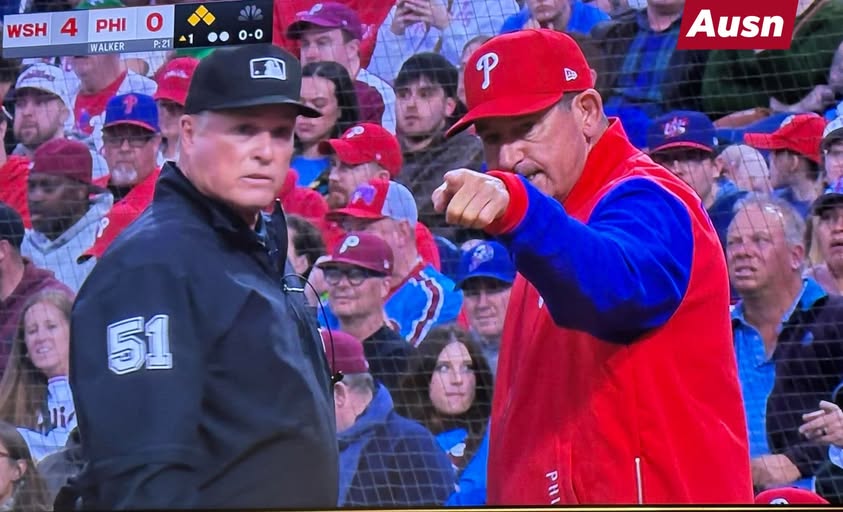
In baseball, the manager’s role is a curious hybrid. They are strategist, leader, motivator, face of the dugout and, sometimes, lightning rod for controversy. They make decisions that affect pitch counts, lineups, substitutions, and — when the moment demands it — they step out of the dugout to argue a call. Rarely is that act without consequence. Rarely does it not carry with it a rush of raw emotion, intensity, and the full weight of competitive urgency. And in the early stretch of the 2026 season, in a moment that men who have spent almost their entire lives devoted to the game know all too well, Phillies manager Rob Thomson found himself at the center of just such a moment — ejected from a ballgame after arguing about a replay decision that had seen a call overturned. The incident highlighted not just a pivotal on–field moment but a deeper truth about how baseball in this modern era is still wrestling with tradition, technology, interpretation and the timeless human element of disagreement that has defined the sport for more than a century. Many fans and commentators who watched that ejection saw something almost archaic despite technology’s grip on the sport — a manager arguing with umpires the way old‑school baseball used to look, yet doing so over a new age replay verdict that only exists because the game is changing in fundamental ways.
The play unfolded early in the game under frustration and confusion. According to fan accounts and chatter from those in the stadium, there was a close play involving a baserunner who had originally been called out at first base. In real time, that call ended the inning, as three outs had ostensibly been recorded. But then, in a twist emblematic of baseball’s evolving review system, a replay review was initiated. On replay, the call at first was overturned, which meant the out was wiped off the board. That, in turn, fundamentally changed the situation: since the runner was no longer out, other runners who had been on base needed to be retreated back to where they had last legally occupied, a rule that can create strange sequences and sometimes frustrate players and fans alike. In this case, one runner who had been returned to third base now stood in scoring position where moments before an inning had ended and the next half‑inning was about to begin. The umpires’ decision to send that runner back, essentially re‑establishing him on third base, was the spark that ignited Thomson’s fury and the ensuing confrontation that would lead to his ejection. Onlookers — including fans on social platforms — noted that Thomson’s ire wasn’t directed so much at the replay itself but at the resulting placement of the runner back at third after the overturned call, a decision he felt was illogical and unfair. One fan’s account succinctly captured the sentiment of many watching: Thomson was arguing not merely the replay but the outcome of it — that reversing a call and then sending a runner back to a base he had already jogged past was nonsensical and punitive. That perceived discrepancy between what the rulebook says and what common sense might dictate was part of what made the moment so frustrating and so intense for a manager already wrapped tightly around every nuance of the game’s competitive flow. (Reddit)
In baseball lore, a manager being ejected is not in itself rare. What makes Thomson’s situation distinctive is how it contrasts tradition with technology. For generations, managers argued balls and strikes, checked swing calls, tag plays and boundary decisions, all based on instinct, gut and the collective weight of the moment. Today, with the advent of replay review, challenge systems, and machine‑based strike zones, one might assume that managers would become increasingly removed from these confrontations, that technological clarity would dampen the emotional confrontations on the field. Yet Thomson’s ejection proved that the human element still demands expression. No matter how advanced the systems become, when something feels wrong to a competitor at the moment, that instinct to voice it remains visceral. The difference now is that managers like Thomson argue not just about an umpire’s eye but about how replay technology applies and interprets its own rules, and that makes the argument both modern and old‑school at the same time. It’s the timeless clash between man and official — now digital hybrids — and the fragile subjectivity that underpins it. (Reddit)
To understand this moment fully, you have to consider what’s at stake. This was early in the season, a time when teams are still feeling each other out, settling pitch counts, adjusting rotations and deciding how they want to attack a long, 162‑game grind. Every win and loss matters, but perhaps more importantly, every moment helps establish the identity of a club in the narrative that will shape the rest of its season. Managers are acutely aware of this; they are attuned to momentum, morale, psychology and the narrow margins that can swing a series. When an overturned call fundamentally alters a situation — especially one that takes a run off the board or keeps a runner alive in a key spot — the impact ripples outward. In Thomson’s mind, as in the minds of many players and fans, it wasn’t just about one runner or one moment. It was about fairness, the integrity of play and how a high‑stakes professional game should interpret the rules it has established. Thus, when he rose out of the dugout to voice his displeasure, it wasn’t just a knee‑jerk emotion but the culmination of an intense competitive instinct to fight for his team in a moment where the game’s mechanics felt as though they had been misapplied.
The ejection itself was swift. After a sustained argument with the umpiring crew over the play and the subsequent runner placement, Thomson was handed the customary signal: he was out of the game. In baseball, that gesture — the umpire pointing toward the clubhouse dugout, signaling that the manager is dismissed — is both symbolic and decisive. It ends the argument, but it doesn’t end the feelings around it. For Thomson, a seasoned baseball lifer who has spent years in big‑league dugouts both as a coach and bench boss, that ejection was clearly the boiling over of deep conviction — a conviction that the call and its aftermath had been mishandled. Watching the exchange, observers might have noted the red in his face, the sighs and shakes of the head, the way he stepped back to emphasize his point before ultimately being led off the field. It was a vivid example of the raw passion baseball still evokes, even in an era where technology is meant to clarify and corral human judgment. (Reddit)
That passion extends beyond the basic argument; it touches on a broader narrative in today’s game: how do you balance the purity of baseball’s traditions with the undeniable benefits — and occasional frustrations — of modern replay systems and automated calls? Major League Baseball’s new automated ball‑strike system, known as ABS, has already dramatically affected games by overturning calls with video technology that baseball once left entirely to the umpires’ subjective judgment. Some managers and players have embraced it as a tool to ensure fairness, others see it as a challenge to the human element that has always defined the sport. And while Thomson’s ejection wasn’t directly about ABS, it happened in an ecosystem where technology plays a larger role in how the game is officiated and interpreted. That backdrop only intensifies the emotional and cultural stakes of any dispute over an overturned call. (Front Office Sports)
In the end, what happened to Rob Thomson that day is part of baseball’s broader storyline in 2026. It’s a reminder that even as the sport evolves, the core human reactions — pride, frustration, loyalty, protectiveness — remain unaltered. A manager arguing a call may seem like an old trope, something out of black‑and‑white footage from decades ago, but here it was, alive and intense on a modern diamond. It also underscores how every generation of rule changes, replay protocols and technological enhancement carries with it a learning curve — one that players, coaches, umpires and fans are still navigating. Managers will continue to dissent. Umpires will continue to enforce. And the game, timeless yet ever‑changing, will push forward into a future where technology and human emotion coexist in a complicated but enduring love affair.
In the postgame reactions that followed, opinions diverged. Some fans and pundits agreed with Thomson’s frustration, arguing that the replay reversal and runner placement seemed absurd and overly punitive. Others felt that managing a baseball game means accepting the replay outcomes graciously, even when they feel unfair, and that arguing them rarely changes the ultimate outcome. But whether people saw Thomson as a righteous defender of fairness or as a manager who overstepped his bounds, one thing was clear: his ejection sparked discussion about how baseball is officiated today, how managers interact with those systems, and how deep the emotional investment in the sport truly is. That clash — between technology and tradition, between rulebook precision and the spirit of competition — is exactly what keeps baseball endlessly fascinating, even in its 21st‑century iteration. (Reddit)
In a sport that often moves slowly, where the tension of a single decision can reverberate for days or weeks, moments like Rob Thomson’s ejection remind everyone that at its heart, baseball is still played by imperfect humans trying to interpret imperfect rules, all while striving for something as pure as victory and fairness. And while calls can be overturned, arguments can be lost, and managers can be ejected, the passion that drives those confrontations will always be a defining element of the game.