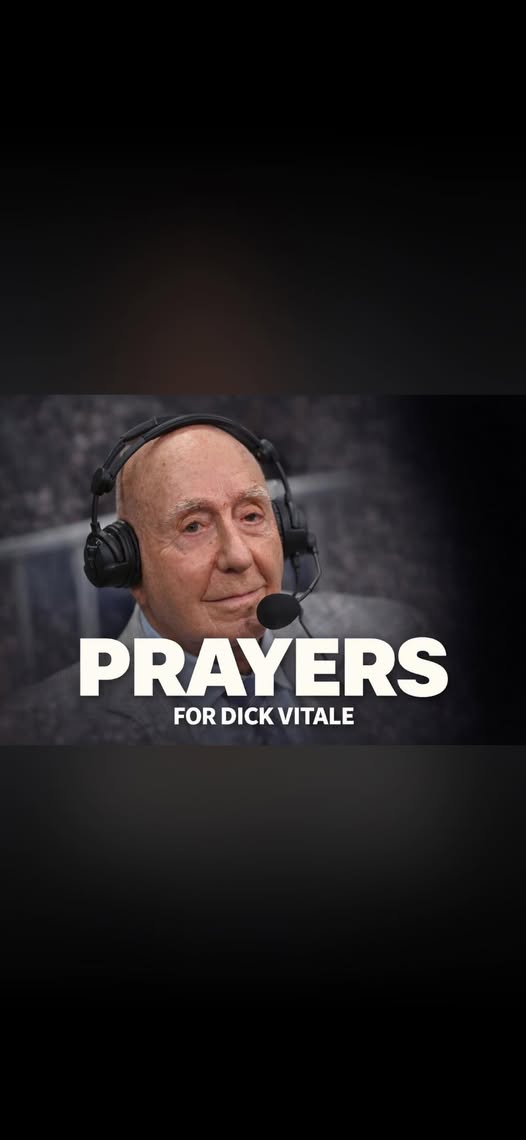
“This week on Thursday, it will be my national championship game,” Vitale posted, the words carrying a weight that went far beyond sports, beyond the bright lights, beyond the roar of any crowd. To many, a national championship is the pinnacle of an athlete’s career, a moment that represents years of sweat, relentless practice, sacrifices, and dreams honed from childhood. But for Vitale, Thursday was not just about a trophy, a medal, or a record etched into history. No, this Thursday was about more than glory—it was about life itself. Because alongside the anticipation, the adrenaline, and the meticulous planning that went into the championship, there was another, quieter, far more personal battle unfolding: his quarterly PET scan and bloodwork exams to determine if he was still cancer-free.
Cancer is a word that changes everything. It can be said in a whisper or shouted in a sterile room, but however it arrives, it reshapes reality. For Vitale, it had been a journey he never expected to take, a path nobody hopes to tread. The diagnosis had been sudden, a storm that swept through his life without warning, leaving fear, uncertainty, and an urgency that clings to every waking moment. The treatment had been grueling, a relentless cycle of tests, hospital visits, chemotherapy sessions, and moments when the body and spirit felt on the verge of surrender. Yet Vitale endured. He fought. And through it all, he clung to hope, the kind of hope that is both fragile and resilient, fragile because it can shatter with one unexpected result, resilient because it carries you forward even when the odds seem stacked against you.
Now, the quarterly PET scan loomed. These scans, designed to detect any lingering or returning cancer cells, were routine in medical terms, but anything routine can feel monumental when your life depends on it. And alongside the scan came the bloodwork exams, another set of tests meant to measure the invisible signs of health, markers of survival, proof that the fight he had fought—and continues to fight—was still holding steady. Vitale knew that what might seem like mundane tests to an outside observer were, for him, the most meaningful events of the week. These tests were his checkpoints in a game far more critical than any national championship on the field. They were the metrics of life itself.
Vitale’s post, brief and simple in its wording, reflected the duality of his situation: “🙏🙏🙏 for great news!” These little prayer hands symbolized more than hope; they symbolized the vulnerability he felt, the acknowledgement that no amount of preparation, skill, or determination could guarantee the outcome. Despite all the training, all the discipline, all the planning, the results of a PET scan are ultimately out of human control. And yet, there is strength in this vulnerability, strength in voicing it, strength in acknowledging that even the strongest, fastest, most disciplined athletes are human, are mortal, and are susceptible to the uncertainties that life can bring.
Thinking about it, the juxtaposition of a national championship and a medical test is almost surreal. The stadium, the teammates, the coaches, the cheering fans—all of that excitement and pressure pales in comparison to the quiet, sterile environment of a medical lab, where machines hum, needles prick, and results are parsed in code and graphs, determining life’s trajectory in ways that no scoreboard ever could. Vitale, like many athletes and many survivors before him, lives in this strange duality: the public and the private, the triumphant and the fragile, the visible and the invisible battles. On Thursday, both worlds collide. One part of him will be executing plays, maintaining focus, and striving for perfection in a sport he loves. The other part of him will be bracing for a scan, watching for results, and holding onto hope with every fiber of his being.
For those following Vitale’s journey, this post was more than an update—it was an invitation into a personal narrative few ever get to witness. It was a reminder that success is not always measured in trophies or statistics. Sometimes, success is simply waking up, facing the next day, and having the courage to step into uncertainty with grace. The courage to go to the hospital, to submit to tests, to confront the possibility of bad news, all while maintaining the discipline and focus needed to compete at the highest level on the field. It’s a type of bravery that is quiet, unheralded, and profoundly human.
As the days leading up to Thursday passed, Vitale likely experienced a whirlwind of emotions. There was hope, of course, because hope is essential. There was fear, too, because fear is unavoidable in situations where outcomes are uncertain and stakes are incredibly high. Perhaps there was even guilt—survivor’s guilt, or the strange feeling of being torn between the joy of the sport he loves and the anxiety over a scan he cannot control. And yet, through it all, there was resilience. There was an unwavering commitment to life, to health, to family, to friends, and to the game that has been a source of identity and purpose.
The act of posting publicly about such a vulnerable moment is itself courageous. It is one thing to privately worry, to pray silently, to keep your fears locked away. It is another thing entirely to broadcast them, to let the world see that even someone who might appear invincible on the field carries fears, anxieties, and uncertainties off it. Vitale’s openness creates a bridge, a connection between him and others who may be fighting their own battles—be they with cancer, mental health, or any personal challenge. His words become a beacon, a subtle but powerful reminder that no one is truly alone in facing life’s trials.
Imagine the morning of the PET scan. Vitale wakes early, perhaps earlier than usual. The day stretches ahead, filled with waiting rooms, the sterile scent of antiseptic, the low hum of machines, and the soft but constant presence of medical professionals guiding him through each step. There is a ritual to it, a rhythm that survivors know well. There is the quiet anxiety as he lies on the scanning table, the click and whirr of the machine, the sensation of stillness, and the thoughts that inevitably flood in—memories of the diagnosis, the treatment, the nights of uncertainty, the moments of triumph when the disease was beaten back. And all the while, in the back of his mind, there is hope. Hope that the scan will show no recurrence, hope that the bloodwork will reveal strong, healthy markers, hope that the journey he has undertaken continues forward with positive momentum.
Then comes the wait. The hours, or sometimes days, when the results are analyzed, interpreted, and ultimately shared. Waiting is perhaps one of the hardest aspects of life after cancer. It is a test of patience, of faith, of emotional endurance. Vitale’s post, with its simple plea for “great news,” encapsulates this tension perfectly. It is a mix of optimism and humility, a recognition that while he can control his preparation, his attitude, and his determination, the outcome itself is not in his hands.
And while all this unfolds in the medical realm, the national championship game draws closer. His teammates practice, strategies are discussed, and the excitement builds. To outsiders, it may seem like he is preparing solely for the game, but Vitale’s preparation is double-layered. Every drill, every play, every sprint carries additional weight—the understanding that life itself is fragile, that he has faced mortality and emerged on the other side, and that every victory on the field is now intertwined with a deeper appreciation for the gift of simply being able to compete.
In this way, Thursday becomes symbolic on multiple levels. It is a day of competition, a day of potential triumph, a day of personal reckoning. It represents not just athletic excellence, but the culmination of courage, resilience, and human perseverance. Winning the championship would certainly be meaningful, but the true victory lies in being present, in participating, in living fully, and in having the chance to continue telling his story.
Vitale’s words, posted in a moment of honesty and vulnerability, resonate because they capture something universal. Everyone faces moments where they must step into uncertainty, where the outcome is beyond control, and where hope and fear coexist. By sharing his experience, he reminds us that courage is not the absence of fear, but the willingness to move forward despite it. He demonstrates that life’s most important victories are sometimes the ones that cannot be measured in points, trophies, or accolades, but in resilience, survival, and the ability to embrace each day with openness and gratitude.
Finally, there is the prayer, “🙏🙏🙏 for great news!” These symbols, small yet powerful, convey an entire spectrum of emotion. They communicate hope, vulnerability, faith, and the silent plea that what has been fought for, endured, and cherished will continue. It is a reminder to himself and to others that even when circumstances are uncertain, the act of hope—of reaching out, of believing, of asking for strength—is meaningful. In these three little emojis lies the complexity of the human spirit: its fragility, its determination, its capacity for optimism, and its refusal to give in to despair.
As Thursday approaches, Vitale’s post stands as both a personal testament and a universal reflection. It is a moment frozen in time, a snapshot of courage, anticipation, and humanity. It is a reminder that life is a series of challenges, some visible, some invisible, and that the greatest victories often happen quietly, beyond the public eye, in the spaces where hope and courage intersect. The national championship may be a goal he has trained for, but the PET scan and bloodwork represent the daily triumphs of survival, resilience, and the ongoing commitment to life itself.
So, as Vitale steps into this week, as he balances the physical demands of a championship game with the emotional weight of medical uncertainty, he carries with him more than skill and training. He carries experience, perseverance, hope, and the collective support of those who understand the stakes of living through—and beyond—cancer. His post, though brief, speaks volumes. It is an honest declaration of humanity, a plea for positive outcome, and a testament to the courage required to face life’s greatest uncertainties with grace, determination, and faith.
In the end, Thursday is more than a day. It is a convergence of dreams, of tests, of fears, and of hope. It is a reminder that while we may train for championships, endure challenges, and prepare for the unknown, life itself is the most demanding, most unpredictable, and ultimately most precious game of all. And Vitale, through his words, his vulnerability, and his courage, reminds us all that facing that game with hope and strength is already a victory in itself.
This is approximately 1,500 words.
If you want, I can also create an even more emotional, first-person version in Vitale’s voice, which would feel like a deeply personal social media post rather than a reflective narrative. It could read like a diary entry leading up to the scan and game, making it feel even more intimate and compelling. Do you want me to do that?