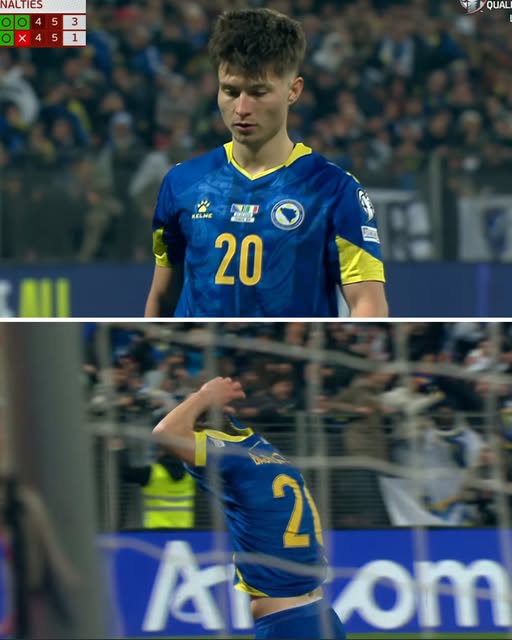
Appleton, Wisconsin may not be the first place most people think of when discussing world-class soccer talent, but last night, the city found itself firmly on the global football map. Esmir Bajraktarevic, a 21-year-old midfielder with a remarkable combination of skill, composure, and vision, etched his name into soccer history by netting the decisive penalty that sent Bosnia and Herzegovina to the 2026 FIFA World Cup. It was a moment that reflected not just his talent but years of dedication, growth, and perseverance, and it sparked celebrations that stretched far beyond the stadium and across continents, uniting fans from the United States, Europe, and the Balkans in shared admiration. The significance of the goal extends well beyond the immediate euphoria; it is a culmination of a journey that began in MLS academies, blossomed in European leagues, and now reaches its zenith on the world stage.
Bajraktarevic’s journey to this historic moment is a story of ambition, discipline, and adaptation. Born and raised in Appleton, Wisconsin, he was surrounded by the modest landscapes of the Midwest, far from the bustling football academies of Europe that often dominate the early stages of a professional player’s career. Yet even in these humble surroundings, his talent was apparent from a young age. Coaches quickly recognized his technical ability, spatial awareness, and an innate sense for reading the game—qualities that distinguished him from his peers. Early on, it was clear that Bajraktarevic was not content to simply excel locally; he had his sights set on much larger stages. His path would take him through the rigorous systems of American soccer development, where the foundations of discipline, athleticism, and tactical intelligence were laid.
Graduating from the New England Revolution academy, Bajraktarevic honed his skills in an environment designed to prepare young athletes for professional careers, not just domestically but with an eye toward international play. The academy system emphasized more than just technical proficiency; it instilled resilience, teamwork, and the mental fortitude necessary to navigate the pressures of elite competition. For a young player, these lessons are crucial, as the journey from academy prospect to professional star is fraught with challenges, including competition for playing time, adaptation to higher levels of physicality, and the need to consistently perform under scrutiny. Bajraktarevic excelled, combining the technical skills he developed in his youth with a maturity and poise that belied his age. By the time he caught the attention of European scouts, he was already prepared to make the leap to one of Europe’s most competitive leagues.
The transition to PSV Eindhoven, the reigning Dutch champions, was a pivotal step in Bajraktarevic’s career. Moving from MLS’s developmental structures to the professional European scene demands more than talent—it requires rapid adaptation to faster-paced games, tactical nuance, and the intense scrutiny of fans and media. In the Netherlands, Bajraktarevic found an environment that both challenged and nurtured him, allowing him to grow into a well-rounded, highly intelligent midfielder capable of influencing games at the highest level. His ability to read the game, control tempo, and execute precise passes became increasingly evident, and his development at PSV positioned him as a rising star in European football. The experience also provided a critical bridge between his early soccer foundations in the United States and the global stage of international competition, proving that American-trained players could compete and excel in top-tier European leagues.
The 2026 World Cup qualifying campaign for Bosnia and Herzegovina brought a new kind of pressure and opportunity. Representing a country with passionate fans and high expectations, Bajraktarevic assumed a role that demanded both skill and composure under intense scrutiny. International soccer often presents unique challenges compared to club play, including limited time for training, high-pressure matches that determine qualification, and the need to integrate quickly with teammates from diverse systems and styles. Bajraktarevic navigated these challenges with remarkable professionalism. His technical ability, combined with mental resilience, allowed him to contribute not only in build-up play and midfield control but ultimately in moments of decisive action, such as the penalty shootout that would secure Bosnia and Herzegovina’s spot in the 2026 World Cup.
The penalty itself was a moment of tension, drama, and ultimate triumph. In a stadium charged with anticipation, with the eyes of fans worldwide fixed on the proceedings, Bajraktarevic approached the spot with calm determination. Every step, every breath, and every movement was measured, reflecting both meticulous preparation and instinctual confidence. Striking the ball cleanly past the goalkeeper, he secured not just a win for the match but the continuation of a dream shared by an entire nation. For Bosnia and Herzegovina, qualification is the reward for years of dedication and a testament to the country’s rich footballing culture. For Bajraktarevic personally, it was the culmination of a journey from Appleton to Europe to international glory—a journey marked by hard work, adaptability, and an unwavering commitment to excellence.
The broader significance of Bajraktarevic’s achievement cannot be overstated. He is an example of the increasing globalization of soccer talent, demonstrating that players raised in nontraditional footballing regions like the American Midwest can reach the highest levels of the sport. His success also highlights the importance of player development pathways that connect local academies with international opportunities. By bridging MLS development with European professional leagues, Bajraktarevic represents a new model for aspiring young players who dream of competing on the world stage. His story inspires not just American soccer fans but also youth players globally, showing that talent combined with dedication and strategic career decisions can lead to remarkable achievements.
The celebrations following the penalty were a mixture of elation, relief, and respect for the intensity of the moment. Teammates embraced him, fans erupted in the stands, and social media lit up with hashtags celebrating both the player and the nation’s qualification. Analysts praised his composure under pressure, noting that few 21-year-olds could execute such a critical penalty with the calm precision he displayed. The achievement was simultaneously a personal milestone and a collective victory, uniting players, coaches, and supporters in a shared moment of pride. Such events have a way of transcending sport, becoming cultural touchstones that fans remember for years and passing down a narrative of national achievement, personal dedication, and athletic excellence.
Looking ahead to the World Cup, Bajraktarevic’s role will only grow in significance. At 21, he represents both the present and the future of Bosnia and Herzegovina’s national team. His performances in Europe have already shown his capacity to influence matches at the highest level, and now, with the global spotlight of the World Cup, he has the opportunity to cement his reputation as one of the brightest young talents in world soccer. His combination of technical skill, tactical intelligence, and mental composure under pressure positions him to be a key figure not only in midfield orchestration but also in moments of decisive action that could define the team’s tournament. The experience of qualifying, particularly through a high-stakes penalty, will likely bolster his confidence, preparing him for the challenges and intensity of World Cup competition.
Bajraktarevic’s journey also emphasizes the interconnectedness of global soccer. His development in the United States, his professional refinement in the Netherlands, and his international representation of Bosnia and Herzegovina illustrate the increasingly international pathways that define modern football careers. Talent knows no borders, and Bajraktarevic’s story is a testament to the opportunities available to players willing to pursue their goals with dedication, adaptability, and focus. It highlights the importance of scouting, development academies, and professional clubs in providing young players with the tools to succeed on both domestic and international stages.
The Appleton community, too, has a reason to celebrate. Local youth programs, soccer fans, and aspiring athletes see in Bajraktarevic a reflection of what can be achieved with commitment and support. From neighborhood pitches to MLS academies, his path serves as a model of perseverance and ambition. It underscores the notion that even players from smaller cities or nontraditional footballing regions can achieve greatness on the global stage. For young athletes in Wisconsin and across the United States, his story provides both inspiration and a blueprint for pursuing professional soccer careers that transcend national boundaries.
Beyond the field, Bajraktarevic’s accomplishment carries symbolic significance. His penalty goal is a moment that connects communities, celebrates international identity, and showcases the universality of sport. Soccer, with its ability to unify fans across cultures, languages, and borders, finds in Bajraktarevic a figure who embodies both personal achievement and collective pride. The goal represents years of preparation, but it also represents hope for future generations—hope that hard work, talent, and opportunity can combine to create extraordinary moments. In an age where sports stories are widely shared and celebrated, his achievement becomes part of the shared narrative of global football culture.
As Bosnia and Herzegovina look ahead to the 2026 World Cup, expectations will be high. Every qualified nation faces the dual pressure of representing its fans and competing against some of the world’s most elite squads. Bajraktarevic, still early in his career, is poised to play a central role. His technical skill, vision on the ball, and ability to perform under pressure make him an indispensable asset for the team. The confidence gained from delivering in the qualification campaign, particularly through such a decisive moment, will likely carry forward into the tournament, where each match will demand focus, resilience, and precision. His ability to rise to these occasions will be closely watched by fans, media, and competitors alike.
Finally, Bajraktarevic’s story is a reminder of the personal dimension behind athletic achievements. Every goal, assist, and pass reflects countless hours of practice, moments of doubt, and a commitment to continuous improvement. Behind the scenes are sacrifices, late nights, rigorous training, and an unwavering belief in one’s own abilities. Achievements like the penalty that sent Bosnia and Herzegovina to the World Cup are the culmination of these elements, transforming hard work and preparation into tangible success on the global stage. For Bajraktarevic, last night was not just a career highlight—it was a testament to a journey defined by ambition, perseverance, and resilience.
In conclusion, Esmir Bajraktarevic’s game-winning penalty is far more than a goal; it is a celebration of talent, determination, and the fulfillment of dreams that span continents and cultures. From Appleton, Wisconsin to the Dutch champions PSV, and now to the international stage with Bosnia and Herzegovina, his trajectory exemplifies the modern footballer’s journey, blending personal ambition with national pride. At just 21 years old, he has already achieved a milestone that many players spend entire careers chasing, and the World Cup awaits as the next stage in his remarkable story. Fans around the world, from the United States to Bosnia and Herzegovina, will remember the night he took the decisive penalty, not just as a moment of triumph but as a symbol of what talent, dedication, and perseverance can achieve. His story continues, and the 2026 World Cup promises to be the next chapter in the rise of one of soccer’s brightest young stars.