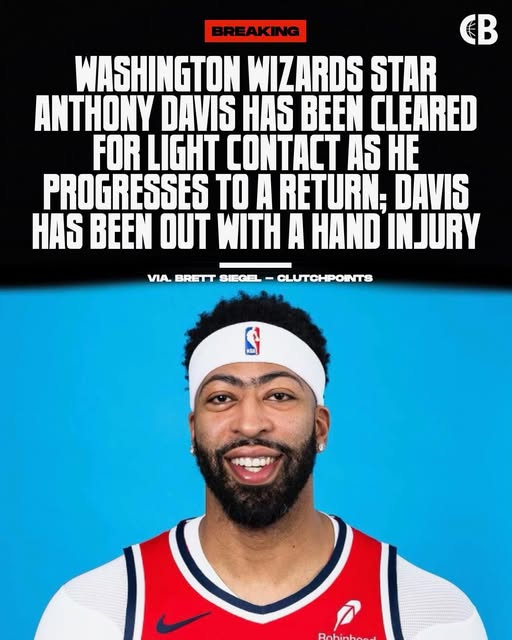
Breaking news out of the NBA has fans watching closely as Anthony Davis, the star big man for the Washington Wizards, has officially been cleared for light contact as he continues progressing toward a full recovery. After months of rehabilitation following ligament damage in his left hand, this development signals a meaningful step forward in what has been a long and carefully managed recovery process. With only seven games remaining in the 2025–26 NBA season, the question now dominating conversations across the league is simple but significant: will Davis make his return before the season concludes, or will the Wizards opt to hold him out until he is completely healthy?
To understand the weight of this moment, it’s important to look at the timeline of Davis’ injury and recovery. The injury occurred on January 8, sidelining him during a critical stretch of the season. Ligament damage, particularly in the hand, is no minor setback for a player of Davis’ profile. As a dominant interior presence who relies on touch, grip strength, and control for everything from rebounding to finishing at the rim, any injury to the hand can significantly impact performance. Since that point, the Wizards’ medical staff has taken a cautious approach, ensuring that every phase of his rehabilitation was handled with precision. The clearance for light contact suggests that Davis has progressed beyond basic conditioning and non-contact drills and is now entering the final stages of recovery, where real basketball activity begins to simulate game conditions.
For a player like Davis, whose impact extends across scoring, defense, rebounding, and overall presence, returning too early carries risks that go beyond just physical health. His game is built on physicality—battling in the paint, contesting shots, securing rebounds in traffic—and all of those actions place stress on the hands and fingers. Even a slight limitation could affect his ability to catch passes cleanly, finish through contact, or protect the ball in tight spaces. That is why “light contact” is such a crucial milestone. It allows the coaching staff and medical team to evaluate how his hand responds under controlled physical pressure, gradually increasing intensity while monitoring for setbacks.
At the same time, the context of the Wizards’ season plays a major role in determining whether Davis will return. With just seven games left, the margin for reintegration is narrow. Bringing a player back into the lineup requires not only physical readiness but also rhythm, conditioning, and chemistry with teammates. Even for a player of Davis’ caliber, jumping straight into game action after an extended absence can be challenging. There is a difference between being medically cleared and being fully game-ready, and teams must weigh that distinction carefully. The Wizards will need to consider whether a limited return—potentially with restricted minutes—would benefit the team or disrupt the flow they have established in his absence.
Another factor to consider is the long-term outlook. Davis is not just a short-term contributor; he is a cornerstone player whose health is vital for future success. Rushing him back for the final stretch of a season that may or may not have playoff implications could be a risky decision. Organizations often prioritize long-term stability over immediate gains, especially when dealing with injuries that could be aggravated by premature return. If there is any doubt about the strength or durability of his hand, the safer route would be to continue his recovery into the offseason, allowing him to return at full strength for the next campaign.
However, the competitive nature of both the player and the league cannot be ignored. Anthony Davis has built a reputation as a fierce competitor, someone who wants to be on the court whenever possible. For players of his stature, sitting out while the team competes can be mentally challenging. The desire to contribute, to help teammates, and to finish the season strong is a powerful motivator. If Davis feels confident in his recovery and the medical staff agrees that the risk is minimal, there is a strong possibility that he will push for a return, even if only in a limited role.
From a strategic standpoint, even a partial return could provide benefits. Davis’ presence alone changes how opponents approach the game. Defensively, he anchors the paint, deters drives, and alters shots without necessarily recording a block. Offensively, he draws attention, creating space for perimeter players and opening up scoring opportunities. Even if he is not at full capacity, his impact could be felt in subtle but meaningful ways. The coaching staff could use him in specific situations—defensive possessions, key stretches, or matchups where his size and skill offer a clear advantage—without overextending his workload.
Yet, there is also the question of timing and rhythm. Seven games is not a long runway for a player to regain form, especially after missing a significant portion of the season. Basketball is a game of timing, coordination, and instinct, all of which are sharpened through consistent play. Returning too late in the season may not provide enough time for Davis to find his rhythm, potentially limiting his effectiveness. In such cases, teams sometimes choose to prioritize recovery and preparation for the next season rather than forcing a return that may not yield meaningful results.
The uncertainty surrounding his return also highlights the broader challenges of injury management in professional sports. Advances in medical science have improved recovery timelines and outcomes, but each injury remains unique. Ligament damage, particularly in a high-use area like the hand, requires careful monitoring. The transition from rehabilitation to game action is one of the most delicate phases, as it tests not only physical healing but also confidence and comfort. Players must trust their bodies again, and that trust is built gradually through controlled exposure to game-like situations.
For fans, the anticipation of Davis’ potential return adds an extra layer of intrigue to the closing stretch of the season. Every update, every practice report, every hint from the coaching staff becomes a point of discussion. The question “Will AD be back this season?” is not just about one player; it’s about hope, momentum, and the possibilities that his presence could unlock. Even in a limited timeframe, a player of his caliber can shift narratives, influence outcomes, and provide moments that resonate beyond the standings.
Ultimately, the decision will come down to a combination of medical evaluation, team strategy, and player readiness. The Wizards have not officially ruled him out, which keeps the door open. The clearance for light contact is a positive sign, indicating progress and potential. But the final step—from light contact to full game participation—is significant and cannot be rushed. The organization will need to balance optimism with caution, ensuring that any decision aligns with both immediate goals and long-term priorities.
In the end, whether Anthony Davis returns this season or not, this moment underscores the complexity of managing elite athletes. Recovery is not just about healing; it is about timing, judgment, and understanding the bigger picture. For Davis, this is another chapter in a career that has seen both brilliance and adversity, a reminder of the physical demands of the game and the resilience required to overcome them. For the Wizards, it is a test of decision-making, balancing the excitement of a potential return with the responsibility of protecting one of their most valuable players.
As the final games approach, all eyes will remain on Davis and his progress. Each step forward brings him closer to a return, but the ultimate decision will hinge on whether that return makes sense in the context of the season. The possibility is there, the progress is real, and the anticipation is undeniable. Whether he steps back onto the court in the coming days or continues his recovery into the offseason, one thing is certain: when Anthony Davis is ready, his impact will once again be felt in a way that only a player of his caliber can deliver.