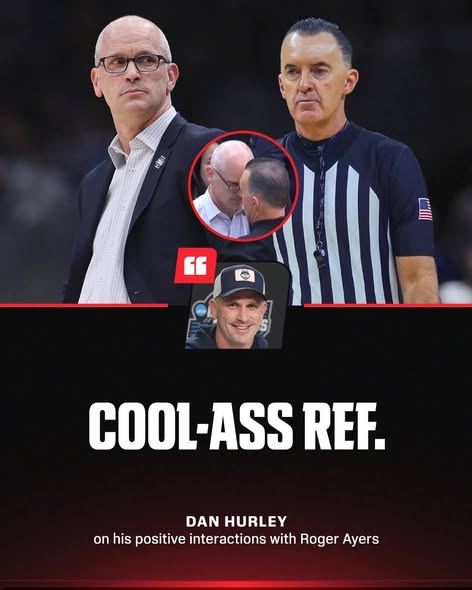
Dan Hurley, the head coach of the University of Connecticut men’s basketball team, recently made a statement that drew attention and sparked conversations among fans, analysts, and the broader college basketball community. In explaining a particular incident during a game, Hurley stated that he believed the referee simply wanted to celebrate the victory over Duke with a chest bump. At first glance, the comment might seem lighthearted, even humorous, but it opens the door to deeper discussions about officiating, sportsmanship, perception, and the nuanced relationships between coaches, referees, and players. Sports, particularly at the collegiate level, is rife with intensity, emotion, and high stakes, and even seemingly small actions can have outsized implications for how games are perceived, remembered, and analyzed. Hurley’s comment, with its blend of humor and incredulity, illustrates the human side of basketball, reminding fans that even amidst competition, the personalities and interactions off the ball are just as compelling as the action on it.
The context of Hurley’s remark is critical to understanding its significance. In a high-stakes game, where every call, decision, and possession is magnified, coaches and players are hyper-aware of the referee’s influence. College basketball is particularly known for its emotional intensity; referees must manage not only the technical rules of the game but also the passions, strategies, and personalities of student-athletes and coaching staff. In such an environment, even small gestures—a nod, a smile, a handshake—can be interpreted in multiple ways. Hurley’s interpretation of the chest bump as celebratory rather than partisan underscores the need to consider the human and social elements that accompany officiating. While the comment might appear humorous on the surface, it also subtly emphasizes the importance of perspective: what seems like an innocuous action to one person may be viewed differently by another, particularly in the heat of competition.
From a broader perspective, Hurley’s statement highlights the complex relationship between coaches and referees. Coaches often walk a fine line between advocating for their teams, challenging calls, and maintaining professionalism. Humor and levity can serve as tools to diffuse tension, build rapport, or frame a potentially contentious incident in a less confrontational light. By attributing the chest bump to a celebratory impulse rather than a deliberate favoritism, Hurley navigates the delicate terrain of post-game commentary. He avoids overt criticism of the referee while still acknowledging the unusual nature of the interaction, demonstrating both awareness of the situation and a strategic approach to public statements. In collegiate athletics, where reputation, media scrutiny, and institutional relationships all play crucial roles, such framing can be as impactful as the games themselves.
Hurley’s remark also sheds light on the performative aspects of sports officiating. Referees, like players and coaches, operate under intense scrutiny, and their actions are constantly analyzed, dissected, and debated. Celebratory gestures, even those intended as neutral or playful, can be magnified in perception when observed by tens of thousands of fans, broadcast audiences, and social media communities. The chest bump, in this context, becomes more than a simple gesture—it is a moment that invites interpretation, commentary, and even controversy. Hurley’s comment, by framing it as celebratory rather than controversial, reflects an understanding of the social dynamics at play. He acknowledges the human element in officiating while simultaneously diffusing potential tension, allowing the narrative to focus on the achievement of victory rather than the mechanics of the gesture.
Additionally, Hurley’s statement provides insight into the culture of collegiate sports. College basketball, in particular, combines high-level competition with a strong emphasis on tradition, relationships, and community. Coaches, players, and officials are often part of interconnected networks, and interactions on and off the court carry social weight. A chest bump, while seemingly trivial, can symbolize camaraderie, mutual respect, or even playful rivalry. By interpreting the gesture as celebratory, Hurley highlights the human dimension of sports, where emotions, relationships, and gestures matter alongside scores, statistics, and strategy. This perspective encourages fans and analysts to consider the broader context in which games unfold, recognizing that sports are as much about interpersonal dynamics as they are about technical execution.
The comment also illustrates the role of humor and narrative framing in coaching communication. Coaches frequently use media interactions to shape public perception, motivate teams, or manage expectations. Humor can be a strategic tool, allowing coaches to address unusual situations without creating unnecessary controversy. Hurley’s framing of the chest bump as celebratory accomplishes multiple objectives: it humanizes the interaction, reduces potential tension, and reinforces the positivity of the game’s outcome. Moreover, it reflects a nuanced understanding of audience perception, acknowledging that fans and commentators are keenly attuned to the actions of referees and coaches alike. By presenting the incident in a lighthearted manner, Hurley controls the narrative, guiding attention toward the team’s victory and away from potential criticism or misinterpretation.
Hurley’s remark also opens a conversation about perception versus intention in sports. In competitive settings, the same action can be interpreted in vastly different ways depending on context, perspective, and bias. Fans may perceive the chest bump as favoritism or a breach of neutrality, while Hurley frames it as a natural expression of enthusiasm. This disparity between perception and intention is a recurring theme in sports commentary, where gestures, expressions, and interactions are scrutinized under intense public observation. Hurley’s interpretation underscores the importance of empathy, context, and nuance in understanding sports events, reminding observers that not all unusual moments are motivated by malice, bias, or controversy.
From a psychological standpoint, gestures like chest bumps also carry symbolic weight. In sports, they can signal encouragement, celebration, or acknowledgment of effort. Hurley’s acknowledgment of the gesture as celebratory highlights the social and emotional functions that such interactions serve. They reinforce human connection, signal acknowledgment of achievement, and provide a non-verbal language that complements the technical rules of the game. In this sense, Hurley’s framing aligns with broader principles of sports psychology, where recognition, celebration, and emotional engagement are critical components of team culture and performance. By interpreting the chest bump positively, Hurley reinforces the importance of emotional intelligence and perspective in managing high-stakes environments.
The statement also demonstrates Hurley’s communication style, which blends humor, humility, and insight. By framing a potentially awkward or controversial incident in a humorous, human-centered way, he models effective media engagement, balancing candor with diplomacy. Coaches who can navigate these interactions effectively often build trust with players, fans, and officials, while mitigating unnecessary criticism or misinterpretation. Hurley’s comment, in essence, exemplifies the art of framing narratives in sports, where the language used to describe events can shape perception, sentiment, and broader cultural narratives around games and competitions.
Moreover, the comment underscores the unpredictable and often amusing elements of live sports. No matter how carefully games are planned and rehearsed, spontaneous interactions, gestures, and expressions frequently emerge, creating moments that captivate audiences. Hurley’s acknowledgment of the chest bump captures this unpredictability, highlighting how sports combine skill, strategy, and human emotion in ways that produce memorable, sometimes quirky moments. Fans are drawn to these incidents precisely because they are unexpected, blending the seriousness of competition with the humor and humanity of the participants. In this context, Hurley’s comment provides a lens through which the audience can appreciate the lighter, more human side of high-stakes sports.
Hurley’s framing of the chest bump as celebratory also carries pedagogical implications. For coaches, players, and officials, it serves as a reminder that sportsmanship, empathy, and perspective are integral to the culture of competition. Recognizing the intentions behind actions, rather than reacting solely to appearances, can reduce conflict, enhance collaboration, and promote mutual respect among participants. Hurley’s comment thus functions as both a narrative about a specific event and a broader lesson about understanding, interpretation, and communication within competitive environments. It models how humor, insight, and empathy can coexist with seriousness, strategy, and high performance.
Finally, Hurley’s comment contributes to the cultural narrative surrounding basketball, officiating, and coaching. It exemplifies how seemingly small moments—gestures, expressions, interactions—can resonate far beyond the immediate context. Fans, analysts, and commentators dissect such moments, creating stories, debates, and discussions that enrich the experience of sports. By framing the chest bump as celebratory, Hurley not only diffuses potential controversy but also invites a conversation about perspective, human behavior, and the multi-dimensional nature of competitive sports. It reinforces the idea that sports are not merely technical contests but arenas where personality, emotion, and social dynamics play a central role in shaping experiences, perceptions, and histories.
In conclusion, Dan Hurley’s statement that he believed the referee simply wanted to celebrate the victory over Duke with a chest bump is a moment rich in meaning, humor, and insight. It highlights the human side of sports, the complexity of interpreting gestures and interactions, and the importance of framing and perspective in media commentary. Beyond the immediate event, it offers lessons about empathy, communication, and the emotional dynamics of competitive basketball. Hurley’s comment reminds fans and participants alike that sports are as much about relationships, perception, and shared human experience as they are about points, statistics, and victories. By interpreting a curious gesture in a positive, celebratory light, Hurley underscores the value of humor, perspective, and understanding in navigating the unpredictable, high-pressure world of collegiate athletics, creating a narrative that resonates both on and off the court, and providing an enduring example of grace, insight, and levity in the face of unexpected moments.