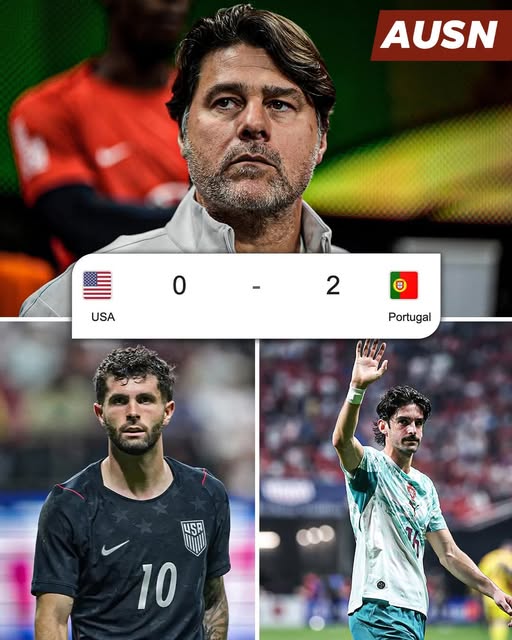
The United States Men’s National Team (USMNT) recently faced a challenging stretch of international friendlies, culminating in a 2-0 loss to Portugal. This defeat came on the heels of a 5-2 setback against Belgium just days earlier, marking a turbulent conclusion to the USMNT’s pre-World Cup international window. Both matches were played on home soil, adding to the surprise and disappointment felt by fans and analysts alike. These results have prompted widespread discussion about the team’s preparedness, tactical approach, and psychological readiness as they head into the highly anticipated tournament. While friendlies are traditionally seen as opportunities to experiment with lineups and strategies, consecutive losses—particularly with the margin of defeat seen against Belgium—raise legitimate concerns regarding both the team’s defensive solidity and its offensive cohesion.
The 2-0 loss to Portugal showcased several key aspects of the USMNT’s current form, both positive and negative. Defensively, the team struggled to contain Portugal’s skilled attackers, who utilized quick passing, precise positioning, and individual flair to create scoring opportunities. Portugal’s ability to break lines and exploit gaps highlighted structural vulnerabilities in the U.S. backline. Communication, spacing, and positional awareness—critical components of modern defensive play—appeared inconsistent at times, leaving openings that Portugal capitalized on. For coaches, analysts, and fans, this match reinforced the notion that while the U.S. has talent and athleticism, translating that into disciplined, organized defensive play at the international level remains a work in progress.
Offensively, the USMNT showed flashes of creativity but struggled to convert opportunities into goals. In high-level international matches, finishing is a decisive factor, and the inability to capitalize on scoring chances often proves costly. Against Portugal, the U.S. generated some promising sequences, particularly through wing play and transitional attacks, yet lacked the clinical edge needed to threaten a team of Portugal’s caliber consistently. This reflects a combination of factors: decision-making under pressure, timing of runs, and execution in the final third. For players and coaches, these moments of offensive promise offer both hope and frustration—a reminder of potential that has yet to be fully realized in high-stakes scenarios.
The context of these losses is particularly relevant given their proximity to the World Cup. The pre-tournament international window serves multiple purposes: refining tactics, building team chemistry, and simulating competitive conditions against elite opponents. While friendly matches do not carry points or rankings, they offer insights into player performance, cohesion, and resilience under pressure. Consecutive losses, therefore, provide critical data points for coaching staff, highlighting areas that require adjustment before the tournament’s opening matches. Tactical shifts, player selection, and defensive organization are likely to be reassessed in light of the challenges faced against Belgium and Portugal, ensuring the team can present its strongest version on the world stage.
The 5-2 defeat against Belgium, in particular, drew significant attention due to both the margin of defeat and the high-profile nature of the opponent. Belgium, ranked among the top national teams globally, presented a formidable challenge, testing the U.S. across multiple dimensions: defensive positioning, transitional play, and offensive efficiency. Conceding five goals on home soil underscored weaknesses in defensive structure and response to sustained pressure. Simultaneously, scoring two goals demonstrated that the U.S. has the capability to create high-quality chances and finish against elite opposition. Taken together, these results suggest a team in development—talented but still refining the tactical and mental cohesion required to succeed consistently at the international level.
Psychologically, back-to-back losses can affect player confidence and team morale. Confidence is a critical component in international competition, where matches are often decided by fine margins. Players may begin to question tactical instructions, individual positioning, or collective strategy after repeated setbacks. Coaches, therefore, play a vital role in managing not only technical adjustments but also the mental state of the squad. Leadership, both from the coaching staff and senior players on the field, becomes crucial in maintaining focus, motivation, and belief ahead of the World Cup. While losses can shake confidence, they can also serve as valuable lessons, providing clarity on what adjustments are necessary and highlighting the areas in which the team must improve to compete with the world’s best.
The U.S. squad also faces scrutiny regarding player selection and roster depth. Friendlies offer opportunities to test new players and evaluate combinations that might be used during the World Cup. While some players showed promise in these matches, others struggled to assert influence, leaving questions about the optimal lineup and tactical approach. The coaching staff will likely use these games to make final decisions regarding starting roles, positional assignments, and substitute strategies. Balancing veteran experience with emerging talent is a recurring challenge in tournament preparation, and the results against Belgium and Portugal provide essential insights into how different players respond under pressure and how they contribute to team dynamics.
Tactically, these matches exposed both strengths and vulnerabilities in the USMNT’s approach. Portugal and Belgium are both technically skilled, disciplined teams with experience competing at the highest levels of international football. Their ability to maintain possession, exploit spaces, and pressure the U.S. defenders created scenarios that tested every aspect of the American team’s tactical setup. Adjustments in formation, pressing strategy, and transitional defense are likely to be a focus for coaches in the lead-up to the World Cup. Conversely, the U.S. demonstrated potential in transitional attacks, high-energy pressing, and wing play—elements that, if refined and executed consistently, could provide a foundation for success in the tournament.
Another consideration is the role of home-field advantage and crowd expectation. Both matches were played on U.S. soil, theoretically providing the team with familiarity, comfort, and fan support. However, playing at home can also add pressure, as expectations for performance are heightened. The combination of elite opposition and high stakes creates an environment where mistakes are magnified, and momentum can shift quickly. Understanding how players respond to these pressures is critical for tournament preparation, as the World Cup will present similar challenges on an even larger stage. Managing psychological stress, maintaining composure, and executing under pressure are as vital as tactical adjustments in achieving success.
Looking at the broader implications, these friendly losses serve as both a warning and an opportunity. They highlight areas of vulnerability that could be exploited by other top-tier teams while simultaneously providing clear guidance on where improvement is needed. The coaching staff can analyze patterns, identify weaknesses, and implement targeted training sessions to address specific issues. Similarly, players gain firsthand experience against world-class competition, learning to adapt to the speed, precision, and tactical sophistication they will face during the World Cup. These matches, while disappointing in outcome, function as critical preparation tools that could ultimately strengthen the team if lessons are effectively applied.
Media coverage and public reaction also play a significant role in shaping the narrative around these results. Fans and analysts alike scrutinize every aspect of performance, from tactical decisions to individual player contributions. Social media amplifies both praise and criticism, creating a dynamic in which public perception can influence the team’s confidence and pressure levels. While losses inevitably generate criticism, they also prompt constructive analysis, conversation, and engagement with the sport. The discourse surrounding these matches contributes to the cultural and emotional fabric of U.S. soccer, highlighting the passion and investment that fans bring to the national team.
Ultimately, the USMNT’s losses to Belgium and Portugal underscore the challenges of competing at the highest level of international football. The team possesses talent, athleticism, and potential, but achieving consistency against elite opponents requires refinement, cohesion, and mental resilience. The results serve as a reality check, emphasizing the importance of tactical discipline, defensive organization, and offensive execution. At the same time, they provide valuable learning experiences that can inform preparations for the World Cup, offering insights into player performance, team dynamics, and strategic adjustments.
As the USMNT moves forward from this international window, the focus will likely shift toward integrating lessons learned, solidifying tactical approaches, and building team chemistry. Coaches must balance critique with encouragement, ensuring that players remain confident while addressing areas of vulnerability. Players, in turn, will need to internalize feedback, refine execution, and maintain focus on the broader goal of competing successfully on the world stage. While the losses are disappointing, they are not definitive; they represent a critical stage in preparation, highlighting both challenges and opportunities for growth.
In conclusion, the USMNT’s 2-0 loss to Portugal, following a 5-2 defeat against Belgium, marks a sobering end to a challenging pre-World Cup international window. Both results highlight tactical vulnerabilities, defensive lapses, and the need for offensive efficiency, while also providing insights into player performance, team cohesion, and psychological readiness. These matches offer valuable lessons for coaches and players, emphasizing the importance of preparation, adaptation, and resilience. As the team shifts focus toward the World Cup, the experiences gained from these friendlies—though difficult—can serve as a foundation for refinement, strategic planning, and ultimately, competitive success. While fans may be frustrated by the results, the critical takeaway is that the lessons learned, if properly applied, could strengthen the USMNT as they step onto the global stage, prepared to compete against the world’s elite and represent their country with skill, strategy, and determination.