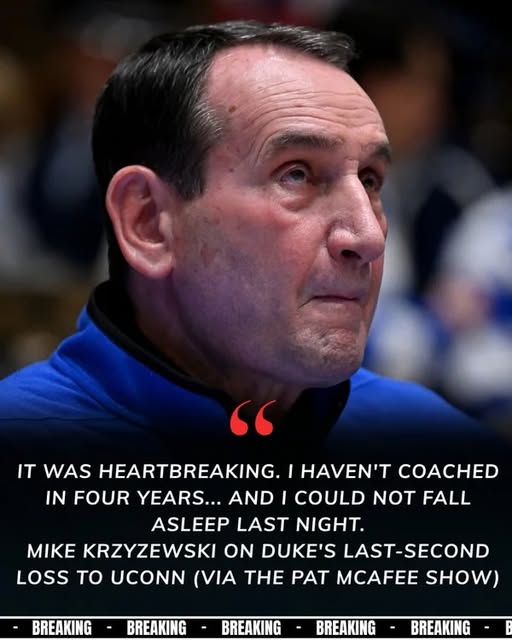
Mike Krzyzewski has seen just about everything the sport of college basketball can offer. Over a Hall of Fame career that spanned more than four decades, the former Duke Blue Devils head coach built a legacy defined by poise, preparation, and an almost unmatched ability to manage the emotional swings of high-stakes competition. Yet even in retirement, far removed from the sideline, the game still finds ways to reach him in deeply personal ways. That was evident after Duke’s stunning late-game collapse against the UConn Huskies in the Elite Eight, a loss that left Krzyzewski restless long after the final buzzer had sounded.
For someone like Krzyzewski, basketball has never been just a profession. It is a lens through which he understands discipline, leadership, and human resilience. Watching Duke surrender control in such a critical moment wasn’t merely disappointing in the abstract; it struck at the core of principles he spent a lifetime instilling. Even without direct responsibility for the outcome, the emotional investment remained intact. That kind of connection doesn’t simply disappear when a coach steps away from the bench.
The game itself had all the elements of a classic tournament battle. Duke, youthful yet immensely talented, had built a lead that seemed sturdy enough to withstand late pressure. Their offense flowed with confidence, their defense rotated with purpose, and for long stretches they looked like the more composed team. But as the clock wound down, momentum began to shift. UConn, battle-tested and relentless, chipped away possession by possession. What had once been a comfortable cushion became fragile, then fleeting, and finally nonexistent.
Krzyzewski, watching from afar, likely recognized the subtle signs before the collapse fully materialized. Experienced coaches develop an instinct for these moments—the slight hesitation in a player’s decision-making, the rushed shot that signals creeping anxiety, the defensive lapse that hints at mental fatigue. These are the details that don’t always stand out to casual viewers but can feel glaring to someone who has spent decades dissecting the game.
When Duke’s execution faltered in the closing minutes, it wasn’t just about missed shots or defensive breakdowns. It was about composure under pressure, a quality Krzyzewski emphasized relentlessly during his tenure. He often spoke about the importance of “next play mentality,” the ability to remain present regardless of what just happened. In the Elite Eight matchup, that mental discipline appeared to waver at the worst possible time.
For Krzyzewski, the inability to sleep after the game speaks volumes about how deeply he still cares—not only about the program but about the players themselves. Coaches at his level don’t view athletes as interchangeable pieces. They see individuals navigating intense emotional terrain, especially in the NCAA tournament where a single loss ends a season. Watching young players experience that kind of heartbreak can be difficult, particularly for someone who understands exactly what they’re going through.
It’s also worth considering how perspective changes after retirement. During his active years, Krzyzewski would have immediately shifted into problem-solving mode after a loss—reviewing film, analyzing decisions, preparing adjustments. There was always a sense of forward motion, another practice to run, another game to prepare for. But as a spectator, he no longer has that outlet. The lack of control can make the emotional impact even more pronounced. Instead of channeling frustration into action, he’s left to sit with it.
That helplessness can be unsettling for someone who built a career on influence and leadership. Krzyzewski’s teams were known for their structure and clarity in high-pressure situations. He cultivated an environment where players understood not just what to do, but why they were doing it. Seeing a breakdown in those areas—especially in a program he helped shape—can feel personal, even if he’s no longer directly involved.
The loss also underscores the razor-thin margins that define success in March Madness. The difference between advancing to the Final Four and going home often comes down to a handful of possessions. A missed free throw, a defensive miscommunication, a rushed decision—each moment carries amplified weight. For a coach like Krzyzewski, who has been on both sides of those outcomes, the unpredictability of the tournament is both its greatest allure and its harshest reality.
In many ways, this reaction reveals the enduring bond between Krzyzewski and Duke basketball. Programs with rich traditions are built not just on wins and championships, but on shared identity. Even after stepping away, he remains part of that identity. The players may change, the coaching staff may evolve, but the foundational culture persists. When the team struggles in a pivotal moment, it resonates beyond the immediate participants.
There’s also an element of empathy in Krzyzewski’s response. He knows what it’s like to be in the locker room after a devastating loss, to see players grappling with disappointment and self-doubt. He understands how quickly narratives can shift, how one game can overshadow an entire season’s worth of effort. That awareness likely contributed to his restless night, as his thoughts extended beyond the scoreboard to the human experience behind it.
At the same time, moments like this can serve as powerful learning opportunities. Krzyzewski often framed adversity as a necessary component of growth. While the loss to UConn was undoubtedly painful, it also provides a reference point for the players and coaching staff moving forward. Understanding how and why the collapse occurred can help build resilience, sharpen decision-making, and reinforce the importance of maintaining composure under pressure.
For fans, the reaction from a figure like Krzyzewski adds another layer of meaning to the game. It’s a reminder that basketball, at its highest levels, is not just entertainment. It’s a deeply emotional pursuit that connects people across generations. When someone with his experience and accomplishments admits to losing sleep over a game, it validates the intensity of those connections.
It also highlights the unique nature of the NCAA tournament. Unlike professional leagues with extended series, March Madness offers no margin for error. Every game carries the weight of finality, which amplifies both the triumphs and the heartbreaks. For a program like Duke, where expectations are consistently high, the pressure can be particularly intense. Navigating that environment requires not just skill, but emotional fortitude.
Krzyzewski’s comments may also reflect a broader truth about leadership: stepping away doesn’t necessarily mean letting go. The habits, values, and emotional investments developed over a lifetime don’t simply fade. They remain active, shaping how one perceives and reacts to events even from a distance. In this case, they manifested in a sleepless night, a testament to how much the game—and Duke basketball—still matters to him.
Ultimately, the loss to UConn will become part of the program’s ongoing story, one chapter among many in a long and storied history. For the current players, it will likely serve as a defining moment, one that influences their development both on and off the court. For Krzyzewski, it’s another reminder of the game’s capacity to evoke powerful emotions, even after a career filled with championships and accolades.
The image of a retired coaching legend lying awake, replaying the final minutes of a game he didn’t coach, is both poignant and revealing. It speaks to the enduring nature of passion, the difficulty of detachment, and the profound impact that sports can have on those who dedicate their lives to them. In a way, it’s fitting. Basketball gave Krzyzewski a lifetime of purpose and connection, and even now, it continues to challenge and move him in unexpected ways.
That restless night, shaped by a game he could not influence, may have been frustrating. But it also reflects something deeper: a lifelong commitment to excellence, a genuine care for the people involved, and an unwavering belief in the values the game represents. Those qualities don’t disappear with retirement. If anything, they become even more visible in moments like this, when the only role left is that of a passionate observer, still fully invested in every possession.