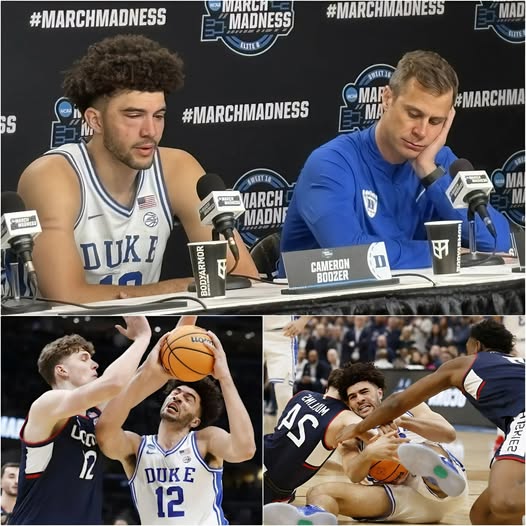
The arena had already begun to empty when the weight of the moment finally caught up with everyone. What had started as a night filled with anticipation and belief ended in a quiet, heavy disappointment that lingered in the air long after the final buzzer sounded. The loss itself was painful, but it was what came after that seemed to strike even deeper. When Coach Jon Scheyer stepped forward to speak, his voice unsteady and his emotions clearly overwhelming him, it became evident that this was about much more than a single game.
“He’s only 18 years old,” he said, pausing as he tried to compose himself. That simple statement cut through the noise, reframing everything that had just happened. In a sport where expectations can feel relentless and unforgiving, it is easy to forget the humanity behind the jerseys. Cameron Boozer, despite his talent and composure on the court, is still a teenager navigating a world that demands excellence while often offering little patience for growth.
The loss in the quarterfinals was tough for everyone connected to the program. Fans had hoped for a deeper run, analysts had predicted success, and the team itself had poured everything into preparing for that moment. When it didn’t go as planned, frustration quickly turned outward. Social media lit up with criticism, some measured but much of it harsh and deeply personal. For Boozer, who had been one of the focal points of attention all season, the spotlight intensified in a way that few people his age are equipped to handle.
Scheyer’s words revealed that what the public saw on the court was only a small part of the story. In the days leading up to the game, Boozer had been dealing with pressures and challenges that went far beyond basketball. The details weren’t shared for sympathy, but rather to provide context—an attempt to remind people that performance is never isolated from the person behind it. There are emotions, struggles, and unseen battles that don’t show up in box scores or highlight reels.
It’s easy, in the aftermath of a loss, to search for someone to blame. That instinct is as old as sports itself. But what often gets lost in that process is perspective. Boozer wasn’t just another player having an off night; he was a young man carrying expectations that have followed him for years. From the moment he began to attract national attention, every game became a measuring stick, every mistake magnified. For someone still learning and growing, that kind of scrutiny can be overwhelming.
Scheyer’s emotional response spoke volumes about the kind of relationship he has with his players. Coaches are often seen as strategists or motivators, but in moments like this, they become protectors. His tears weren’t just about the loss; they were about seeing one of his players hurt, not just physically or competitively, but emotionally. It was about recognizing the toll that constant criticism can take, especially on someone so young.
The reality is that athletes at this level are asked to mature quickly. They are placed in high-pressure environments, expected to perform consistently, and judged publicly in ways that most people will never experience. For Boozer, the transition into that world has been swift and intense. One moment he’s a highly touted prospect, and the next he’s being dissected on national platforms, his every move analyzed and debated.
What makes this situation particularly difficult is the disconnect between expectation and understanding. Fans invest emotionally in their teams, and that passion is part of what makes sports so compelling. But when that passion turns into harsh criticism, especially directed at young players, it can cross a line. Boozer’s experience is a reminder that behind every performance is a person who feels the weight of those words.
Scheyer’s decision to speak openly about what Boozer had been going through was not about making excuses. It was about humanizing the situation. It was about asking people to pause and consider the broader picture. When he said, “He’s only 18 years old,” it wasn’t just a statement of fact—it was a plea for empathy.
For many fans, hearing those words sparked a moment of reflection. It’s one thing to critique a play or analyze a game, but it’s another to direct anger or negativity at someone who is still developing, still learning how to navigate both the sport and the attention that comes with it. Boozer’s situation has resonated because it highlights a reality that often goes unspoken: the mental and emotional challenges that accompany high-level competition.
The aftermath of the game has been difficult, but it has also created an opportunity. Conversations have shifted, at least in some spaces, toward a more compassionate perspective. People are beginning to acknowledge that growth takes time, that setbacks are part of the journey, and that young athletes deserve support as much as they do critique.
For Boozer, the road ahead will not be easy. The expectations will not suddenly disappear, and the spotlight will remain. But moments like this can also serve as turning points. They can build resilience, deepen understanding, and shape the way a player approaches both the game and the challenges that come with it. With the right support system—coaches, teammates, family—there is every reason to believe that he can emerge stronger.
Scheyer’s emotional honesty also sets an important example. In a culture that often values toughness above all else, showing vulnerability can be powerful. It sends a message that it’s okay to care deeply, that it’s okay to acknowledge when something is difficult. For a team, that kind of leadership can foster a sense of trust and unity that goes beyond wins and losses.
As the dust settles, what remains is a story that extends far beyond a single game. It’s a story about pressure, expectation, and the human side of competition. It’s about a young player learning to navigate a challenging environment, and a coach willing to stand up and remind the world that there is more to the story than what appears on the surface.
Fans will always have opinions—that’s part of what makes sports engaging. But Boozer’s experience is a reminder that those opinions carry weight. Words, especially in the digital age, can travel far and hit hard. Choosing empathy doesn’t mean abandoning passion; it means channeling it in a way that supports rather than harms.
In the end, the image that lingers is not the final score, but the sight of a coach fighting back tears as he speaks about one of his players. It’s a moment that strips away the spectacle and reveals something real and deeply human. It’s a reminder that behind every jersey is a person with hopes, fears, and a story that deserves to be understood.
Cameron Boozer’s journey is still just beginning. There will be more games, more challenges, and more opportunities to grow. What he needs now, more than anything, is patience and support. The same people who cheer for his successes have the power to uplift him in moments of difficulty. And sometimes, that support can make all the difference.
“He’s only 18 years old.” It’s a simple truth, but one that carries profound meaning. It asks us to look beyond the scoreboard, beyond the expectations, and to see the person at the center of it all. It asks for compassion in a space that doesn’t always offer it. And perhaps most importantly, it reminds us that even in the high-stakes world of college basketball, humanity should never be an afterthought.