The college basketball world has been buzzing nonstop since Isaiah Evans’ name first appeared in transfer portal conversations, sending a ripple effect through programs across the country. In an era where NIL deals have fundamentally reshaped the landscape of college athletics, top-tier talent entering the portal often signals a bidding war waiting to happen. Evans, one of Duke’s most electrifying young stars, instantly became one of the most coveted players on the market. Coaches, boosters, and collectives from powerhouse programs reportedly lined up with aggressive offers, each one more lucrative than the last, hoping to lure him away from Durham.
Evans, however, had other plans.
Behind the scenes, as speculation reached a fever pitch, the sophomore guard remained unusually quiet. No cryptic social media posts. No public flirtations with other programs. Just silence. That silence only intensified the intrigue, with insiders suggesting that the offers on the table were not just competitive—they were massive. Some reports even hinted at NIL packages that would have placed Evans among the highest-paid players in college basketball next season.
Then came the moment that shifted everything.
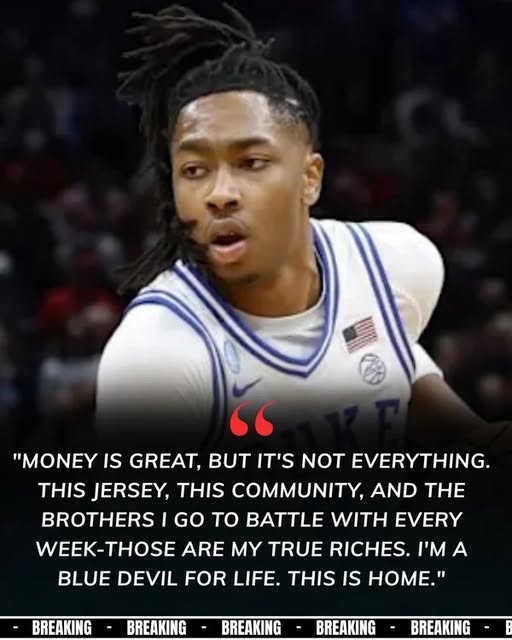
In a statement that caught fans, analysts, and rival programs completely off guard, Evans made it clear that money would not be the deciding factor in his future. Despite the eye-popping offers, he expressed a strong willingness to return to Duke, prioritizing development, team chemistry, and unfinished business over financial gain. For a player in his position, in this era, it was a rare stance—almost unheard of.
Almost immediately, the narrative changed. What was once a transfer saga driven by speculation and financial leverage suddenly became a story about loyalty, culture, and belief in a program. Duke fans, who had been bracing for the worst, erupted with excitement and admiration. Social media lit up with praise for Evans, calling him a throwback competitor and a cornerstone piece for the Blue Devils’ future.
But what happened next is what truly stunned everyone.
According to sources close to the program, Evans’ camp expected a straightforward conversation with the Duke coaching staff—a reaffirmation of his importance, a clear path to a larger role, and mutual enthusiasm about running it back for another season. After all, turning down major NIL opportunities to stay is a statement of commitment that most programs would reward immediately.
Instead, the response he received was far more complex—and far more surprising.
Rather than simply celebrating his decision or promising him a starring role, the coaching staff reportedly challenged him. They didn’t just want him back; they wanted a better version of him. The message was clear: loyalty alone wouldn’t guarantee anything. Minutes, leadership responsibilities, and offensive freedom would still have to be earned.
For many, that revelation was shocking.
In a time when players often hold significant leverage, especially after proving their market value, it would have been easy—expected, even—for the staff to cater to Evans’ decision. But Duke’s approach signaled something deeper about the program’s philosophy. They weren’t interested in short-term appeasement or transactional relationships. They were focused on long-term development, accountability, and maintaining a culture that has defined their success for decades.
The conversation reportedly centered around growth areas in Evans’ game. While undeniably talented, his freshman season showed flashes of brilliance mixed with moments of inconsistency. The staff emphasized defense, decision-making, and leadership as key areas where he needed to take a leap. They made it clear that if he committed to that process, the rewards would follow—not just in terms of playing time, but in his future as a professional prospect.
For Evans, it was a pivotal moment.
He could have interpreted the message as a lack of appreciation, especially given the financial sacrifices he was willing to make. Many players in his position might have reconsidered, reopening conversations with other programs ready to offer both money and immediate star status. But instead, those close to him say he embraced the challenge.
That decision, in itself, speaks volumes.
It suggests a level of maturity and confidence that goes beyond typical college basketball narratives. Evans isn’t just betting on himself—he’s betting on the idea that development, structure, and competition will ultimately outweigh the immediate benefits of a bigger NIL deal elsewhere. It’s a mindset that aligns closely with Duke’s historical identity, where players are pushed, refined, and prepared for the next level.
Still, the fanbase remains divided in its reaction to the coaching staff’s stance.
On one hand, there is immense respect for maintaining standards. Many believe that this is exactly what keeps Duke at the top—refusing to compromise its culture, regardless of external pressures. On the other hand, some fans worry about the risk involved. In an increasingly competitive NIL landscape, alienating a player of Evans’ caliber, even unintentionally, could have consequences.
What if he changes his mind?
What if another program comes back with an even stronger pitch, combining financial incentives with guaranteed star treatment?
These are the questions lingering beneath the surface, even as optimism remains high.
For now, though, all signs point toward Evans staying the course. Teammates have reportedly rallied around him, recognizing both his talent and his commitment. There’s a growing sense within the program that this moment could serve as a turning point—not just for Evans individually, but for the team as a whole.
If he responds the way the coaching staff believes he can, the implications are significant.
A more consistent, defensively engaged, and vocal Isaiah Evans could elevate Duke from a talented roster to a true national contender. His scoring ability is already well-documented, but the next step in his evolution could unlock an entirely different level of impact. And if that happens, the narrative surrounding his decision will shift once again—from surprising loyalty to calculated brilliance.
Beyond the immediate season, there’s also a broader message being sent.
In an era dominated by movement and money, Evans’ situation highlights an alternative path. It doesn’t dismiss the importance of NIL—far from it—but it reinforces the idea that not every decision has to be purely transactional. Fit, development, and belief in a system still matter. For younger players watching closely, it’s a powerful example of balancing opportunity with long-term vision.
At the same time, Duke’s response underscores a critical point about sustainability.
Programs that abandon their core principles in pursuit of talent risk losing the very identity that made them attractive in the first place. By holding firm, even in a high-stakes situation, the coaching staff is signaling to current and future players that the standard remains unchanged. It’s a gamble, but one rooted in confidence.
As the offseason unfolds, all eyes will remain on Evans.
Every workout clip, every practice report, every subtle hint about his mindset will be scrutinized. The spotlight, already bright, has only intensified. But if there’s one thing this entire episode has revealed, it’s that Evans is not shying away from pressure.
He’s leaning into it.
And that might be the most important takeaway of all.
Because while the headlines focus on NIL offers and shocking conversations, the real story is about what happens next. It’s about whether Evans can translate belief into performance, whether Duke’s approach will pay off, and whether this bold, unconventional path will lead to the kind of success both sides are clearly aiming for.
For now, the basketball world waits.
Not just to see where Isaiah Evans plays next season—but to see what kind of player he becomes when everything is on the line.