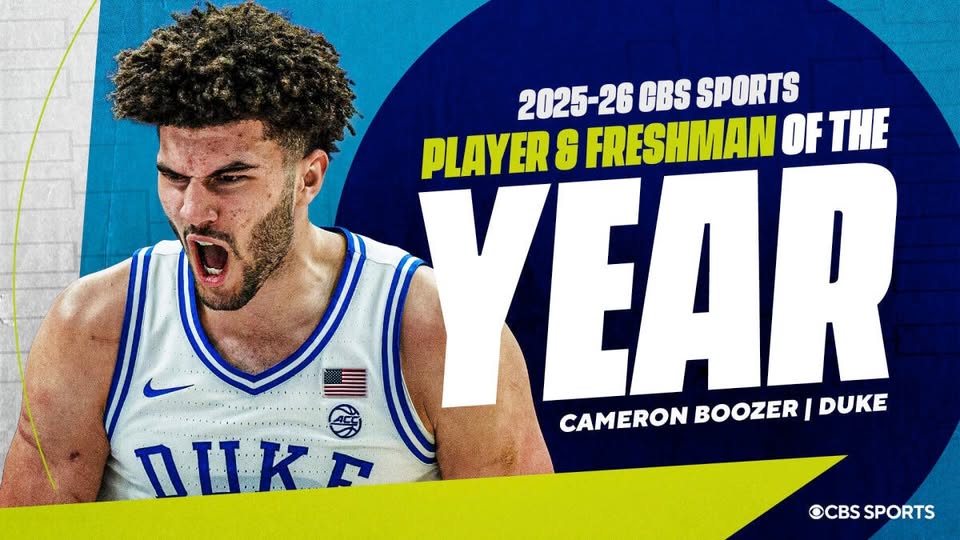
Cameron Boozer’s recognition as both Player of the Year and Freshman of the Year by CBS Sports represents a landmark achievement in the annals of college basketball, not only for his personal career but for the broader narrative surrounding Duke University and the NCAA at large. This dual acknowledgment underscores the magnitude of Boozer’s contributions during the 2026 season, highlighting a level of performance, leadership, and consistency that is rarely seen in collegiate athletics. It is a distinction that reflects his dominance across multiple dimensions of the game, his influence on team success, and his emerging role as a model for what is possible when talent, preparation, and resilience converge at the highest level of competition. By earning both accolades, Boozer has positioned himself in a unique historical context, as few players have ever commanded such recognition simultaneously, especially during their freshman campaign. This milestone invites a detailed exploration of the factors that contributed to his historic season, the statistical and qualitative evidence of his excellence, the impact on his team and program, and the broader implications for his trajectory in professional basketball and the sport overall.
From the very outset of the season, Boozer displayed a maturity and skill set that set him apart from his peers. He seamlessly transitioned into the collegiate level, demonstrating advanced understanding of the game, physical readiness, and an ability to perform under pressure that belied his status as a freshman. His offensive contributions were remarkable, encompassing scoring from multiple areas on the court with a combination of perimeter shooting, mid-range accuracy, and post-up efficiency. Boozer’s versatility allowed him to adapt to different defensive schemes, exploiting mismatches while maintaining composure in high-pressure situations. He routinely delivered in critical moments, whether it was hitting game-tying shots, executing clutch baskets in the final seconds, or facilitating plays that elevated his teammates. These performances were consistently recognized in weekly national coverage, with analysts highlighting both the quantity and quality of his scoring as a distinguishing factor that contributed to his selection as Player of the Year.
However, Boozer’s excellence extended far beyond scoring. His rebounding and defensive contributions were central to Duke’s overall performance, reflecting a comprehensive approach to the game. On the boards, Boozer demonstrated impeccable timing and positioning, often securing crucial possessions in both offensive and defensive transitions. His defensive versatility allowed him to guard multiple positions effectively, disrupting opponents’ strategies and creating opportunities for fast-break points. Analysts and coaches alike noted that his defensive awareness and communication skills reinforced Duke’s collective defensive framework, providing a foundation that allowed the team to execute complex schemes and respond dynamically to the adjustments of opponents. This multidimensional impact is a hallmark of truly elite players, and Boozer’s ability to influence the game in multiple facets was a key reason CBS Sports recognized him as the nation’s top player across all classifications, not merely among freshmen.
Leadership emerged as another defining characteristic of Boozer’s season, elevating his contributions beyond measurable statistics. Despite being a freshman, he exhibited poise, maturity, and resilience that allowed him to guide his team through challenges both on and off the court. His approach to leadership combined leading by example with fostering a collaborative and accountable team culture. Boozer was often the first to arrive at practice and the last to leave, demonstrating a work ethic that inspired teammates and reinforced standards of excellence. His calm demeanor under pressure and ability to provide guidance during critical game moments further amplified his influence, cultivating trust and cohesion within the roster. Observers consistently remarked on his natural ability to galvanize a team, emphasizing that his leadership style was inclusive and effective, allowing players to perform at their peak while maintaining a focus on collective success.
The statistical achievements that bolstered Boozer’s case for Player and Freshman of the Year were equally compelling. He ranked among the national leaders in points per game, rebounds, and efficiency metrics, demonstrating not only volume but consistency and high-quality performance. His shooting percentages reflected careful shot selection and a refined ability to score efficiently from multiple areas, while his turnover rates remained impressively low given his central role in the team’s offense. Advanced analytics highlighted his contributions in defensive metrics, including blocks, steals, and defensive win shares, confirming that his impact was comprehensive and measurable across the full spectrum of the game. What set Boozer apart from many of his contemporaries was the seamless integration of traditional and advanced metrics to showcase a level of excellence that transcended simple scoring, reflecting a complete and well-rounded basketball profile.
One of the most remarkable aspects of Boozer’s season was his adaptability in high-pressure situations. College basketball is characterized by constant tactical shifts, whether through opponent adjustments, coaching strategies, or the dynamics of tournament play. Boozer demonstrated the ability to read the game, anticipate opponent behavior, and make real-time decisions that maximized both his individual performance and team outcomes. In games against ranked opponents or during closely contested conference matchups, he consistently delivered pivotal contributions, whether scoring, rebounding, facilitating, or executing defensive stops. His ability to perform under such conditions is a significant factor in his recognition as Player of the Year, emphasizing that elite performance is not measured solely by raw statistics but by the capacity to influence outcomes in crucial moments.
The season’s historical significance is further amplified by the dual nature of Boozer’s honors. Being named Freshman of the Year acknowledges his immediate impact as a newcomer, while simultaneously earning Player of the Year recognition places him in a broader context that includes all players, regardless of experience. This dual distinction underscores the rarity of his achievement and signals to the basketball world that Boozer’s talent is not confined by age or collegiate tenure. Few players in NCAA history have achieved such recognition in the same season, marking his accomplishments as truly exceptional. Analysts frequently highlighted this dual honor as indicative of a generational talent, capable of reshaping expectations for what a freshman can achieve at the highest level of college basketball.
Boozer’s recognition also reflects his impact on Duke as a program. His performances generated excitement, media attention, and national visibility, enhancing the team’s profile and contributing to the program’s broader prestige. Fans, alumni, and recruits were all captivated by his displays of talent and leadership, strengthening Duke’s reputation as a destination for elite athletes seeking both development and exposure. This type of impact is not merely symbolic; it translates into tangible outcomes such as increased attendance, higher broadcast viewership, and elevated interest in the program’s recruiting efforts. By excelling in a manner that benefits the entire organization, Boozer reinforced the symbiotic relationship between individual achievement and program success, demonstrating the transformative effect a single player can have on multiple levels.
In addition to his performance on the court, Boozer navigated the external pressures associated with being a highly visible collegiate athlete. Media scrutiny, public attention, and the demands of representing a storied program like Duke require a degree of professionalism and composure that can challenge even experienced players. Boozer managed these pressures with remarkable poise, maintaining focus on his performance and supporting his teammates despite the constant spotlight. His ability to balance public attention with on-court responsibilities is a critical component of his overall excellence, demonstrating maturity beyond his years and signaling readiness for the professional level. This capacity to handle pressure effectively enhances his legacy, reinforcing the significance of his Player and Freshman of the Year honors.
Another dimension of Boozer’s season was his influence on the evolution of team dynamics. His presence created opportunities for other players to thrive, whether by drawing defensive attention, facilitating open shots, or setting the tone for intensity and discipline. The ripple effect of his contributions extended across the roster, fostering cohesion and raising the overall level of play. Coaches consistently highlighted his impact on team chemistry, noting that his leadership and on-court decisions allowed Duke to execute complex strategies more effectively and respond dynamically to the challenges posed by elite competition. This influence on team success underscores the broader significance of his awards, as Player of the Year recognition reflects both individual excellence and the ability to elevate a collective effort.
The postseason provided additional evidence of Boozer’s exceptional abilities. In tournament play, where the stakes are heightened and the margin for error is narrow, his performances were defining. He delivered in critical moments, producing game-changing plays on both ends of the court, whether through clutch scoring, key rebounds, or defensive stops. These high-pressure contributions not only advanced Duke’s position in postseason brackets but also reinforced the narrative of Boozer as a player capable of impacting outcomes in the most consequential situations. Analysts and commentators frequently emphasized the combination of skill, intelligence, and composure that allowed him to thrive under such conditions, highlighting the consistency and reliability that are essential criteria for Player of the Year consideration.
The season’s broader implications extend beyond Boozer’s immediate recognition. His achievements set a benchmark for future freshmen entering the NCAA, redefining expectations for performance, leadership, and maturity. They also influence perceptions of Duke’s program as a platform capable of nurturing elite talent from the outset, reinforcing the university’s reputation for developing players ready to compete at the highest levels immediately. The intersection of individual brilliance, team impact, and program visibility creates a legacy that resonates beyond a single season, illustrating the multi-layered significance of his Player and Freshman of the Year honors.
Boozer’s dual recognition by CBS Sports also underscores the evolving criteria for evaluating collegiate excellence. Modern assessments consider not only traditional statistics but also leadership, versatility, efficiency, and impact in high-pressure scenarios. Boozer exemplifies this holistic approach to evaluation, combining quantitative dominance with qualitative contributions that elevate both his team and the sport. His season illustrates the importance of multifaceted excellence, demonstrating that elite performance encompasses skill, intelligence, adaptability, and character in equal measure. This comprehensive impact is what ultimately secured his historic dual honors, setting a standard for recognition that extends beyond conventional metrics and resonates across all levels of the game.
Looking ahead, Boozer’s season and recognition position him as a highly anticipated prospect for professional basketball. Scouts and executives have taken note of his skill set, versatility, and ability to perform under pressure, signaling a potential trajectory toward elite professional opportunities. His combination of scoring, rebounding, defensive aptitude, leadership, and composure aligns with the attributes sought at the highest levels of competition. Furthermore, his ability to manage media attention, public scrutiny, and team responsibilities provides additional assurance of his readiness to transition successfully into the professional sphere. The dual accolades from CBS Sports thus serve not only as a capstone to an exceptional collegiate season but also as a launching point for a promising professional career, reinforcing the significance of his accomplishments within a broader basketball context.
Cameron Boozer’s 2026 season, culminating in his selection as Player of the Year and Freshman of the Year by CBS Sports, represents a historic achievement in college basketball. His contributions encompassed scoring, defense, rebounding, leadership, adaptability, and composure under pressure, establishing a model of excellence that transcends conventional evaluation metrics. The dual recognition highlights his immediate impact as a freshman while affirming his status as the premier player in the nation, reflecting both individual brilliance and transformative influence on Duke’s program. His performances set new benchmarks for future athletes, reshaped expectations for freshman impact, and reinforced the importance of multidimensional excellence in collegiate basketball. Boozer’s season exemplifies the convergence of talent, preparation, resilience, and leadership, creating a legacy that will be celebrated, analyzed, and remembered for years to come. The recognition from CBS Sports solidifies his place among the elite in NCAA history, providing a defining moment that captures the full scope of his contributions, the significance of his impact, and the promise of his future in the sport. His achievements illuminate the potential of collegiate athletes to shape both their teams and the broader landscape of basketball, leaving an enduring mark on the game that extends well beyond the confines of a single season. In every aspect—statistical, qualitative, and symbolic—Boozer’s campaign for Duke represents a historic standard of performance, one that will influence players, programs, and evaluators in the years to follow. It is a season that redefines what is possible for a freshman, elevates Duke’s program, and demonstrates the full measure of athletic excellence, making Cameron Boozer’s dual honors a watershed moment in the history of college basketball.