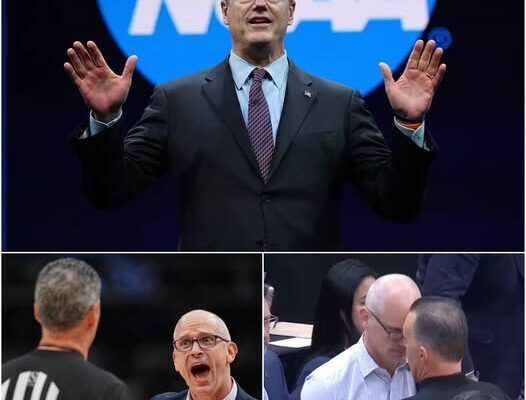
In recent developments that have captured the attention of college basketball fans, coaches, and sports officials alike, Dan Hurley, the head coach of the University of Connecticut Huskies men’s basketball team, has been formally disciplined by the NCAA following an incident characterized by the use of explicit language directed toward officials and opponents. The controversy centers around Hurley’s behavior after UConn’s victory over the Duke Blue Devils, during which he reportedly directed profane remarks, including “f**k you,” at Jon Scheyer, Duke’s head coach, and the officiating crew.
This disciplinary action, though viewed by some as overdue, underscores a broader conversation about sportsmanship, respect, and conduct on the sidelines in collegiate sports. It also raises questions about the appropriate boundaries for coaches’ expressions of emotion, the role of the NCAA in regulating sideline behavior, and the persistent challenge of maintaining civility amid the high-pressure environment of competitive basketball.
The Incident in Context
The game in question was a highly anticipated matchup between two storied programs, UConn and Duke, two of college basketball’s most prestigious teams. Such contests often carry heightened emotions, intensity, and stakes, leading to passionate coaching and player reactions. However, in this case, the focus shifted from the game itself to the conduct of one of its central figures—UConn head coach Dan Hurley.
According to reports, Hurley’s frustration boiled over after a call went against his team, or perhaps during a heated exchange with officials or opposing coaching staff. Witnesses say that Hurley used explicit language, including the phrase “f**k you,” directed at Jon Scheyer, Duke’s head coach, as well as the officiating crew. The incident was caught on camera, and social media quickly circulated clips of Hurley’s outburst, igniting a wave of commentary across the sports community.
The NCAA’s Response and Disciplinary Measures
In the aftermath of the incident, the NCAA launched an investigation into Hurley’s conduct. While the organization traditionally emphasizes sportsmanship and respect, disciplinary steps are often taken in response to egregious or repeated violations. After reviewing the evidence, the NCAA announced that Dan Hurley would face sanctions, which include a formal reprimand and possibly other measures such as fines or suspension, depending on the severity and context of the violation.
The NCAA’s decision was widely viewed as an attempt to send a clear message: sideline conduct matters, and coaches are role models whose behavior reflects on the sport and the institution they represent. Although some critics argued that the punishment was delayed, they acknowledged that the disciplinary action serves as a firm reminder that respect for officials and opponents must be maintained, even amid intense competition.
The Broader Issue of Sportsmanship in College Basketball
This incident is not isolated in the history of college basketball or sports in general. The tension between passionate coaching and maintaining civility has always been a delicate balance. Coaches are under immense pressure to win, motivate players, and manage the game’s emotional landscape. However, expectations of professionalism and sportsmanship serve to uphold the integrity of the game and foster a positive environment for players, officials, and fans.
Historically, the NCAA has implemented various policies and educational programs aimed at promoting respect and reducing unsporting conduct. Yet, high-profile incidents continue to surface, highlighting the ongoing challenge of enforcing these standards consistently.
The Role of Coaches as Role Models
Coaches like Dan Hurley are influential figures in their communities and serve as role models for players, staff, and fans. Their words and actions set a tone for the team and the broader fanbase. When a coach resorts to profanity or shows disrespect toward officials or opponents, it can have ripple effects, normalizing poor conduct and undermining the values of sportsmanship.
In recent years, there has been increased emphasis on teaching coaches and players about emotional regulation, respect, and the importance of maintaining dignity during games. The NCAA, athletic conferences, and individual institutions have all invested in educational initiatives aimed at fostering a culture of civility.
The Impact of Public and Media Reaction
The media coverage of Hurley’s disciplinary action reflects the broader societal debate about acceptable behavior in sports. Some view the NCAA’s response as necessary to uphold standards and demonstrate that such conduct will not be tolerated. Others argue that coaches, under immense stress, should be given some leeway, especially when their passion is genuine.
Social media platforms have amplified both perspectives, with fans and analysts dissecting the incident and debating the appropriate boundaries for coaches’ conduct. The viral nature of video clips ensures that such moments reach a global audience, increasing pressure on governing bodies to act decisively.
The Importance of Respect and Civility
Respect and civility are cornerstones of sportsmanship. They foster an environment where competition is fierce but fair, and where players and coaches can express their passion without crossing lines of decency. The NCAA’s disciplinary action serves as a reminder that language and behavior matter, especially in a setting where young athletes look up to coaches as mentors.
By addressing incidents of misconduct publicly, the NCAA aims to reinforce the importance of maintaining decorum. This not only preserves the reputation of the sport but also ensures a positive experience for all involved.
The Future of Sideline Conduct Policies
Moving forward, many experts suggest that the NCAA and individual programs should consider implementing more comprehensive policies and training on sideline behavior. This could include mandatory coaching conduct workshops, stricter penalties for violations, and ongoing education about emotional regulation and communication.
Furthermore, fostering a culture where respect is prioritized over heated exchanges can contribute to healthier competition and better development for student-athletes. Coaches, players, officials, and fans all share responsibility for creating an atmosphere that upholds the values of integrity and respect.
The disciplinary action taken against Dan Hurley by the NCAA marks a significant moment in the ongoing conversation about conduct in college basketball. While passion and intensity are integral to sports, they must be balanced with respect and professionalism. The NCAA’s decision underscores that actions have consequences and that maintaining civility on the sidelines is essential for the integrity of the game.
As college basketball continues to evolve, so too must the standards and expectations for conduct. Coaches like Hurley set powerful examples—whether positive or negative—that influence the culture of the sport. The hope is that this incident serves as a catalyst for continued efforts to promote sportsmanship, respect, and dignity in all levels of collegiate athletics.
BREAKING: Dan Hurley, the head coach of the UConn Huskies men’s basketball team, has received disciplinary action from the NCAA due to his repeated use of explicit profanity — including saying “f**k you” — directed at Jon Scheyer and the officiating staff following UConn’s win over the Duke Blue Devils. Although the ruling comes somewhat late, it is seen as a strong deterrent and emphasizes the importance of proper sideline conduct and respect for opponents and officials.