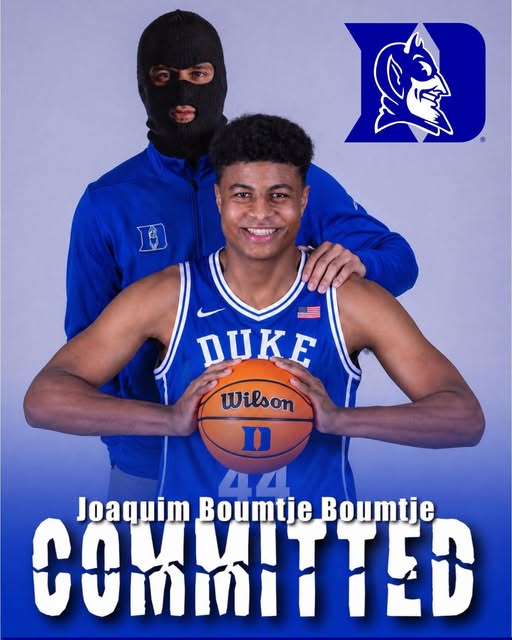
The news hit like a thunderclap across the college basketball world: a towering 7-foot, 230-pound center, Joaquim Boumtje Boumtje, is bringing his talents from FC Barcelona to Duke. In an era where recruiting battles stretch across continents and timelines blur between professional development and collegiate opportunity, this commitment feels different. It’s not just about adding size or depth—it’s about the arrival of a presence, a player whose physical tools and international polish could immediately reshape the identity of a program already synonymous with excellence.
Boumtje Boumtje’s journey to this moment hasn’t followed the traditional path of most college recruits. Instead of rising through the American high school or AAU circuits, he has been honing his game within one of Europe’s most respected basketball systems. FC Barcelona isn’t just a club; it’s a developmental institution that demands discipline, intelligence, and adaptability. Players who come through that system are rarely raw. They understand spacing, timing, and the subtleties of team basketball in ways that often take years for others to grasp. For Duke, landing a player from that background means acquiring someone who is already comfortable playing within structure while still possessing the upside to grow.
At 7 feet tall, Boumtje Boumtje naturally draws attention for his size, but it’s how he uses that size that makes him intriguing. He’s not just a stationary rim protector or a traditional back-to-the-basket big. Reports from his time in Spain suggest a player who moves fluidly, who can hedge on pick-and-rolls, recover defensively, and alter shots without fouling. His wingspan alone changes the geometry of the court, discouraging drives and forcing opponents into difficult decisions. For a Duke team that has always prided itself on defensive intensity, his presence could anchor the paint in a way that allows perimeter defenders to apply even more pressure.
Offensively, the potential is just as compelling. While he may not yet be a fully polished scorer, Boumtje Boumtje has shown flashes of versatility. He runs the floor well for his size, which means he can be a threat in transition—a valuable asset in today’s faster-paced game. In half-court sets, he’s capable of finishing around the rim with authority, using both hands and showing a soft touch when needed. There are also hints of a developing mid-range game, and if that continues to evolve, it could open up even more options within Duke’s offense. The idea of a 7-footer who can stretch defenses, even modestly, adds a layer of unpredictability that coaches love.
What makes this commitment particularly fascinating is the cultural and stylistic blend it represents. European-trained big men often bring a different rhythm to the game. They’re accustomed to reading defenses, making quick decisions, and valuing ball movement over isolation. When that approach is combined with the athleticism and intensity of American college basketball, the result can be something special. Boumtje Boumtje has the chance to embody that fusion, becoming a bridge between styles and elevating the overall sophistication of his team’s play.
For Duke, this move signals continued evolution in recruiting philosophy. The program has never been afraid to adapt, whether it was embracing one-and-done stars or building veteran-heavy lineups. Now, tapping into international pipelines at this level shows a willingness to compete globally for talent. It’s a recognition that the game itself is global, and that the next wave of dominant players may come from anywhere. Securing a commitment from a player developed at FC Barcelona sends a message—not just to other recruits, but to the entire basketball community—that Duke remains a destination for elite talent regardless of geography.
There’s also an emotional element to this story. Leaving a professional club environment in Europe to play college basketball in the United States isn’t a simple decision. It involves adjusting to a new culture, a new style of play, and a different kind of spotlight. College basketball carries its own intensity, with packed arenas, passionate fan bases, and a schedule that demands consistency. For Boumtje Boumtje, the transition will test not just his physical abilities but also his mental resilience. Yet, those who have followed his development believe he’s more than capable of handling the challenge. His time in Spain has already exposed him to high expectations and competitive environments.
Imagining him in a Duke uniform, it’s easy to see how he could become a focal point. The Cameron Indoor Stadium crowd thrives on energy, and there’s something inherently electrifying about a dominant big man controlling the paint. Every blocked shot, every rebound, every emphatic finish at the rim has the potential to ignite the arena. Fans will quickly rally behind a player who brings that kind of presence, especially one with an international story that adds an extra layer of intrigue.
From a strategic standpoint, his arrival could influence how Duke constructs its roster and game plans. Having a reliable anchor in the middle allows for greater flexibility elsewhere. Guards can take more risks defensively, knowing there’s a safety net behind them. Offensively, the team can explore inside-out dynamics, creating opportunities for shooters while still maintaining a strong interior threat. It’s the kind of balance that championship teams often rely on.
Of course, expectations will be high. Anytime a player with this combination of size, pedigree, and international experience joins a program like Duke, the spotlight is immediate. There will be questions about how quickly he can adapt, how his game translates, and what role he will ultimately play. Development is rarely linear, especially for big men, and there may be moments of adjustment. But the foundation is there, and the environment at Duke is designed to nurture growth while competing at the highest level.
There’s also the broader narrative of what this commitment represents for the future of basketball. The lines between professional and amateur pathways continue to blur, and players are increasingly exploring diverse routes to reach their goals. Boumtje Boumtje’s decision to move from a European powerhouse to an American college program highlights the fluidity of those choices. It suggests that development isn’t confined to a single system or region, and that players can seek out opportunities that best align with their aspirations.
As the season approaches, anticipation will only build. Teammates will begin to adjust to his presence in practice, coaches will experiment with lineups and schemes, and fans will eagerly await the first glimpse of what he can bring to the court. There’s a sense that this isn’t just another addition—it’s a potential turning point, a chance to redefine what the team can be.
In the end, the commitment of Joaquim Boumtje Boumtje to Duke is more than a headline. It’s a convergence of talent, opportunity, and vision. It’s about a player stepping into a new chapter, a program embracing a global perspective, and a sport continuing to evolve in exciting ways. Whether he becomes a dominant force immediately or grows into that role over time, one thing is certain: his presence will be felt, and his journey will be one to watch.