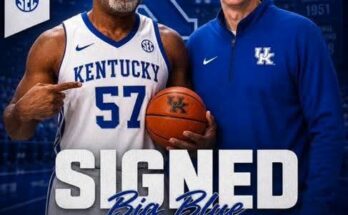
There’s a certain kind of player you recognize almost instantly, even if you can’t fully explain why. It’s not just the stat line, not just the highlights, not even just the wins. It’s a feel. A rhythm. A kind of quiet control over the game that makes everything look easier than it should be. That’s what you’re seeing here. That’s why the excitement feels different. Because this kid doesn’t just play basketball—he glides through it, like he’s already a step ahead of whatever the defense is thinking, like he’s solving problems before they even fully form.
“Silk Wilk” isn’t just a nickname that sounds cool—it fits. It captures that smoothness, that effortless flow in his game. The way he gets to his spots without forcing it. The way his handle doesn’t just break defenders down, it lulls them into a false sense of security before slipping past them. There’s no wasted motion. No panic. Just poise. You watch him and it feels like the game slows down on command.
And what’s wild is how people still manage to doubt that. You see the chatter, the skepticism, the nitpicking. Too this, not enough that. Questions about competition, about physicality, about whether it’ll “translate.” It’s the same tired cycle we’ve seen so many times before—people overthinking a player whose talent is right there in plain sight. Because when someone makes it look easy, there’s always a tendency to assume it must be easy. That what they’re doing isn’t as difficult as it actually is.
But that’s the illusion. That’s the trap.
What he does requires a ridiculous level of skill. That handle? Tight, controlled, creative without being reckless. He’s not just dribbling to dribble—every move has purpose. He’s reading angles, manipulating defenders, setting them up two or three beats in advance. That’s not something you fake your way into. That’s years of work, of feel, of understanding the game at a deeper level than most players ever reach.
Then there’s the scoring. It’s not just about putting the ball in the basket—it’s about how he gets there. He’s not reliant on one move, one spot, one type of shot. He can pull up, get downhill, finish through contact, float it over length, or create just enough space to get a clean look. And again, it all looks smooth. No rush. No strain. Just a steady confidence that he’ll get what he wants when he wants it.
What really stands out, though, is how adaptable his game is. That’s the part people keep missing when they talk about whether he’ll succeed in a different conference, a different system, a different level. Skill translates. Feel translates. Decision-making translates. If anything, those qualities become even more valuable when the competition gets tougher, when the game speeds up for everyone else but somehow still looks slow for him.
Put more talent around him, and that’s when things really get interesting. Because now defenses can’t key in the same way. Now there’s space to operate, lanes that open up just a little bit wider, passing windows that become easier to exploit. And he’s not the type to force the issue just to get his numbers—he’ll make the right play. He’ll take what’s there. He’ll elevate the guys around him because he understands that the game isn’t just about individual moments, it’s about flow and timing and trust.
That’s where the “big season loading” feeling comes from. It’s not hype for the sake of hype. It’s recognition of a trajectory. You can see the pieces coming together. The confidence growing. The game expanding. There’s a sense that everything is about to click in a bigger way, that the flashes people have seen are about to turn into something more consistent, more undeniable.
And when that happens, the narrative shifts. It always does.
The same voices that questioned will start to come around. The same people who doubted will start to highlight the very things they overlooked. It’s part of the cycle. But for those who’ve been paying attention, who’ve seen the skill and the feel and the composure from the beginning, it won’t feel surprising. It’ll feel inevitable.
Because players like this don’t just disappear. They don’t suddenly lose what makes them special when the stage gets bigger. If anything, they thrive. They grow into it. They take on the challenge and use it to sharpen what they already do well.
And let’s talk about that composure for a second, because it’s easy to overlook but it matters more than people realize. There’s no rush in his game. No frantic energy. Even when things get chaotic around him, he stays steady. That kind of presence can anchor a team. It can settle things down in tough moments. It can turn what might’ve been a bad possession into a good one just by making the right read at the right time.
That’s leadership, even if it doesn’t always show up in the loud, vocal way people expect. It’s about control. It’s about trust. It’s about knowing that when the ball is in his hands, something good is likely to happen.
And that’s why the excitement keeps building. Because you’re not just watching a talented player—you’re watching someone who understands how to play. Someone who processes the game at a high level. Someone whose style isn’t dependent on being the biggest or the fastest, but on being the smartest, the smoothest, the most in tune with the flow of everything happening on the court.
“Silk Wilk” captures that perfectly. It’s not about flash for the sake of flash. It’s about that effortless quality, that sense that everything is under control even when it looks like it shouldn’t be. It’s the kind of nickname that sticks because it reflects something real.
And if you’re projecting forward, imagining what this could look like with more weapons, more spacing, more opportunities—it’s easy to see why the anticipation is so high. Because the foundation is already there. The skill set is already versatile. The mindset already leans toward making the right play.
All that’s left is the stage getting bigger and the opportunities expanding.
That’s when you find out how real it is. That’s when the conversation shifts from potential to production, from flashes to full performances. And everything about his game suggests he’s ready for that moment. Not just physically or skill-wise, but mentally. He plays like someone who expects to succeed, not in an arrogant way, but in a calm, assured way that comes from knowing the work has been put in.
So yeah, a big season feels like it’s on the way. Not because of wishful thinking, but because the signs are already there. The smoothness. The control. The adaptability. The feel. Those aren’t things that suddenly disappear when the lights get brighter—they’re the things that stand out even more.
And when it all comes together, when the talent around him matches the way he sees the game, when the opportunities line up with the skill set, that’s when you really start to see what “Silk Wilk” is all about. Not just a nickname, not just a vibe, but a player whose game speaks for itself—quietly, confidently, and smoother than most people are ready for.