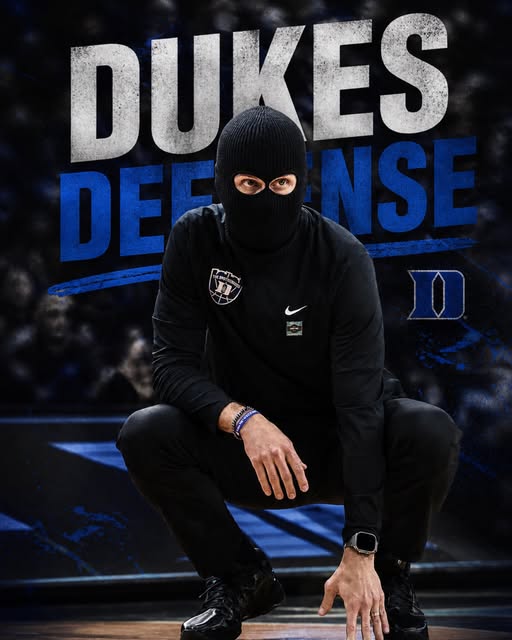
Duke’s defense under Jon Scheyer next season has every reason to evolve from solid and structured into something genuinely suffocating, the kind of system that doesn’t just disrupt opponents but actively dictates the emotional tone of a game. The foundation is already there: length, discipline, and a coaching philosophy that values positional awareness as much as raw athleticism. But what could push it into “nightmare” territory is the convergence of experience, recruiting, and Scheyer’s growing comfort imprinting his own identity rather than simply extending the framework he inherited. This is where things get interesting, because the next step for Duke isn’t about tweaking rotations or marginal improvements in efficiency; it’s about building a defense that feels inevitable, one that wears teams down possession by possession until their offense begins to unravel before shots even go up.
Scheyer has shown a clear preference for versatility over specialization. That matters more than ever in modern college basketball, where rigid defensive roles can be exposed quickly by spacing and ball movement. Instead of relying on a traditional rim protector to erase mistakes, Duke’s system is trending toward a layered approach where help defense arrives early, rotations are premeditated, and the entire unit moves as if connected by a single string. When this works at a high level, it doesn’t look chaotic or reactive; it looks like the offense is constantly running into invisible walls. Passing lanes close half a second faster than expected. Driving angles disappear just as a guard commits to them. Even simple actions like a high pick-and-roll start to feel congested, not because of a single elite defender, but because of collective anticipation.
Next season presents the ideal conditions to amplify that style. Returning players will have a deeper understanding of Scheyer’s terminology and expectations, which is often the biggest barrier to defensive cohesion. It’s one thing to know where you’re supposed to be; it’s another to instinctively arrive there without hesitation. That difference—between thinking and reacting—can shave critical fractions of a second off rotations, and those fractions are exactly what turn decent defense into oppressive defense. When players trust the system and each other, they’re more willing to take calculated risks, like jumping passing lanes or showing aggressively on ball screens, because they know the coverage behind them won’t collapse.
Personnel-wise, the potential for length across multiple positions is what really hints at something special. Long wings who can guard up and down the lineup give Scheyer the flexibility to switch more actions without creating mismatches. Switching, when executed properly, is one of the most demoralizing defensive tactics because it neutralizes offensive advantages before they can develop. But switching alone isn’t enough; it has to be paired with physicality and communication. If Duke can combine those elements, opponents won’t just see a defender in front of them—they’ll feel like every option is equally difficult, which often leads to rushed decisions and inefficient shots late in the clock.
Another factor that could elevate Duke’s defense is its potential to generate turnovers without gambling recklessly. There’s a fine line between aggressive and undisciplined, and Scheyer has generally leaned toward the former while avoiding the latter. The goal isn’t to rack up steals at the expense of structure; it’s to apply just enough pressure to force discomfort. Think of it as controlled chaos, where ball handlers are constantly nudged off their preferred spots, passing windows are contested, and the offense is pushed further and further from its intended rhythm. Over time, that pressure compounds. A team might handle it well for a few possessions, but sustaining that level of execution for an entire game becomes exhausting.
Rebounding is another area where a nightmare defense truly separates itself. A great defensive possession doesn’t end with a missed shot; it ends with securing the ball. Duke’s size and athleticism should give it a significant advantage on the glass, particularly if guards are committed to crashing down and helping finish possessions. When a team consistently limits second-chance opportunities, it not only protects its defensive efficiency but also fuels transition offense. And that’s where the psychological impact starts to snowball. An opponent misses a contested shot, fails to grab the rebound, and then has to sprint back to defend in transition against a team that’s already building momentum. That sequence, repeated over and over, can break a team’s confidence.
Communication will be the invisible backbone of all this. The best defenses aren’t silent; they’re constantly talking, calling out screens, directing traffic, and reinforcing positioning. For Duke to reach that nightmare level, communication has to become second nature. It can’t spike only in high-energy moments; it has to be sustained regardless of game flow. That’s often what separates elite defensive teams from merely good ones. Even when shots aren’t falling or the offense stalls, the defense remains consistent because it’s rooted in habits rather than emotion.
Scheyer’s evolution as a coach also plays a role here. Early in his tenure, there was an understandable emphasis on continuity and stability. Now, with more experience and a stronger grasp of what his roster can handle, he has the opportunity to push boundaries. That might mean incorporating more varied coverages, mixing in zones or hybrid looks to disrupt rhythm, or adjusting on the fly based on matchups. The more unpredictable a defense becomes, the harder it is to prepare for. Opponents can study film and anticipate tendencies, but if those tendencies are constantly shifting within a cohesive framework, preparation only goes so far.
Conditioning shouldn’t be overlooked either. Playing high-level defense for forty minutes requires more than just effort; it requires stamina and discipline. Fatigue is often the enemy of defensive execution, leading to late rotations, missed assignments, and fouls. If Duke can maintain its intensity deep into games, it gains a significant edge, especially against teams that rely heavily on a few key players. Wearing those players down physically can have a cascading effect on the entire offense.
Fouling, in fact, is one of the few areas that could undermine an otherwise dominant defense. Aggression has to be controlled, particularly when contesting shots and fighting through screens. A nightmare defense doesn’t give opponents easy points at the free-throw line; it forces them to earn everything through difficult, contested attempts. Discipline in this area will be crucial, especially in close games where free throws can swing the outcome.
There’s also a mental component to consider. Defense at this level isn’t just about stopping plays; it’s about imposing a mindset. When a team believes it can lock down any opponent, that confidence becomes self-reinforcing. Players take pride in defensive stops, celebrate them, and feed off that energy. Over time, it creates an identity that transcends individual games. Opponents come in knowing they’re in for a grind, and that expectation alone can influence how they approach the game. Shots might be rushed, plays might be overthought, and the usual flow of offense can be disrupted before the opening tip.
The environment at home games could amplify this effect. A loud, engaged crowd can elevate defensive intensity, especially during key stretches. Every stop fuels the energy in the arena, which in turn fuels the players. It becomes a feedback loop where defense drives atmosphere, and atmosphere drives defense. For young players in particular, that kind of environment can be overwhelming, leading to mistakes that a disciplined team like Duke is well-positioned to exploit.
Ultimately, the idea of Duke’s defense becoming a “straight nightmare” isn’t about any single statistic or highlight. It’s about the cumulative effect of dozens of small, consistent actions: a hand in the passing lane, a perfectly timed rotation, a box-out that prevents a second chance, a closeout that forces a tough shot. When all of those pieces come together, possession after possession, the result is a defense that feels relentless. Opponents don’t just struggle; they feel suffocated, as if every option has been anticipated and neutralized.
If Scheyer can align all these elements—experience, versatility, communication, conditioning, and strategic flexibility—next season’s Duke defense has the potential to be more than just effective. It can be imposing in a way that reshapes games from the ground up, turning offense into a chore rather than an opportunity. And when that happens, when every trip down the floor feels like an uphill battle, “nightmare” stops being hyperbole and starts to feel like an accurate description.