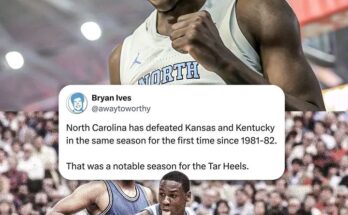
The transformation of North Carolina basketball from a team often “punked” into one capable of crashing through elite competition with winning plays has been a story of patience, planning, and cultural recalibration. For years, UNC had faced the kind of late-game disappointments, blown leads, and narrowly lost contests that left fans frustrated and players questioning their own consistency. To understand this evolution, one must first appreciate the strategic and psychological frameworks Hubert Davis implemented upon taking the reins as head coach. Davis, a former Tar Heel and assistant coach under Roy Williams, brought with him a vision that went beyond X’s and O’s; he understood that changing a team’s mindset and internal culture was as crucial as recruiting top-tier talent or running sophisticated offensive sets.
The journey began with an emphasis on identity. UNC had, for decades, been defined by its rich tradition, an iconic fast-break offense, and the ability to attract transcendent talent. Yet, there was a period when talent alone was insufficient, when the team would frequently falter under pressure, succumbing to opponents who exploited defensive lapses or mental errors. The term “punked” became a shorthand for these moments: when UNC looked overmatched or outcoached in key stretches, unable to assert itself against the physicality and strategic discipline of top-tier teams. Davis recognized that breaking out of this cycle required more than just practicing sets or conditioning; it demanded a holistic approach that fused confidence, resilience, and situational awareness.
Recruitment under Davis became about fit as much as talent. Instead of chasing purely the flashiest prospects, the coaching staff targeted players who could thrive in a system that prioritized pace, precision, and adaptability. The goal was to assemble a roster that could execute under duress, respond to adversity, and make plays in critical moments. Players were evaluated not just for scoring or rebounding but for basketball IQ, work ethic, and mental toughness. By selecting athletes who could internalize the team’s philosophy, Davis laid the groundwork for a unit capable of both consistency and improvisation—a combination crucial for “crashing” against elite opponents like Kentucky.
Equally important was the cultivation of in-game leadership. Davis worked meticulously to ensure that multiple players could assume responsibility during pressure moments, whether orchestrating the offense, directing teammates on defense, or maintaining composure amid chaos. This decentralized leadership approach allowed UNC to avoid the pitfalls of over-reliance on a single star and instead encouraged collective decision-making. When the Tar Heels faced teams like Kentucky, known for their athleticism and aggressive defense, this preparation enabled them to adapt dynamically, creating mismatches and exploiting defensive rotations with intelligence rather than sheer force.
A pivotal aspect of this transformation was defensive discipline. Historically, UNC’s identity had skewed toward high-octane offense, often leaving defensive cohesion as a secondary concern. Davis’s blueprint emphasized that winning at the highest level demanded attention to both ends of the floor. The team implemented schemes that combined aggressive on-ball pressure with disciplined rotations, designed to neutralize opponents’ transition opportunities and force contested perimeter shots. The defensive emphasis created more than just stops; it built confidence. When players realized that they could reliably disrupt elite offenses, they carried that assurance into their offensive execution, knowing that mistakes could be contained.
This focus on confidence and control manifested most visibly in high-stakes moments against Kentucky. In previous encounters, UNC had occasionally allowed the Wildcats’ speed and size to dictate the tempo, resulting in turnovers, hurried shots, and missed assignments—classic examples of being “punked.” In contrast, the recent incarnation of UNC approached these contests with a proactive mentality. They dictated pace, executed set plays with precision, and capitalized on Kentucky’s defensive overcommitments. Winning plays were not random bursts of brilliance; they were the product of methodical preparation, trust among teammates, and the ability to read and respond to the flow of the game. Whether it was a clutch three-pointer, a timely cut to the basket, or a defensive stop followed by a fast-break bucket, these moments were emblematic of a team that had internalized its identity and strategy.
Hubert Davis, as head coach, had anticipated this progression. From the outset, he spoke about building a team that could impose its will, not simply react. His coaching philosophy emphasized patience in development, reinforcing that short-term setbacks were part of a longer-term process. Players were encouraged to study film rigorously, understand opponent tendencies, and develop situational awareness. By preparing the team for every conceivable scenario, Davis ensured that his players could make instinctive, high-quality decisions under pressure. This preparation, combined with meticulous attention to detail in practice, transformed what might have once been panicked responses into decisive, winning actions on the court.
The psychological evolution of UNC basketball cannot be overstated. Transitioning from a team frequently “punked” to one capable of consistent “winning plays” required a shift in mindset. Players had to believe in their ability to compete against the nation’s best, even when faced with adversity. Confidence was cultivated not through empty affirmations but through a cycle of small, measurable successes in practice and non-conference contests, gradually expanding to high-pressure games against premier opponents. When Kentucky presented a formidable challenge, UNC’s roster had already internalized a sense of competence: the knowledge that hard work, preparation, and execution could overcome physical and strategic disparities.
Furthermore, UNC’s offensive execution under Davis exemplified this balance between preparation and creativity. Sets were designed to create spacing, leverage mismatches, and allow for improvisation within structure. Players were trained to recognize defensive cues, make rapid decisions, and finish plays with high efficiency. This approach ensured that winning plays emerged naturally rather than sporadically, with the team consistently exploiting defensive breakdowns while minimizing unforced errors. The combination of structured offense and mental agility made UNC a much more formidable opponent than in prior seasons, capable of turning tight games into decisive victories.
The synergy between veteran leadership and emerging talent also played a critical role. Upperclassmen modeled composure and work ethic, guiding younger teammates through the nuances of high-pressure competition. This mentorship created a culture in which even the newest players could internalize the team’s principles quickly, contributing meaningfully in critical moments. Against Kentucky, this cohesion was evident: the team functioned as a single unit, communicating seamlessly, adjusting rotations, and executing plays with collective precision. No individual acted in isolation; every winning play was the product of coordinated effort, reflecting the culmination of the culture Davis had nurtured.
UNC’s transition was also a narrative of resilience. Past teams often faltered after mistakes, allowing opponents to capitalize on lapses. In the current era, the Tar Heels have learned to treat mistakes as transient setbacks rather than definitive outcomes. Whether it was a missed shot, a turnover, or a defensive lapse, the team maintained composure, recalibrated, and continued to impose its strategy. This mental fortitude is essential when facing elite programs like Kentucky, where the margin for error is minimal, and a single lapse can swing momentum. The ability to recover quickly, maintain intensity, and convert opportunities into winning plays underscores the team’s maturation.
Statistically, this transformation is reflected in UNC’s ability to close games effectively. Metrics such as points off turnovers, defensive rebounding percentage, and clutch shooting improved markedly. These improvements were not coincidental; they were a direct result of deliberate practice, film study, and situational drills designed to simulate the pressure of championship-level competition. The correlation between preparation and execution became evident: the more the team immersed itself in game-like scenarios during practice, the more consistently it produced winning plays when stakes were highest.