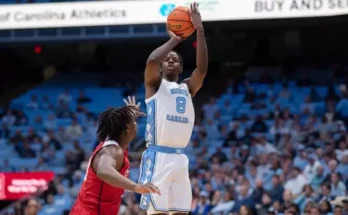
Henri Veesaar and Caleb Wilson’s unexpected takeover of the front court completely disrupted Georgetown’s strategy in a way that few could have anticipated. From the opening tip, the energy in the Dean Smith Center was palpable, with fans eager to see how North Carolina would respond to a team that, on paper, seemed prepared to challenge them but perhaps underestimated the Tar Heels’ depth and versatility. The game quickly transformed into a showcase not only of skill but also of determination and situational awareness, with Veesaar and Wilson establishing a rhythm that forced Georgetown to rethink its approach at every turn. Each possession became a battle of wits and willpower, a microcosm of the broader season’s narrative for both teams.
Veesaar’s presence in the paint was immediately felt. His timing on rebounds, the precision of his post moves, and his ability to read the trajectory of the ball disrupted Georgetown’s usual dominance in the interior. The Hoyas, known for their physicality and disciplined half-court offense, found themselves scrambling to adjust to a player who seemed to anticipate every pass, every cut, every roll. Every time Veesaar received the ball, there was a subtle shift in the defensive alignment, a hesitation, a slight pause that betrayed the uncertainty in Georgetown’s game plan. He was not just scoring; he was commanding attention, and that attention created opportunities for others. The mere presence of Veesaar on the floor altered angles, closed off passing lanes, and made Georgetown reconsider even the simplest of post feeds. His footwork, deceptively nimble for a player of his size, allowed him to maneuver in tight spaces, turning what seemed like ordinary possessions into moments of brilliance.
Wilson complemented Veesaar perfectly, bringing a different but equally impactful dimension to the front court. Where Veesaar relied on anticipation and positioning, Wilson brought brute force and relentless energy. His screens were textbook examples of how to control space, and his rolls to the basket created lanes that UNC’s guards exploited with ease. But it wasn’t just his physicality that mattered; it was his timing, his awareness, and the way he read both the ball and his teammates. Wilson’s presence demanded a defensive focus that Georgetown simply could not afford to ignore. Every double team he drew opened up opportunities for shooters on the perimeter, and every mismatch forced the Hoyas to make split-second decisions that often led to errors. The chemistry between Veesaar and Wilson was evident, a silent language of nods, glances, and positioning that allowed North Carolina to operate seamlessly in transition and half-court sets alike.
The game’s early stages highlighted the strategic disruption. Georgetown’s coach tried to rely on a mix of traditional zone coverage and aggressive man-to-man, but every adjustment seemed to lag a step behind UNC’s execution. The Tar Heels moved with a fluidity that belied the sudden dominance of two players who, just a season ago, might have been considered role players. Veesaar’s ability to stretch the floor with mid-range jumpers and quick putbacks forced defenders to chase him outside the paint, creating gaps that Wilson exploited ruthlessly. On several occasions, Wilson’s offensive rebounds turned into immediate second-chance points, leaving Georgetown’s defense bewildered and scrambling. The psychological impact of this front-court dominance cannot be overstated; the Hoyas began to show signs of frustration, pushing the pace prematurely, forcing contested shots, and overcommitting on drives in an attempt to counteract the inside threat.
As the game progressed, it became clear that these moments were more than just flashes of individual brilliance; they were a statement about North Carolina’s depth and adaptability. Fans in the Dean Smith Center, many of whom had grown accustomed to the ebb and flow of high-level collegiate basketball, found themselves rising from their seats in collective recognition of something special. It was not just the points scored or the rebounds collected; it was the timing, the synergy, the execution under pressure. The kind of performance that demands attention because it shapes the narrative of the contest in real time. With every pick-and-roll, every defensive rotation, every high-energy rebound, Veesaar and Wilson were asserting a presence that transcended the scoreboard, influencing the tempo, flow, and psychological momentum of the game.
Veesaar’s skill set was particularly impactful in situations where Georgetown tried to exploit traditional advantages. His ability to anticipate passes, to read cutters, and to establish position in the post meant that the Hoyas’ standard plays were often rendered ineffective. The textbook sets that had worked against other opponents were now being neutralized by a combination of agility, timing, and basketball IQ. Wilson’s contribution on the offensive boards added a layer of unpredictability that no pre-game scouting report could have fully prepared for. As UNC secured possessions and converted them into points, it became evident that this front-court dominance was more than just statistical; it was transformational.
The psychological effect on Georgetown cannot be overlooked. Early frustrations began to compound as UNC’s front-court duo continued to assert dominance. Mistimed jumps, poor rotations, and rushed decisions became recurring issues. It was as if the Hoyas were being challenged not only physically but intellectually, forced to rethink long-held strategies in the face of unexpected pressure. Veesaar and Wilson were effectively dictating the rhythm, controlling the interior, and forcing Georgetown into uncomfortable positions. This is the kind of influence that shifts games and, ultimately, seasons. Every possession against them became a test of resilience, focus, and adaptability.
On the defensive side, both players contributed with equal intensity. Veesaar’s timing on shot contests disrupted rhythm shooters, while Wilson’s physicality in the post allowed UNC to protect the paint without overcommitting to perimeter threats. They were not just participants in the game; they were influencers, setting the tone for the Tar Heels and forcing the Hoyas into reactive play. The defensive synergy between the two was palpable, as rotations were crisp, help defense timely, and communication seamless. UNC’s guards thrived knowing the front-court presence provided a reliable safety net, allowing them to pressure the perimeter more aggressively, confident that any penetration would be met with formidable resistance.