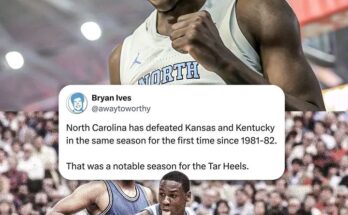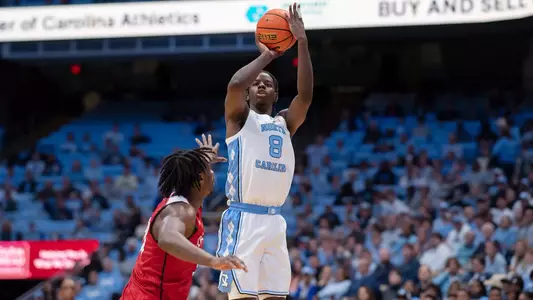
Caleb Wilson’s Monster Game Has Fans Speculating: Future NBA Center, Defensive Star, or Top-5 Bust? On December 2, 2025, Caleb Wilson put on a performance that immediately captured the attention of the basketball world. In a high-profile matchup between the North Carolina Tar Heels and the Kentucky Wildcats.
Caleb Wilson’s performance on December 2, 2025, against the Kentucky Wildcats was nothing short of electrifying, and in the days following the game, the basketball world has been abuzz with speculation about his future. North Carolina fans, NBA scouts, and analysts from across the country have been poring over every play, every movement, and every stat line, trying to decode what Wilson’s performance could mean for his career trajectory. What makes his outing so compelling is not merely the numbers he posted, although they were impressive in their own right, but the way he conducted himself on the floor, the instincts he displayed, and the hints of versatility that suggest he might be more than just a dominant college center.
From the opening tip, it was clear that Wilson had come to impose himself on the game. Kentucky, a team renowned for its athleticism and depth, often tests young prospects in ways that reveal their readiness for the next level. Yet Wilson seemed unfazed. He set the tone with aggressive post positioning, timely cuts, and a motor that never appeared to tire. His scoring was efficient, but it was the manner in which he scored that captured attention. He displayed an array of moves that suggested not only strength but also a high basketball IQ—pivoting in tight spaces, reading double teams, and making decisions under pressure that even seasoned players struggle to manage.
Defensively, Wilson was equally compelling. Centers are often judged not just by their scoring but by their ability to alter shots, control the paint, and anchor a team’s defensive scheme. Wilson showed signs of all three. His rim protection was impactful, not just through shot-blocking but through the positioning that forced Kentucky players into tough, low-percentage attempts. He rotated quickly, communicated effectively with teammates, and demonstrated the kind of timing that often separates good defenders from elite ones. Scouts have long noted that defensive instincts are harder to teach than offensive skills, and Wilson’s performance suggested that he might already have the innate qualities that could translate well to the NBA level.
Perhaps most intriguing to analysts was Wilson’s ability to handle the ball in transition and contribute outside of traditional center responsibilities. While he is a natural big man, there were moments in the game where he displayed an unexpected fluidity, catching passes on the move, pushing the floor, and even showing flashes of perimeter awareness. This kind of versatility is highly prized in today’s game, where the ability to switch defensively, stretch the floor offensively, and contribute in multiple facets is often what separates lottery picks from future All-Stars. Wilson’s willingness to engage in all aspects of the game, rather than merely focusing on scoring or rebounding, made his performance feel especially modern and NBA-ready.
The statistical output of the game was staggering. Wilson posted a double-double with points and rebounds, added multiple blocks, and contributed with assists and steals that spoke to his all-around impact. But beyond the numbers, it was his presence and the way he seemed to elevate his teammates that left the biggest impression. North Carolina’s guards and forwards looked more confident with him on the floor, knowing that he could protect the rim, make the right reads, and be a reliable scoring option when needed. Leadership, both implicit and explicit, is often overlooked in player evaluations, but Wilson’s demeanor on the floor suggested a maturity that could bode well for a professional career.
The immediate reaction on social media was intense. Fans flooded platforms with highlights, debates broke out about his potential draft position, and comparisons began to emerge. Some likened him to traditional defensive anchors in the NBA who dominate in the paint and alter games without needing to carry the scoring load. Others pointed to his glimpses of perimeter awareness and passing as indicators that he could become a more complete, versatile center capable of thriving in multiple offensive systems. However, there were also skeptics who cautioned against overhyping a single performance. Basketball history is littered with prospects who shone brightly in one game or one season only to struggle in the transition to professional play. For every Anthony Davis or Joel Embiid, there are cautionary tales of players whose skills didn’t translate as expected, making the conversation around Wilson both exciting and prudent.
Scouting reports following the game highlighted several key areas that could define Wilson’s future trajectory. His physical attributes—size, wingspan, strength—were ideal for a center, and when combined with his timing and instincts, made him a potential defensive stalwart. Offensively, his footwork in the post, touch around the rim, and ability to pass out of double teams were all praised, but there were questions about his range and whether he could consistently stretch defenses at the next level. These reports emphasized the need for continued development, particularly in areas like free-throw shooting, lateral quickness against smaller, faster players, and consistency in decision-making during high-pressure moments. While scouts were clearly impressed, they also noted that refinement would be essential if Wilson were to achieve a top-tier professional ceiling.
The broader context of the game added weight to Wilson’s performance. Kentucky entered the matchup as a top-ranked team, known for producing NBA talent and for being physically imposing and highly athletic. For a player like Wilson to dominate against such competition sent a strong signal that his abilities were not merely circumstantial but potentially indicative of a higher ceiling. Moreover, the game’s high-profile nature meant that every movement was scrutinized under the lens of national attention. The pressure of such a spotlight can reveal weaknesses, but Wilson seemed to thrive, maintaining composure and executing at a high level across all aspects of the game. This ability to perform under duress is often a strong predictor of professional success, further fueling speculation about his future.
The discussion about Wilson’s NBA prospects has naturally turned to his potential draft position. Some analysts are already debating whether he could be a top-10 pick based on a combination of size, defensive instincts, and offensive versatility. Others caution that inconsistency and the need for skill refinement could place him slightly lower, perhaps in the mid-first-round range. What makes this debate particularly engaging is the balance of potential upside versus risk. Wilson has all the tools to become a franchise-altering player if his development continues on the right trajectory. At the same time, the unpredictability of projecting college performance to the NBA means that scouts and executives must weigh both promise and uncertainty carefully.
There’s also an ongoing debate about what type of player Wilson will ultimately become. Will he be a defensive anchor first, the type of center whose presence alone alters opponents’ strategies? Or is there potential for him to be more offensive-minded, a centerpiece capable of scoring efficiently, facilitating from the post, and contributing to floor spacing? Some even consider the possibility of him becoming a top-5 bust if expectations are set too high too early. Such labels, while speculative, often arise when a player shows flashes of brilliance but still has areas needing growth. The discussion around Wilson highlights the tension between immediate impact and long-term projection—a conversation familiar to NBA executives but now playing out publicly among fans and analysts.
North Carolina’s coaching staff has also weighed in, praising Wilson’s work ethic, competitiveness, and willingness to learn. Coaches often have insight into a player’s character, maturity, and adaptability—factors that are sometimes even more predictive of professional success than raw talent alone. According to those close to the program, Wilson combines a relentless drive to improve with the humility to absorb coaching, a combination that could facilitate a smoother transition to the NBA and help mitigate some of the risks associated with his ceiling.
Fans have responded with a mix of excitement and caution. Social media is filled with highlight reels, analytical breakdowns, and speculative discussions about Wilson’s potential. Some Tar Heel fans are already dreaming of the NBA stardom that Wilson could achieve, imagining him as the next dominant center to emerge from Chapel Hill. Others, more measured, remind observers that one game, no matter how spectacular, is just a snapshot in a larger career arc. This tension between hype and realism is a natural part of the discourse around rising prospects, and Wilson has now become a central figure in that conversation.
The legacy of a performance like Wilson’s also goes beyond immediate speculation. Historically, breakout games against elite competition can redefine a player’s trajectory. They can increase exposure to scouts, accelerate draft stock considerations, and even shape the narrative around a player’s potential for years to come. For Wilson, the December 2 game could be a defining moment, a reference point for future evaluations, and a reminder to the basketball world that a new talent has arrived on the national stage with both skill and poise.