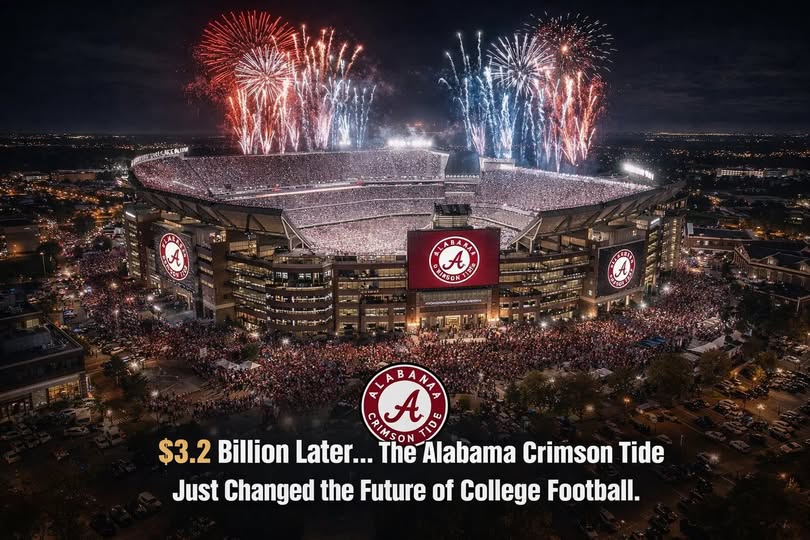
The Alabama Crimson Tide have once again positioned themselves at the forefront of innovation in college athletics with the unveiling of an ambitious, multi-phase transformation plan for Saban Field at Bryant-Denny Stadium. While viral social media posts circulating in early February 2026 hyped a staggering $3.2 billion overhaul—including a full stadium rebuild, luxury hotel, year-round entertainment district, expanded retail, and a groundbreaking “Crimson Tide legacy experience”—official sources paint a more measured but still transformative picture.
The headline-grabbing $3.2 billion figure appears rooted in exaggerated or aggregated fan speculation on platforms like Facebook, where identical posts (often with minor variations like $3.3 billion) describe a sweeping redevelopment backed by “major investors.” These viral claims blend real ongoing upgrades with aspirational elements (e.g., hotel/entertainment district) that align more with broader Tuscaloosa economic visions or comparisons to pro-sports models (like SoFi Stadium or Allegiant Stadium). No official University of Alabama announcement, athletic department release, or Crimson Tide Foundation statement confirms a $3.2 billion single project as of February 5, 2026.
Instead, Bryant-Denny Stadium—currently the fourth-largest on-campus venue in college football with a capacity of approximately 100,077—is undergoing targeted, revenue-generating enhancements under The Crimson Standard (a long-term athletic facilities master plan initiated around 2018) and recent board-approved phases. These build on past expansions (e.g., 2010 south end zone addition, 2006 north end zone) and focus on premium seating, fan experience, and fiscal responsibility amid the NIL/portal era and expanded CFP landscape.
Current and Recent Upgrades: The Real Transformation
- 2025-2026 Premium Upgrades (Ongoing/Design Phase) Approved by the UA Board of Trustees in September 2025, this $5 million project (funded by Crimson Tide Foundation donations) adds premium seating without major structural changes:
- Four new suites in each lower-bowl corner (exterior seating + interior lounges).
- Three additional suites in the press box.
- Total: 130-138 new premium ticket opportunities.
- Expected revenue: Over $5 million (potentially $10 million long-term). Architect: Davis Architects (Birmingham). Construction start targeted post-2025 season, with design in progress and bids in spring 2026. This follows a pattern of incremental improvements to boost revenue while preserving the stadium’s historic feel.
- Seating and Navigation Overhaul for 2026 Season Starting in 2026, Bryant-Denny adopts a numeric section system:
- Lower bowl: Sections 101-142.
- Upper bowl: Sections 801-859. Gates renumbered east-to-west with some consolidation for better flow. This modernizes navigation without physical expansion, aiding fans, recruits, and digital ticketing.
- Historical Context: The Crimson Standard Phase I (Completed/Recent) The most significant recent work (post-2019) added:
- 3,826 premium seats.
- Three new club areas (e.g., North/South Champions Clubs, Terrace Club).
- Loge boxes, skyboxes (including relocated Founders Suites), and press box relocation.
- Improved concourses, concessions, recruiting areas, locker rooms, and team tunnels.
- Budget: Around $109 million (2019 bonds + foundation funds). Contractor: Caddell Construction. These upgrades enhanced game-day immersion, reduced wait times, and impressed recruits—key in competing for top talent.
No evidence supports a massive $3.2 billion stadium rebuild or new hotel/entertainment district directly tied to Bryant-Denny. Tuscaloosa’s economic impact from Alabama football exceeds $3 billion cumulatively (via visitor spending, events, etc.), and some viral posts may conflate this with a single project. Broader campus investments (e.g., performing arts center, Wi-Fi expansions) total hundreds of millions, but stadium-specific plans remain premium-focused.
Why the Hype? Aspirations and Comparisons
The $3.2 billion narrative taps into real trends:
- College programs increasingly seek year-round revenue (concerts, events, hospitality) to offset rising costs.
- Examples: Texas’ Darrell K Royal-Texas Memorial Stadium upgrades, Ohio State’s ongoing enhancements, or pro-inspired developments like Tennessee’s proposed Neyland revamp.
- Tuscaloosa’s growth (population boom, economic development) fuels speculation about mixed-use districts around campus/stadium. A luxury hotel or entertainment zone could mirror successful models (e.g., Atlanta’s Mercedes-Benz Stadium district or Austin’s Q2 Stadium area), potentially involving private investors or public-private partnerships.
- Athletic Director Greg Byrne has emphasized sustainable, fan-first upgrades—some Facebook posts attribute a “$300 million vision” to him, likely referencing aggregated long-term goals rather than a confirmed plan.
In reality, Alabama prioritizes fiscal responsibility: Past projects used bonds, donations, and self-generated revenue. A multi-billion-dollar overhaul would require unprecedented funding (e.g., major donors, state support, or investors like those rumored in viral posts—Saudi interests or billionaires—but unverified).
Impact on the Crimson Tide Program
These enhancements (even the smaller ones) matter hugely:
- Recruiting Edge: Modern facilities impress 5-star prospects like Ezavier Crowell (No. 1 RB) or Xavier Griffin. Premium areas showcase luxury to recruits and families.
- Revenue Generation: Added suites/clubs boost ticket sales, sponsorships, and concessions—critical in NIL era where programs fund player opportunities.
- Fan Experience: Better flow, tech (e.g., Wi-Fi expansions), and immersion maintain “The Best Home Field Advantage” amid competition from Texas, Georgia, Ohio State.
- Long-Term Vision: If a larger master plan emerges (e.g., capacity increase to 110,000+ or adjacent development), it could redefine Tuscaloosa as a football destination city.
As Kalen DeBoer’s Tide reload (2026 class No. 2 nationally, additions like Adrian Klemm), facility upgrades signal sustained excellence. While the $3.2 billion “empire” remains speculative sensationalism, the real progress—premium seating, modern navigation, ongoing renovations—ensures Bryant-Denny evolves without losing its soul.
This isn’t just concrete and steel; it’s investment in tradition, competitiveness, and the future of Alabama football. Shockwaves? Yes—but grounded in strategic, incremental dominance. Roll Tide.