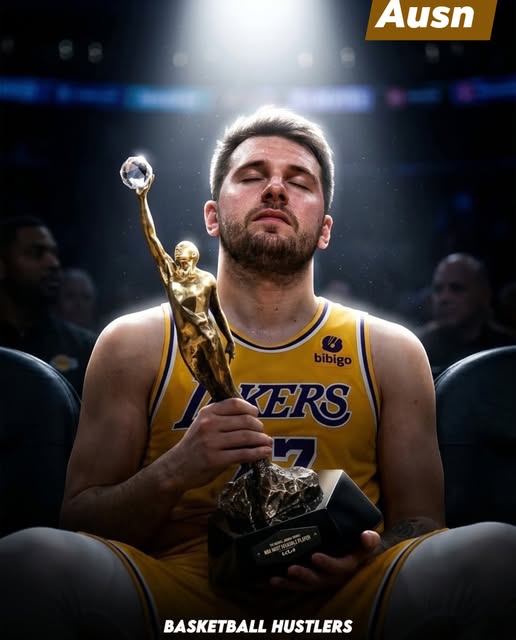
Luka Doncic, one of the brightest stars in the NBA, continues to dazzle fans with his extraordinary skill, uncanny court vision, and seemingly limitless ability to perform in clutch moments. But if we’re being honest, winning MVP in today’s ultra-competitive league is not just about triple-doubles, step-back threes, or buzzer-beating heroics; in the current narrative of modern basketball, Luka would need to achieve feats that extend far beyond anything a mere mortal—or even a basketball god—could reasonably accomplish. To truly secure MVP, it’s become apparent that the things he would need to do are nothing short of universe-altering. It starts with curing cancer. Yes, you read that correctly. If Luka Doncic wants to stand above the field and guarantee himself the MVP, he might as well pick up a lab coat, discover the cure for cancer, and release it to the world in time for the voting period. Not only would this save millions of lives, it would cement his status as not just the best player in the NBA, but a global hero whose impact stretches beyond sports, reminding voters and fans alike that MVP candidates are evaluated on influence as much as stats. It would be the ultimate crossover achievement: dominating on the court while simultaneously changing the trajectory of human history.
Next on Luka’s impossible checklist is solving world hunger. Because, obviously, curing cancer isn’t enough if people are still going to bed hungry. The MVP award in this scenario is no longer just a basketball accolade; it’s a recognition of humanitarian brilliance. Doncic would need to mobilize governments, corporations, and charitable organizations to eliminate food insecurity across continents. He’d have to master logistics, supply chains, and agricultural science, all while maintaining a 38-minute-per-game average and continuing to lead the Dallas Mavericks. Imagine Doncic, in full uniform, orchestrating international food relief efforts at halftime and still coming back to hit a step-back three over Giannis Antetokounmpo. This is not hyperbole—it is the reality of the modern MVP standard when you want to ascend to the mythical tier of basketball legend, the kind that transcends both sport and society.
Then there’s the small matter of making Joel Embiid finally face Nikola Jokic. On the surface, this seems trivial, just a basketball matchup, but it’s actually a metaphorical Everest. Luka needs to craft a scenario in which two of the league’s premier centers—Embiid, with his dominant paint presence, and Jokic, with his transcendent passing ability—clash in a way that will satisfy fans, statisticians, and analytics nerds everywhere. It’s not just about scheduling; it’s about manipulating the narrative of the NBA season to ensure that the greatest talents collide while Doncic himself remains the centerpiece. In other words, Luka has to be part player, part strategist, part master puppeteer, shaping the league’s storylines so that his brilliance is contextualized against the highest level of competition. Only then could MVP voters feel justified in granting him the award, because everyone loves an MVP who shines brightest when the stakes are impossibly high.
And, of course, Luka would need to end the war. Not metaphorically—literally. Imagine Doncic stepping onto a podium, dribbling between world leaders, and negotiating peace treaties with the same confidence and poise he displays on the court. He’d have to balance the delicate interplay of geopolitics, diplomacy, and global strategy, all while averaging 28 points, 9 rebounds, and 8 assists per game. The MVP award, after all, increasingly seems to reward influence, visibility, and the ability to shift public perception, and what better way to demonstrate that than by bringing nations together in peace? If Doncic ends a war, even a minor one, that accomplishment instantly eclipses everything else a player could do statistically, making his candidacy irresistible.
But even these monumental feats might not be enough. In order to truly claim the MVP crown, Luka would likely need to perform a series of increasingly absurd tasks. For instance, he would have to single-handedly develop a new dimension of basketball—literally create a new variant of the sport in which he is allowed to operate under physics-defying rules while everyone else remains bound by normal human limitations. He would need to invent a new scoring system where step-back threes count double, highlight-reel assists count triple, and defensive stops generate bonus points automatically credited to him. In doing so, Luka ensures that his statistical output becomes so absurdly overwhelming that no voter could rationally deny him the award.
Next, there’s the challenge of turning water into Gatorade for his teammates mid-game. The MVP is not just a personal honor; it’s a reflection of leadership and team impact. Doncic would need to ensure his teammates are performing at peak efficiency, and what better way to do that than by hydrating them with miraculous beverages that enhance performance instantly? Every opponent would be frustrated, every fan would be impressed, and every statistician would marvel at the sheer audacity of his impact on the game. It’s a symbolic gesture that captures the essence of leadership: enabling others to perform at their best while simultaneously shining as the undeniable centerpiece.
Luka would also need to develop telepathy for referees. Imagine a scenario in which he can subtly influence calls on the court, ensuring that borderline fouls on him are waived while those on opponents are flagged. This is, of course, a humorous exaggeration, but in the hyper-competitive context of MVP races, such a fantastical edge serves as a metaphor for the level of dominance and control a player like Doncic must wield to stand above peers like Giannis, Embiid, Jokic, or Curry. He must manipulate the game environment so completely that every moment on the court reinforces the perception of his superiority.
Even beyond the court, Luka’s MVP checklist would include a series of global-scale accomplishments. He might need to orchestrate a worldwide initiative to reverse climate change, simultaneously improving living conditions, stabilizing ecosystems, and maintaining perfect on-court performance. The modern MVP, in this exaggerated vision, is not merely a basketball player; he is a cultural, scientific, and humanitarian force whose influence radiates far beyond the lines of the court. By solving global crises, Luka would position himself as an irreplaceable figure not only in sports history but in the broader tapestry of human achievement.
Furthermore, Luka would need to master every position on the court at a world-class level. Not just point guard, not just scorer, not just playmaker—but also defensive anchor, rebounder, shot-blocker, three-point sniper, and facilitator. He would need to be every player simultaneously, covering all responsibilities while still maintaining his signature creativity and flair. Imagine a game where Doncic alternates seamlessly between positions, guarding the best forward while orchestrating offense and draining step-back threes, all in the same possession. The sheer versatility would be so overwhelming that MVP voters would be left with no choice but to award him the honor.
Luka’s MVP checklist would also include feats of entertainment and charisma. He would need to engage fans across social media, deliver iconic interviews, and inspire memes and viral highlights that keep him in the public consciousness throughout the voting period. It is, after all, impossible to win MVP without dominating both the narrative and the numbers, and in the modern age, narrative control is almost as important as statistical dominance. Doncic would need to become a global ambassador of basketball culture, representing not just the Mavericks but the sport itself in a way that reinforces his dominance and appeal.
In addition, Luka would need to perform humanitarian acts on a personal scale that defy belief. Building schools in underprivileged regions, funding clean water initiatives, establishing youth basketball programs, and mentoring the next generation of athletes would all reinforce the idea that MVP is not only about what you do on the court, but about how you impact the world. Each act would create a halo effect, intertwining athletic excellence with moral authority, further cementing his inevitability as a recipient of the league’s top individual honor.
And yet, after all these Herculean tasks—curing cancer, ending world hunger, orchestrating monumental matchups, ending wars, innovating the sport, hydrating teammates magically, influencing referees telepathically, combating climate change, mastering all positions, dominating the cultural landscape, and performing humanitarian feats—it might still feel insufficient for some voters. The modern MVP conversation often hinges on perception, narratives, and timing. Doncic’s challenge, then, is to not only perform these near-mythical feats but to ensure they are recognized at the right moment, framed in a compelling story, and understood in a way that resonates with voters across the league.
In conclusion, while Luka Doncic continues to dazzle with his on-court brilliance, the things he would need to do to “guarantee” MVP are, humorously, the stuff of legend. From curing cancer and solving world hunger to orchestrating historic matchups and ending wars, from bending the physical laws of basketball to influencing referees and saving the planet, the checklist is almost comically unattainable. Yet in exaggerating these feats, we underscore just how remarkable Luka’s achievements already are. Every triple-double, step-back three, and clutch assist is already a step toward this impossible MVP standard. Fans can only marvel at the combination of talent, skill, and charisma that allows Doncic to approach such legendary heights. The reality is, while he might not literally cure diseases or broker peace treaties, his ability to dominate games, influence narratives, and inspire millions worldwide ensures that every MVP conversation is incomplete without his name. And in the playful exaggeration of what it would take to win, we can appreciate just how extraordinary Luka Doncic truly is.