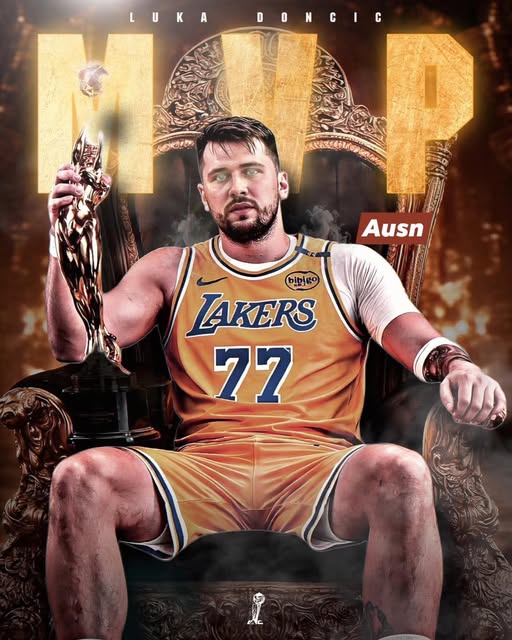
Luka Dončić’s career has been a story of rapid ascension, transcendent talent, and moments that blur the line between basketball brilliance and artistry. Now, as the 2026 season unfolds, he is on the cusp of achieving something truly historic: the possibility of becoming the first Los Angeles Lakers MVP since Kobe Bryant in 2008 while simultaneously contending for an NBA championship in the same season. The mere suggestion of this achievement ignites excitement not only among Lakers fans but throughout the league, as history, legacy, and greatness converge on a single player whose combination of skill, vision, and leadership is already legendary. The implications of Luka’s potential accomplishment extend far beyond personal accolades, shaping narratives about the Lakers’ franchise, modern NBA excellence, and the evolution of the game itself.
Luka’s journey to this point has been defined by consistency, growth, and the ability to elevate those around him. Since arriving in the NBA, he has been recognized as a generational talent, blending court vision, scoring versatility, and basketball intelligence in ways that few players have achieved. His skill set is rare: he can create shots off the dribble, read defenses before they react, and anticipate plays with uncanny precision. He is as comfortable orchestrating the offense as he is finishing through contact, and his passing ability is reminiscent of some of the greatest playmakers in league history. What sets Luka apart is not only his statistics but his impact on the court—the ability to make teammates better, control the pace of the game, and dominate both ends of the floor when necessary. His presence transforms the Lakers into a championship-caliber team, capable of competing with any opponent on any given night.
The potential to capture the NBA MVP award in the same season as winning a championship places Luka in rarefied company. Few players in league history have combined individual dominance with team success at such an elite level, and the context of the Lakers franchise adds even more significance. Kobe Bryant’s MVP season in 2008 was emblematic of his leadership, scoring ability, and relentless drive to win, setting a standard for excellence in Los Angeles that has remained unmatched for nearly two decades. For Luka to achieve a similar feat, he must not only maintain historic individual performance but also lead the Lakers through the trials of an entire season, navigating injuries, fatigue, and the ever-present pressure of expectation in one of the league’s most scrutinized markets. The convergence of personal achievement and team success is a challenge that tests every dimension of a player’s skill, resilience, and mental fortitude.
Statistically, Luka’s season has been nothing short of remarkable. He is posting elite numbers across multiple categories, blending scoring efficiency with assist creation and rebounding. His ability to generate offense from virtually anywhere on the floor makes him nearly impossible to defend, while his decision-making ensures that his teammates are involved and effective. Advanced metrics highlight his impact beyond traditional box score statistics: his presence on the floor improves the Lakers’ offensive rating, spacing, and efficiency, while also contributing to defensive organization through anticipation, communication, and effort. These factors collectively position Luka not only as a candidate for MVP but as the central figure in a team capable of contending for a title. The blend of individual dominance and team relevance is precisely what voters look for when awarding the league’s most prestigious individual honor.
The narrative surrounding Luka’s potential MVP season is also tied to his growth as a leader. Leadership in basketball is multifaceted, encompassing communication, accountability, and the ability to inspire teammates to perform at their highest level. Luka has developed this aspect of his game steadily, earning the respect and trust of veteran teammates while also mentoring younger players. His leadership style is rooted in performance first; he leads by example, often carrying the team through difficult stretches with clutch scoring, timely passes, and a relentless competitive drive. In a franchise like the Lakers, where history and expectation weigh heavily, leadership is as important as individual talent. Luka’s ability to command attention, motivate his peers, and maintain composure under pressure strengthens both his MVP candidacy and the Lakers’ championship aspirations.
The synergy between Luka and the Lakers’ roster is another critical factor in his pursuit of historic success. Surrounding him are complementary pieces capable of executing at the highest level, providing scoring, defense, and versatility. The Lakers have constructed a roster designed to maximize Luka’s unique skill set, offering shooters to space the floor, versatile defenders to mitigate opponent strengths, and role players who thrive in clutch moments. This balance is essential: while Luka is capable of carrying the team, championship-level success requires collaboration and chemistry. The combination of individual brilliance and team cohesion creates the conditions for a season in which an MVP award and a championship are both within reach, reinforcing the idea that Luka’s accomplishments are not only personal but also emblematic of the collective excellence of the Lakers organization.
The historical context of this potential achievement adds another layer of significance. The Lakers have a storied legacy, from Magic Johnson and Kareem Abdul-Jabbar to Kobe Bryant and Shaquille O’Neal, with each era defined by players who combined individual brilliance with championship success. Luka’s pursuit of an MVP and championship simultaneously positions him within this lineage, connecting him to the legacy of greatness that defines Los Angeles basketball. Comparisons are inevitable: fans, analysts, and historians will examine his statistics, impact, and clutch performances alongside those of the franchise’s legends. The possibility of achieving what no Laker has done since Kobe Bryant in 2008 elevates the stakes, creating a narrative arc that spans generations and highlights the cyclical nature of greatness within the organization.
Media coverage and public perception also play a role in Luka’s journey. As a high-profile player in a major market, his every performance is scrutinized, analyzed, and celebrated. Social media amplifies both praise and criticism, with highlights, statistics, and advanced metrics shared instantly across platforms. The narrative of Luka potentially achieving a historic milestone becomes a story that transcends basketball, entering broader cultural discourse. Analysts weigh his efficiency, leadership, and clutch performances against competitors across the league, while fans debate his standing in MVP discussions and potential legacy as one of the all-time greats. The pressure of this environment requires not only skill but mental resilience, as Luka navigates the expectations of a passionate fanbase and the intense spotlight of national and international attention.
Luka’s style of play is particularly suited to a season that could yield both MVP and championship honors. His combination of scoring, playmaking, and situational awareness allows him to control games, dictate pace, and exploit defensive mismatches. Unlike many superstars, he is not limited to one dimension; he can score in isolation, orchestrate pick-and-rolls, find open teammates, and adjust his approach based on the flow of the game. This versatility is critical in the modern NBA, where defensive schemes are complex, athleticism is premium, and small margins often determine outcomes. Luka’s ability to adapt, improvise, and execute under pressure gives the Lakers a decisive edge, reinforcing his status as a legitimate MVP candidate while also positioning the team for deep playoff success.
The narrative of Luka’s historic pursuit also underscores the evolving nature of basketball greatness. Modern NBA stars are defined not only by individual talent but also by their ability to impact the game across multiple dimensions: efficiency, leadership, versatility, and clutch performance. Luka embodies these qualities, blending traditional skills like scoring and rebounding with advanced elements such as floor spacing awareness, tempo control, and decision-making under duress. His pursuit of an MVP and championship simultaneously reflects the convergence of personal excellence and team achievement, illustrating how contemporary basketball greatness is measured not only by statistics but also by influence, adaptability, and the ability to inspire teammates to achieve collective goals.
Fans are already imagining the milestones, memorable games, and potential playoff runs that could define Luka’s season. Each high-scoring performance, clutch shot, and assist that leads to a key victory adds to the narrative of a historic campaign. Comparisons to Kobe Bryant’s 2008 season are inevitable, as are discussions about how Luka’s style, era, and teammates differ from previous generations. The excitement is compounded by the Lakers’ global fanbase, which engages with the narrative across continents, making Luka’s potential achievement a shared experience for millions of supporters. The combination of individual accomplishment and collective success creates a story that resonates deeply, blending personal triumph with organizational pride.
Beyond the statistics and accolades, Luka’s journey represents the pursuit of legacy. Achieving an MVP and championship in the same season is a rare feat, one that cements a player’s place in history and elevates their standing among the greatest of their generation. For Luka, this pursuit is as much about personal excellence as it is about contributing to the Lakers’ enduring legacy. The pressure, challenges, and expectations inherent in this pursuit are part of what defines greatness, requiring sustained focus, resilience, and the ability to rise above adversity. Every game becomes a chapter in a larger narrative, every victory a step toward history, and every moment an opportunity to leave an indelible mark on the franchise and the league.
The potential for Luka to achieve this milestone also highlights the symbiotic relationship between player and organization. The Lakers, in building a roster around Luka’s unique skills and supporting him with complementary talent, are investing in both immediate success and long-term legacy. The alignment between individual talent and organizational vision is critical: the player’s skill must be leveraged effectively, and the team’s strategy must maximize the potential for both personal and collective achievement. Luka’s pursuit of MVP and championship success exemplifies this alignment, demonstrating how franchise planning, coaching, and player execution intersect to create historic possibilities.
As the season progresses, the pressure will mount, the stakes will rise, and every performance will be scrutinized. Luka’s pursuit of MVP and championship simultaneously represents not only an individual challenge but a test of the Lakers’ collective resilience, strategic execution, and ability to perform under pressure. Each victory will be celebrated, each setback analyzed, and every moment will contribute to a larger story of athletic excellence and historical significance. The convergence of individual brilliance, team cohesion, and legacy-defining achievement creates a narrative arc that is as compelling as any in modern sports.
Ultimately, Luka Dončić’s potential to become the first Los Angeles Lakers MVP since Kobe Bryant in 2008 while capturing an NBA championship in the same season represents the pinnacle of basketball achievement. It is a story of skill, leadership, strategy, and resilience, blending personal excellence with collective success. The journey encompasses statistics, narrative, and cultural significance, highlighting the multi-dimensional nature of modern NBA greatness. As fans, analysts, and participants follow Luka’s season, they witness a story that transcends individual games, reflecting the essence of basketball as both sport and spectacle. History is within reach, and the 2026 season promises to be remembered not only for the Lakers’ success but for the historic pursuit of one of the game’s brightest stars.
Luka’s combination of vision, athleticism, and basketball intelligence positions him to achieve what few players in history have accomplished. Every possession, every assist, and every clutch moment is a building block toward potential history. The Lakers, the city, and the basketball world are all watching, aware that they may witness a convergence of talent, timing, and determination that defines an era. Luka’s pursuit of the MVP and championship simultaneously represents the culmination of years of preparation, growth, and refinement, offering a chance to etch his name alongside the legends who have shaped both the Lakers and the NBA at large.
The anticipation surrounding Luka’s historic season also underscores the emotional resonance of basketball. Fans invest not only in victories but in narratives of perseverance, skill, and leadership. Luka embodies these qualities, blending youthful brilliance with mature decision-making and the ability to inspire those around him. Each game is an opportunity to reinforce his legacy, each challenge a test of character, and each performance a reminder of the rare combination of talent and opportunity that defines generational players. In pursuing the first Lakers MVP since Kobe Bryant while contending for a championship, Luka is not merely chasing accolades—he is writing a chapter in NBA history that celebrates excellence, determination, and the enduring magic of basketball.