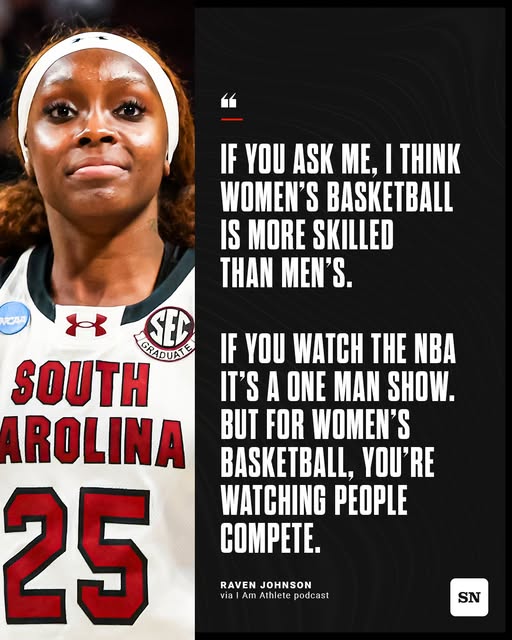
Raven Johnson, the standout guard from the University of South Carolina, has never been one to shy away from bold statements, and her recent remark that women’s basketball is superior to men’s has ignited conversation across the sports world. At first glance, the comment might strike some as playful or provocative, but those who follow Johnson’s career closely know that she speaks from a perspective shaped by experience, skill, and a deep understanding of what it takes to compete at the highest levels of basketball. Johnson has been a force in the women’s game for years, and her perspective offers insights into the evolution of women’s basketball, the skill levels required, and the intensity and strategy that define the sport at its highest level. For Johnson, the comparison isn’t about diminishing men’s basketball but rather about highlighting the attributes, athleticism, and tactical sophistication that have made the women’s game increasingly compelling and competitive. Her career at South Carolina, a powerhouse program with multiple national championships under coach Dawn Staley, has exposed her to elite competition, pressure-packed moments, and a style of play that rewards intelligence, versatility, and teamwork, all of which inform her belief that the women’s game can, in many ways, exceed the spectacle and depth of men’s basketball.
Johnson’s assertion comes at a time when women’s basketball has gained tremendous visibility and respect. Programs like South Carolina, UConn, Stanford, and Baylor have not only produced champions but have consistently elevated the level of competition nationwide. The skill sets required for elite women’s basketball — including shooting precision, defensive awareness, and situational intelligence — are increasingly advanced. Players like Johnson have demonstrated the capacity to dominate in multiple facets of the game: scoring, passing, defending, and rebounding. This versatility challenges the old stereotypes that women’s basketball lacks speed, physicality, or entertainment value. Instead, Johnson argues, the game demands a cerebral approach that is often underestimated by casual observers but is immensely demanding for players who want to compete at the highest level. Her perspective reflects a recognition that the women’s game is not just about athleticism but about strategy, adaptability, and a nuanced understanding of basketball dynamics, which are qualities that can, in her estimation, surpass the men’s game in sophistication and competitiveness.
The evolution of women’s basketball over the past two decades has been dramatic, and Johnson’s career has unfolded within that context. Athletes today train year-round, with access to advanced conditioning, analytics, and coaching that allow them to perform at levels previously thought to be exclusive to men. Players like Johnson are not only fast and strong but also exceptionally skilled in ball handling, shooting, and court vision. The game has become faster, more physical, and more tactical, with an emphasis on spacing, decision-making, and team dynamics. Johnson’s assertion that women’s basketball is superior reflects an appreciation for these qualities, which she believes require a higher level of mental and physical preparation than is often acknowledged. When watching elite women’s basketball, observers can see intricate offensive sets, switch-heavy defenses, and dynamic adjustments in real time, all executed under immense pressure. For Johnson, this is where the game’s true complexity lies and where it can, in some ways, outshine the men’s game, which often relies more heavily on raw athleticism.
One of the factors that fuels Johnson’s belief is the competitive balance in women’s basketball. While the men’s NCAA landscape can sometimes be dominated by a few powerhouse programs with deep recruiting advantages, women’s basketball has evolved to offer more parity at the top level, especially among programs that consistently compete for national championships. Johnson has competed in high-stakes games where the margin for error is razor-thin, and the difference between victory and defeat often comes down to preparation, teamwork, and execution rather than individual talent alone. The intensity of these matchups, coupled with the need for tactical adaptability, reinforces her perspective that women’s basketball requires a unique combination of skill, intelligence, and mental toughness. When she says the game is superior, she is speaking to the richness of the competition, the strategic demands, and the way in which players must constantly elevate their performance to meet the challenge.
Johnson’s own performance at South Carolina exemplifies these qualities. She has consistently been a leader on the court, demonstrating the ability to impact every aspect of the game. Her scoring is precise and versatile, her defense disruptive and intelligent, and her court awareness allows her to anticipate plays before they develop. This level of mastery comes from years of dedication, practice, and study, and it reflects the broader excellence present in elite women’s basketball. Johnson sees her peers as athletes who combine these physical and mental skills in ways that demand respect and admiration. For her, the combination of versatility, skill, and tactical acumen makes the women’s game not just competitive but, in some ways, more sophisticated and complete than the men’s game.
The public’s perception of women’s basketball has also played a role in shaping Johnson’s perspective. Despite growing visibility through national broadcasts and social media, the women’s game has historically been undervalued compared to men’s basketball. Johnson’s remark serves as a challenge to that perception, inviting fans and analysts to reconsider assumptions about skill, excitement, and entertainment value. The women’s game offers a unique blend of athleticism, strategy, and intensity that is often overlooked. Johnson’s confidence in her assessment underscores the legitimacy of these qualities and encourages a broader conversation about how basketball should be evaluated, not solely through the lens of gender but through the lens of performance, intelligence, and competitive excellence. Her comment is both a celebration of the women’s game and a call for greater recognition of the players who dedicate themselves to its advancement.
Teamwork is another area where Johnson highlights the superiority of women’s basketball. The sport emphasizes collaboration, ball movement, and communication in ways that create a fluid, high-level style of play. Players must read defenses in real time, make split-second decisions, and work together to create scoring opportunities or disrupt opponents’ plans. Johnson’s own experience has shown her how critical these elements are to success. She has seen how teams that execute well as units can dominate games, regardless of individual talent, and she appreciates the intellectual and emotional demands this places on players. The emphasis on teamwork, in her view, adds a layer of complexity to the game that makes it not only compelling to watch but also incredibly challenging to play at a high level. This is a dimension that she feels sets the women’s game apart and supports her claim of its superiority.
Furthermore, Johnson’s perspective is informed by the global growth of women’s basketball. The sport has expanded internationally, with professional leagues in Europe, Australia, and Asia offering competitive opportunities for elite players. International competition has introduced new styles of play, higher levels of athleticism, and increased tactical complexity. Johnson has competed against international talent and observed firsthand the sophistication and skill level present on a global scale. This exposure reinforces her belief that women’s basketball is not just a domestic phenomenon but a high-level, worldwide sport with a depth of talent and strategic nuance that rivals or exceeds men’s basketball in certain respects. The combination of domestic and international competition elevates the women’s game, providing constant challenges and opportunities for growth that shape players into complete athletes capable of executing under pressure.
Johnson’s viewpoint also touches on the broader cultural and social context of women’s sports. Athletes in women’s basketball often have to navigate unique challenges, from disparities in pay and exposure to societal expectations about athleticism and gender. The resilience and determination required to thrive in this environment add another dimension to Johnson’s argument about the superiority of the women’s game. Competing at a high level in women’s basketball demands not only physical skill but also mental toughness, adaptability, and a commitment to excellence in the face of structural inequities. Johnson’s confidence in her statement reflects her understanding that the achievements of women’s basketball players, including her own, are remarkable not just for their athletic value but for the broader significance of excelling in a demanding and evolving landscape.
In addition to her own achievements, Johnson points to the excitement and unpredictability of women’s basketball as a factor in its growing appeal. NCAA tournaments and professional leagues regularly feature close, high-intensity games where strategy, stamina, and mental focus determine outcomes. Upsets are common, and games often hinge on the execution of a single possession or a timely defensive stop. Johnson appreciates that this combination of competitive balance and strategic depth creates a thrilling spectacle for fans, making the sport engaging and intellectually stimulating. The unpredictability, combined with the level of skill on display, reinforces her assertion that women’s basketball offers a distinctive, and in some ways superior, experience compared to men’s basketball, where athletic dominance can sometimes overshadow tactical nuance.
Ultimately, Raven Johnson’s claim that women’s basketball is superior to men’s is rooted in her lived experience, her observation of high-level competition, and her appreciation for the unique demands of the game. She celebrates the skill, strategy, teamwork, and resilience inherent in women’s basketball while challenging audiences to reconsider preconceived notions about gender and athletic performance. Her perspective is informed by years of competition, the mentorship of elite coaches, exposure to international play, and participation in some of the most intense tournaments in college basketball. Johnson’s statement is not merely a bold proclamation; it is a reflection of her respect for the sport, her recognition of its growing sophistication, and her desire to elevate the conversation around women’s athletics.
As the sport continues to gain visibility and investment, Johnson’s voice adds an important dimension to the discourse surrounding basketball. Her assertion encourages fans, analysts, and players to examine the game on its merits, evaluating skill, strategy, and competition rather than relying on gender-based assumptions. It highlights the evolution of women’s basketball into a highly competitive, tactically rich, and athletically demanding sport that deserves recognition on the same level as men’s basketball. Johnson’s own career, her leadership on the court, and her outspoken confidence exemplify the qualities that make the women’s game not only compelling but, in her view, superior. In celebrating the unique attributes of women’s basketball, she is also advocating for a broader appreciation of excellence in sports, reminding audiences that talent, dedication, and competitive intensity transcend traditional categorizations.
Raven Johnson’s commentary may provoke debate, but it also reinforces the growing legitimacy and prominence of women’s basketball as a sport worthy of serious attention. Her claim underscores the evolving landscape of basketball, the increasing sophistication of players and teams, and the heightened visibility of women’s athletics. Through her lens, the game is rich with strategy, athleticism, and competitive drama, positioning it as not only compelling entertainment but also a realm in which skill, intelligence, and teamwork are celebrated at the highest level. Her statement reflects a conviction born from experience and expertise, and it challenges both fans and the broader sports community to reconsider assumptions about the relative value and excitement of women’s versus men’s basketball. By doing so, Johnson contributes to the ongoing narrative that women’s basketball is an elite, sophisticated, and increasingly influential sport, deserving of recognition, respect, and admiration for its unique contributions to the world of athletics.