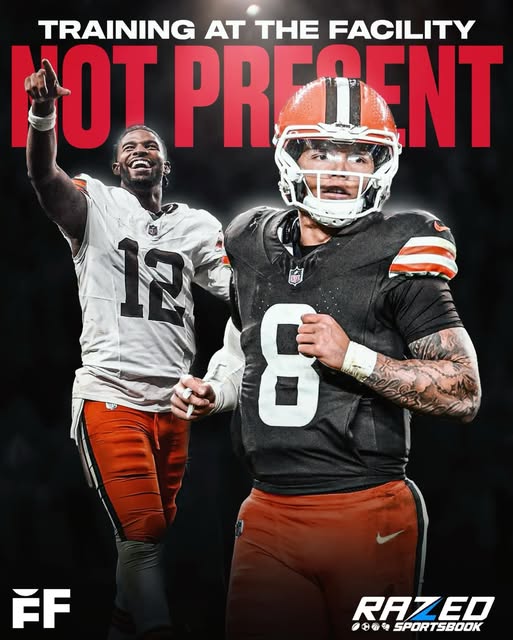
According to Todd Monken, the current head coach of the Cleveland Browns, one of the more intriguing storylines developing ahead of the 2026 NFL season centers on the contrasting offseason presence of two young quarterbacks: Dillon Gabriel and Shedeur Sanders. Monken noted that Gabriel has not been around the team’s facilities this summer, while Sanders, by contrast, has been consistently working out there and building familiarity with the organization. That difference, subtle on the surface, has quickly fueled speculation about Gabriel’s standing within the team and whether his future in Cleveland could already be in question.
In the NFL, offseason presence matters more than it might appear at first glance. While attendance at certain workouts may not always be mandatory, especially depending on contract structure or injury status, coaches and front offices still take note of who is around the building, who is putting in extra work, and who is building chemistry with teammates. For a young quarterback—particularly one drafted just a year earlier—those details can carry even greater weight. Gabriel, selected in the third round, entered the league with expectations of development and competition, not necessarily immediate stardom. However, the absence from team facilities at this stage of his career naturally raises eyebrows, especially when another young quarterback is doing the opposite.
Shedeur Sanders’ consistent presence has not gone unnoticed. Being around the facility allows a quarterback to build relationships with receivers, learn the nuances of the playbook, and demonstrate commitment to coaches and teammates alike. For Sanders, these workouts are more than just physical preparation—they are opportunities to establish trust, show leadership, and position himself as a serious contender within the quarterback room. In a league where perception can influence opportunity, showing up regularly can send a strong message about dedication and readiness.
Meanwhile, Gabriel’s absence has become a focal point not necessarily because it is unusual in isolation, but because of the context surrounding it. After being drafted in the third round, he was expected to compete, develop, and gradually carve out a role within the Browns’ offense. However, reports indicate that he has yet to make a strong impression on Monken and the coaching staff. That lack of immediate impact, combined with his current absence, has created a narrative that suggests uncertainty about his place on the roster.
Rumors of Gabriel potentially being a trade candidate have begun to circulate, and while such speculation is common during the offseason, it often has roots in observable patterns. Teams rarely move on quickly from recent draft picks unless there are concerns about fit, performance, or long-term potential within the system. In Gabriel’s case, the combination of limited early impact and reduced visibility during offseason activities has contributed to the perception that he may not be fully aligned with the team’s plans moving forward.
It’s important, however, to approach these rumors with a degree of caution. The NFL offseason is a time when narratives can form quickly, sometimes outpacing reality. A player’s absence from team facilities can be due to a variety of reasons—training independently, managing personal matters, or following a different preparation schedule. Without full context, it is difficult to draw definitive conclusions. That said, perception often becomes reality in professional sports, and once questions about a player’s commitment or fit begin to circulate, they can be difficult to shake.
For Monken, the situation presents both a challenge and an opportunity. As a head coach, he must evaluate talent objectively while also managing the dynamics of the locker room. Highlighting Sanders’ presence without directly criticizing Gabriel suggests a careful approach—acknowledging one player’s effort while allowing the broader narrative to develop naturally. Coaches often use subtle messaging to motivate players or signal expectations, and in this case, the contrast between the two quarterbacks speaks volumes without requiring explicit commentary.
The Browns’ quarterback situation adds another layer of complexity. Teams are always searching for stability and depth at the position, and young quarterbacks are often evaluated not just on their physical tools but on their intangibles—work ethic, leadership, adaptability, and consistency. Sanders’ visible commitment could give him an edge in these areas, while Gabriel’s absence, fair or not, may raise questions that extend beyond his on-field performance.
If Gabriel is indeed being considered as a potential trade candidate, it would reflect a broader evaluation of his fit within the organization. Trades involving young quarterbacks are not unprecedented, especially if a team believes another player better aligns with its system or long-term vision. For Gabriel, a change of scenery could potentially offer a fresh start, an opportunity to reset expectations, and a chance to prove himself in a different environment. For the Browns, moving on from a recent draft pick would signal a willingness to make decisive changes in pursuit of the best possible roster configuration.
At the same time, it’s worth noting that development timelines for quarterbacks can vary significantly. Not every player makes an immediate impression, and some require time to adjust to the speed and complexity of the NFL. Gabriel’s journey may still be in its early stages, and a single offseason does not necessarily define a career trajectory. However, in a competitive environment where opportunities are limited and expectations are high, even small factors can influence how a player is perceived and evaluated.
The contrast between Gabriel and Sanders also highlights the broader theme of competition within the NFL. Every roster spot, every rep, and every opportunity must be earned, and players are constantly being evaluated on both tangible and intangible factors. Sanders’ approach—showing up, putting in work, and making his presence felt—aligns with what coaches typically value in young players trying to establish themselves. Gabriel’s situation, whether influenced by circumstance or choice, serves as a reminder that visibility and engagement can play a crucial role in shaping a player’s standing within a team.
As the 2026 season approaches, the Browns will continue to assess their quarterback room, weighing performance, potential, and fit. Decisions made during this period can have long-term implications, influencing not only the team’s immediate competitiveness but also its future direction. For Gabriel, the coming weeks and months could be pivotal. Whether he remains with the team, earns a larger role, or becomes part of a trade scenario, his next steps will likely shape the narrative surrounding his early NFL career.
For Sanders, the focus will be on building momentum. Consistent offseason work is only the beginning; translating that effort into performance during training camp and the regular season is what ultimately determines a player’s trajectory. Still, the foundation he is building now could position him favorably as the team evaluates its options.
In the end, the situation underscores the delicate balance between opportunity and perception in professional sports. Talent alone is rarely enough; how that talent is developed, showcased, and perceived can make all the difference. Gabriel’s absence has raised questions, Sanders’ presence has created buzz, and the Browns find themselves at the center of a developing storyline that could have significant implications for their quarterback depth chart. As with many offseason narratives, the full picture will only become clear with time, but for now, the contrast between the two quarterbacks serves as a compelling glimpse into the dynamics of competition, evaluation, and decision-making at the highest level of football.