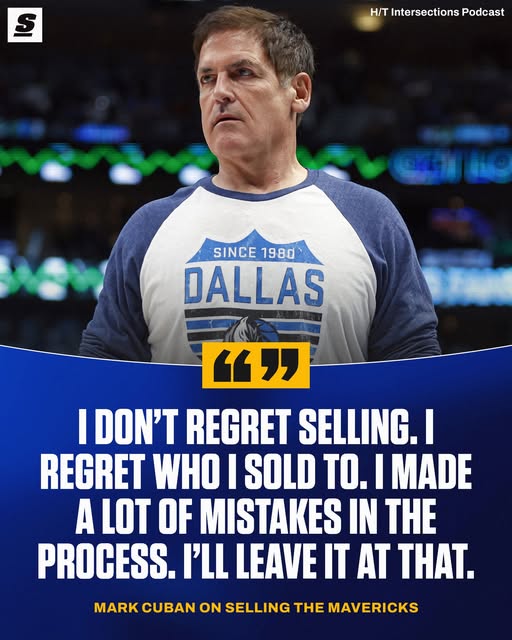
When Mark Cuban openly talks about selling the Dallas Mavericks, it immediately grabs attention—not just because of the franchise, but because of how closely Cuban has been tied to the team’s identity for more than two decades. This isn’t just an owner stepping away from an asset; it’s one of the most visible and hands-on figures in modern sports ownership addressing a major shift.
Cuban bought the Mavericks in 2000 and quickly became one of the most recognizable owners in sports. He wasn’t the distant, behind-the-scenes type—he was courtside, vocal, emotional, and deeply involved in both basketball operations and the overall culture of the organization. Under his leadership, the Mavericks transformed from a struggling franchise into a consistent contender, highlighted by their 2011 NBA championship. That run, led by Dirk Nowitzki, cemented Cuban’s legacy as an owner willing to invest, take risks, and build a winning environment.
So when Cuban speaks candidly about selling, it naturally raises questions: why now, what changes, and what does it mean for the future of the team? From a business standpoint, selling a stake—or even full control—of an NBA franchise today is vastly different than it was in 2000. Team valuations have skyrocketed, media rights deals are expanding, and ownership groups are increasingly tied to larger corporate ecosystems, including real estate, entertainment, and even gambling infrastructure. Cuban himself has hinted at that reality, suggesting that modern ownership is about more than just basketball—it’s about positioning the franchise within a broader business strategy.
That context helps explain why a sale doesn’t necessarily mean Cuban is stepping away entirely. In fact, in many modern ownership transitions, former owners retain some level of involvement, whether in basketball operations, branding, or advisory roles. Cuban has long expressed that his passion lies in the competitive side—the team-building, the culture, the pursuit of winning—rather than just the financial ownership piece. So even as ownership structures evolve, it wouldn’t be surprising to see him remain a visible and influential figure around the Mavericks.
There’s also the reality that the NBA itself is changing. New ownership groups are often backed by massive financial resources and bring different priorities to the table. Some focus on global expansion, others on arena development or entertainment districts, and others on leveraging data and analytics at a deeper level. If Cuban believes a new ownership structure can elevate the Mavericks in those areas—especially in ways that require capital or partnerships beyond what a single owner typically provides—that could be a driving factor behind his openness about selling.
From a basketball perspective, the timing is interesting as well. The Mavericks are in a competitive window, built around superstar talent and aiming to contend in a stacked Western Conference. Ownership transitions during competitive periods can be delicate, as stability is crucial for maintaining team chemistry and long-term planning. Cuban’s transparency may actually help in that regard, signaling that any changes are being considered thoughtfully rather than abruptly.
Fans, of course, have a different lens. For many Mavericks supporters, Cuban is the franchise. He represents an era of passion, accessibility, and willingness to challenge norms. Hearing him talk about selling can feel like the end of an era, even if the team itself remains competitive. At the same time, his openness may also provide reassurance—he’s not disappearing quietly or leaving uncertainty behind; he’s engaging with the conversation directly.
Another layer to this is Cuban’s personality. He has always been someone who embraces transparency, often speaking candidly about decisions, successes, and mistakes. That approach carries over here. Rather than avoiding the topic or issuing vague statements, he’s addressing it head-on, which keeps the narrative grounded in reality rather than speculation. It also reflects a level of confidence—both in the value of the franchise and in his own legacy as its steward.
Financially, the move makes sense in the broader context of sports ownership trends. NBA teams are now among the most valuable assets in sports, and selling—even partially—can unlock enormous capital. Owners across leagues have explored similar paths, bringing in partners or selling stakes to position their franchises for long-term growth. Cuban acknowledging this reality doesn’t diminish his connection to the Mavericks; it highlights his awareness of where the league and the business of sports are headed.
There’s also the question of control versus collaboration. Modern ownership often involves groups rather than individuals, and that can shift how decisions are made. Cuban has historically been a hands-on owner, deeply involved in both big-picture strategy and day-to-day operations. Transitioning into a structure where decisions are shared—or where his role evolves—would be a significant change. But it could also allow him to focus more on the areas he enjoys most while leveraging the strengths of new partners.
Ultimately, Cuban talking openly about selling the Mavericks isn’t just about a transaction—it’s about evolution. It reflects changes in the NBA, in sports business, and in his own role within that landscape. It signals that even the most iconic owner-player relationships aren’t static; they adapt over time as circumstances and opportunities shift.
And maybe that’s the most important takeaway. This isn’t necessarily an ending—it’s a transition. Cuban helped build the Mavericks into what they are today, and whether he remains a minority owner, a decision-maker, or simply a guiding presence, his influence isn’t going to disappear overnight. But the idea of new ownership, new structure, and new direction does mark a significant moment, one that fans, players, and the league as a whole will be watching closely.