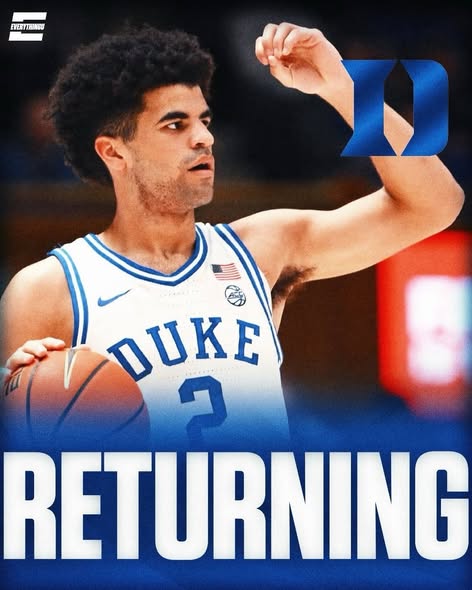
The news hit like a thunderclap across the college basketball world, the kind that jolts even the most seasoned fans out of their routines and sends message boards, group chats, and social media into overdrive. In an era where roster continuity feels like a relic and one-and-done departures are almost expected, the decision by Cayden Boozer and Cameron Boozer to return to Duke landed with a kind of emotional weight that’s become increasingly rare. It wasn’t just about talent coming back. It was about belief, unfinished business, and a throwback sense of purpose that resonated far beyond Durham.
For Duke fans, this moment felt like a reclaiming of something that has slowly eroded in modern college basketball. The program has always been synonymous with excellence, discipline, and a relentless pursuit of championships, but in recent years, like many elite programs, it has had to navigate the churn of early NBA departures. That reality makes the Boozer twins’ decision stand out even more. These are not fringe contributors or role players testing the waters and opting for another year. These are foundational stars, the kind of players who shape the identity of a team and define its ceiling.
Cameron Boozer, already widely projected as a future National Player of the Year, embodies the modern forward in every sense. At 6’9”, he blends size, skill, and basketball IQ in a way that makes him a matchup nightmare. He can stretch the floor, attack off the dribble, rebound with authority, and defend multiple positions. More importantly, he plays with a composure and maturity that belies his age. His decision to return wasn’t framed around draft positioning or personal accolades. Instead, he made it clear that his motivation centered on one thing: winning a championship for Duke.
That statement alone speaks volumes. In a landscape where individual branding and professional aspirations often dominate the conversation, Cameron’s emphasis on team success felt refreshingly grounded. It’s not that he lacks ambition for the next level—far from it. Rather, it’s that he recognizes the value of legacy, of leaving a mark that isn’t solely defined by where he’s selected in the NBA Draft. Championships endure. They become part of a program’s lore, replayed in highlight reels and remembered by generations of fans.
Cayden Boozer’s return carries its own significance. While Cameron often draws the headlines, Cayden’s impact cannot be overstated. As a guard, he provides the kind of stability and playmaking that elevates everyone around him. His ability to control tempo, make smart decisions under pressure, and deliver in key moments makes him the engine that keeps Duke’s offense running smoothly. He’s not just a complementary piece; he’s a co-pillar of the team’s success.
Together, the Boozer twins bring a chemistry that can’t be manufactured. Years of playing alongside each other have created an intuitive connection, the kind where a glance or subtle movement is enough to communicate intent. That familiarity translates into efficiency on the court, where split-second decisions can determine the outcome of a game. It also fosters a sense of trust that extends to their teammates, setting a tone for unselfish play and collective accountability.
The ripple effects of their return are already being felt. For teammates, it’s a surge of confidence. Knowing that two elite talents are committed to the same goal reinforces belief in what the team can achieve. For incoming recruits, it’s a powerful signal that Duke remains a destination where top players can pursue both individual growth and team success. For opponents, it’s a warning that the road to a championship just became significantly more challenging.
There’s also a broader narrative at play, one that touches on the evolving identity of college basketball. The sport has undergone significant changes in recent years, from the transfer portal to NIL opportunities, reshaping how players approach their careers. Within that context, decisions like this stand out as reminders that there’s still room for tradition, for loyalty, and for the pursuit of something bigger than oneself. It’s not about rejecting the modern realities of the game but about finding a balance between personal advancement and collective achievement.
Cameron’s comments about wanting to help Duke win a championship weren’t delivered with bravado or theatrics. They carried a quiet determination, a sense that this goal had been weighing on him long before the announcement was made. It’s the kind of mindset that can galvanize a locker room. When your best player is fully invested in a shared mission, it creates a standard that everyone else feels compelled to meet.
Of course, expectations will now skyrocket. That’s the nature of the beast when you play at a program like Duke, and it only intensifies when players of this caliber return. Every game will be scrutinized, every performance dissected. Opponents will circle matchups against Duke on their calendars, eager for the opportunity to measure themselves against one of the nation’s most talented rosters. Pressure will be constant, unforgiving, and inescapable.
But if anything, the Boozer twins seem built for that environment. They’ve grown up around the game, accustomed to high expectations and the spotlight that comes with being elite prospects. Pressure isn’t something they shy away from; it’s something they embrace. It sharpens their focus, fuels their preparation, and ultimately brings out the best in their abilities.
There’s also an emotional component to this story that shouldn’t be overlooked. College basketball is, at its core, about more than just wins and losses. It’s about moments, connections, and the shared experiences that bind players and fans together. When stars choose to stay, they deepen those connections. They give fans another season to invest, to cheer, to hope. They create continuity in a sport that often feels transient.
Imagine the atmosphere at Cameron Indoor Stadium when the Boozer twins take the floor again. The anticipation, the energy, the sense of possibility—it all becomes amplified. Every home game transforms into an event, every possession infused with the knowledge that this could be part of a special run. Those are the moments that define college basketball at its best.
For the program itself, this decision represents an opportunity to build something lasting. Championships aren’t won on talent alone. They require cohesion, resilience, and the ability to navigate adversity. Having experienced players who understand the system and each other provides a foundation that can withstand the inevitable challenges of a long season. It allows the coaching staff to expand the playbook, to trust in the team’s ability to execute at a high level, and to push for excellence without constantly starting from scratch.
There will be hurdles along the way. Injuries, tough losses, and the grind of conference play will test the team’s resolve. But with leaders like Cameron and Cayden, there’s a sense that Duke is better equipped to handle those challenges. Their presence offers stability, a steadying force that can keep the team focused when things don’t go according to plan.
In the end, the significance of this moment goes beyond any single season. It’s about what it represents—a reaffirmation of values that sometimes feel overshadowed in the modern game. It’s about players choosing to invest in a shared vision, to chase something that requires sacrifice and commitment. It’s about the idea that greatness isn’t just measured by individual milestones but by the impact you have on those around you and the legacy you leave behind.
As the season approaches, the narrative will continue to evolve. There will be predictions, debates, and endless analysis about Duke’s chances of cutting down the nets. But at the heart of it all remains a simple, powerful truth: two of the program’s brightest stars chose to stay, to believe, and to chase a championship together.
And in a sport that thrives on passion and possibility, that might be the most compelling story of all.