The debate around Cameron Boozer and the way he is officiated has become one of the most polarizing discussions in college basketball, but when you strip away the noise, the outrage, and the tribal loyalty that often defines the sport, the reality is far more straightforward than many are willing to admit. Watching Boozer night after night, possession after possession, it becomes increasingly difficult to understand how anyone can credibly argue that he is somehow benefiting from favorable whistle treatment. If anything, the evidence points overwhelmingly in the opposite direction.
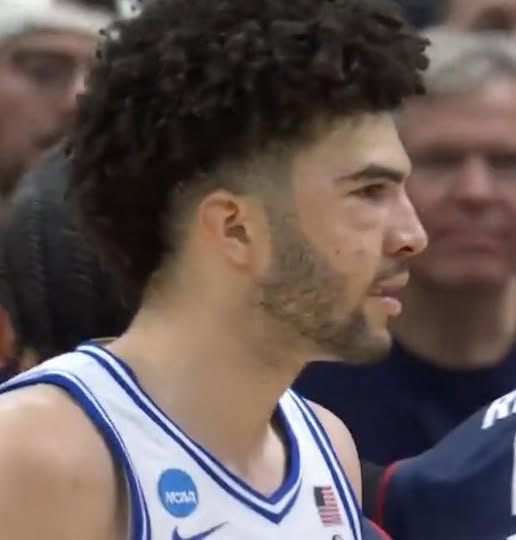
Start with the physical toll. Basketball is inherently a contact sport, especially for dominant frontcourt players who operate in the paint, but there is a clear difference between routine physicality and what Boozer has been subjected to over the course of the season. A swollen eye is not a minor detail—it is a visible, undeniable indicator of repeated, forceful contact. It is the kind of injury that doesn’t happen in isolation or by accident. It accumulates, often from missed calls, from moments when defenders push the boundaries of legality because they believe they can get away with it.
Then there was the jersey incident, a moment that should have been a flashpoint for broader conversation but somehow faded into the background. Having your jersey ripped during live play is not just symbolic—it is literal evidence of excessive contact. Jerseys don’t tear under normal defensive pressure. They tear when players are grabbed, pulled, or held beyond what the rules permit. That play alone should have reinforced what many already suspected: Boozer is being defended with a level of physical aggression that goes well beyond standard practice, and far too often, it goes unpunished.
Layer on top of that the scratches—visible, repeated, and impossible to ignore. These aren’t isolated marks; they are part of a pattern. Scratches on arms, shoulders, and upper body areas typically come from defenders swiping, reaching, and making contact that should, under most interpretations of the rulebook, result in fouls. When those calls aren’t made consistently, it sends a message, whether intentional or not. It tells opposing players that they can push the limits further against Boozer than they might against others.
And that is where the conversation becomes less about individual plays and more about systemic perception. Great players often face the paradox of their own dominance. Because they are stronger, more skilled, and more capable of playing through contact, officials sometimes subconsciously adjust their thresholds. What might be a foul for an average player becomes “play on” for someone like Boozer. It’s not necessarily bias in the traditional sense; it’s a recalibration of expectations. The problem is that the rulebook does not change based on who has the ball.
This phenomenon isn’t new. Basketball history is filled with examples of elite players who had to endure more contact than their peers before getting a whistle. The logic often goes that because they can handle it, they should handle it. But that logic is fundamentally flawed. The purpose of officiating is to enforce rules consistently, not to test the durability of star players.
For Boozer, this inconsistency has real consequences. It affects not just his individual performance but also the way defenses scheme against him. If defenders believe they can be more physical without being penalized, they will take that risk every time. It becomes a strategic advantage—one that is only possible because of inconsistent officiating. Over time, that shapes the entire dynamic of a game.
Critics who argue that Boozer is already benefiting from calls often point to his physicality on offense, suggesting that he initiates contact and therefore shouldn’t expect whistles. But this argument doesn’t hold up under closer scrutiny. Initiating contact does not give defenders carte blanche to respond with illegal physicality. Offensive aggression and defensive fouling are not mutually exclusive; both can occur on the same play. The key is whether the defender’s actions violate the rules, and in Boozer’s case, there is ample evidence that they often do.
There is also the matter of visibility. Boozer’s style of play puts him in high-contact areas—the paint, the low block, the lane—where collisions are frequent and intense. These are the zones where fouls are both most likely to occur and most difficult to officiate. But difficulty does not excuse inaccuracy. If anything, it demands greater focus and consistency from officials.
Another layer to this discussion is the psychological aspect. Players adapt to how games are called. If Boozer senses that he is not going to get whistles, he may adjust by either becoming more physical himself or by trying to avoid contact altogether. Both scenarios can impact his effectiveness. Meanwhile, defenders gain confidence, pushing boundaries further with each uncalled foul. It becomes a feedback loop that reinforces itself over time.
From a broader perspective, the way Boozer is officiated raises questions about how the sport protects its stars. College basketball, like any major sport, thrives on its marquee players. They are the draw, the storyline, the reason fans tune in. Allowing those players to be subjected to excessive, unpenalized physicality not only affects individual games but also the overall product. It risks diminishing the quality of play and increasing the likelihood of injury.
There is also an element of fairness that cannot be ignored. The integrity of the game depends on consistent rule enforcement. When one player is clearly absorbing more contact than others without corresponding calls, it undermines that integrity. It creates a perception—whether accurate or not—that the game is not being officiated evenly.
What makes the situation even more frustrating for observers is the clarity of the evidence. This isn’t a case built on subjective interpretation alone. The swollen eye, the ripped jersey, the visible scratches—these are tangible, undeniable indicators. They tell a story that goes beyond box scores or highlight reels. They speak to the physical reality of what Boozer is enduring on the court.
And yet, despite all of this, the narrative persists in some circles that Boozer is somehow favored by officials. It is a narrative that seems disconnected from the visual and statistical evidence. Perhaps it stems from a broader skepticism toward star players, or from a reluctance to acknowledge that officiating inconsistencies can cut both ways. Whatever the source, it does not align with what is actually happening on the floor.
Ultimately, the conversation should not be about whether Boozer is “tough enough” to handle the contact. That is not in question. He has already demonstrated remarkable resilience and composure in the face of sustained physical play. The question is whether the game is being officiated in a way that is fair, consistent, and in line with its own rules.
If the answer to that question is no—and the available evidence suggests that it often is—then the focus needs to shift. It needs to move away from questioning Boozer and toward examining the standards being applied by officials. Because at its core, this is not just about one player. It is about the principles that govern the sport.
Boozer’s situation serves as a case study, a lens through which to examine broader issues within college basketball officiating. It highlights the challenges of managing physical play, the influence of player reputation, and the importance of consistency. But most importantly, it underscores the need for accountability.
The solution is not complicated, even if its implementation can be challenging. It starts with recognizing the problem—acknowledging that Boozer is not getting the level of protection that the rules are designed to provide. From there, it requires a commitment to consistency, to calling games the same way regardless of who is involved or how physically imposing they might be.
Until that happens, the debate will continue. Fans will argue, analysts will dissect, and players will adapt. But for those watching closely, the reality is already clear. The physical evidence is there, visible in every game, etched into Boozer’s appearance and style of play. It tells a story that words alone cannot fully capture.
And that story does not support the idea that he is getting too many calls. If anything, it makes a compelling case that he isn’t getting nearly enough.