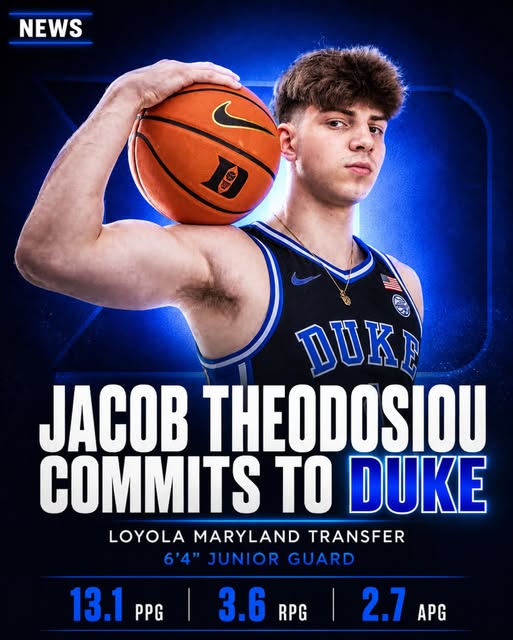
Welcome to the brotherhood, Jacob Theodosiou. That’s the kind of line that feels half like a joke and half like a quiet acknowledgment of something real, something earned in ways that don’t always show up on stat sheets or highlight reels. The funny part—if you can call it that—is how quickly people will label someone a “practice body,” as if that role exists in a vacuum, as if it doesn’t come with its own grind, its own pride, its own strange kind of pressure. Because the truth is, nobody who gets anywhere near that level just wandered in off the street. Even the guys who aren’t expected to play meaningful minutes had to fight, scrape, and prove themselves over and over just to be allowed in the gym.
And yet, labels stick. Practice body. Extra guy. Depth piece. Whatever version you want to use, it always carries the same implication: you’re there to fill space, to help the “real” players get better, to simulate opponents, to take hits and run reps and disappear when the lights come on. It’s a role that demands humility, but also resilience, because it’s easy to feel invisible when your contributions are designed to go unnoticed. Still, there’s something quietly powerful about embracing that space and making it your own.
That’s where the intrigue comes in with someone like Jacob Theodosiou. You hear the label first, maybe even laugh it off, but then you actually watch him. Maybe it’s a clip from practice, maybe it’s a warmup sequence before a game, maybe it’s just a few shots taken casually in an empty gym. And suddenly, the narrative doesn’t quite line up. Because the shot looks smooth. Not just “decent for a guy at the end of the bench” smooth, but genuinely clean. Balanced. Repeatable. The kind of form that doesn’t happen by accident.
There’s a certain honesty in a jump shot. You can fake a lot of things in basketball—effort, intensity, even flashes of athleticism—but you can’t fake a pure release. It’s built over years, through thousands of repetitions when nobody is watching. Early mornings, late nights, empty courts where the only sound is the ball bouncing and the net snapping. So when you see a smooth shot, you’re seeing evidence of work, of discipline, of belief. It tells you that, regardless of how he’s labeled, this is someone who takes the game seriously.
And maybe that’s what makes the whole “practice body” label feel incomplete. Because it reduces a player to a function instead of recognizing the full picture. It ignores the fact that these guys are often the backbone of a team’s preparation. They’re the ones mimicking star opponents, pushing starters in drills, forcing everyone to stay sharp. Without them, the whole system breaks down. They might not get the spotlight, but they’re part of the engine that keeps everything running.
There’s also a mental side to it that doesn’t get talked about enough. Imagine showing up every day knowing you’re not the priority, knowing your opportunities will be limited, knowing that even if you do everything right, it might not change your role. That takes a certain kind of mindset to handle without becoming bitter or disengaged. It requires finding motivation in the work itself, in the small improvements, in the respect of teammates and coaches who see what you bring even if the public doesn’t.
And that’s where the idea of a “brotherhood” starts to make more sense. Because within a team, roles are understood in a way that outsiders don’t always grasp. The starters know who’s pushing them in practice. The coaches know who’s reliable, who shows up prepared, who can be counted on to execute. There’s a shared awareness that everyone contributes, even if the contributions look different on the surface. So when someone says “welcome to the brotherhood,” it’s not just about hype—it’s about recognition. It’s about acknowledging that you’re part of something bigger, something built on trust and shared effort.
Still, there’s always that lingering question: what if? What if the opportunity comes? What if the “practice body” gets thrown into a real game, even for a few minutes? That’s where the smooth shot becomes more than just an interesting detail. It becomes a hint, a possibility. Because in basketball, things can change quickly. Injuries happen. Rotations shift. Coaches experiment. And sometimes, all it takes is one moment—one open look, one confident release—for perceptions to start shifting.
Of course, it’s not as simple as having a nice jumper. The jump from practice to real competition is huge. The speed is different, the pressure is different, the stakes are higher. But fundamentals travel. A clean shooting form doesn’t suddenly disappear under bright lights. If anything, it becomes an anchor, something to fall back on when everything else feels chaotic. So even if the odds are long, there’s a foundation there, something that suggests he’s more than just a placeholder.
There’s also something to be said about the way teammates react to a player like that. Basketball players, especially at higher levels, have a keen sense for who can actually play. They see each other every day, they compete against each other, they know who’s tough, who’s skilled, who’s reliable. If a “practice body” has a smooth shot and carries himself with confidence, that doesn’t go unnoticed. It earns respect, even if it doesn’t immediately translate into playing time.
And respect inside a locker room matters. It shapes how people communicate, how they trust each other, how they respond in tough moments. A player who might not see the floor much can still have an impact by being steady, by bringing energy, by pushing others to be better. It’s not glamorous, but it’s real. And in a long season, those small, consistent contributions add up.
So maybe the more interesting way to look at someone like Jacob Theodosiou isn’t through the narrow lens of a label, but through the broader context of what it means to be part of a team. He’s a worker. A shooter with a smooth release. A guy who shows up, puts in the reps, and stays ready even when the chances are slim. That’s not something to dismiss—it’s something to respect.
Because at the end of the day, the line between roles isn’t always as fixed as it seems. Today’s practice body could be tomorrow’s surprise contributor. Or maybe not—but even if that leap never happens, the effort still matters. The discipline still matters. The willingness to embrace a role and perform it well still matters.
And there’s a certain quiet dignity in that. In knowing your position, accepting it, and still finding ways to take pride in your work. In putting up shot after shot, refining your craft, staying prepared for whatever comes. In being part of a brotherhood that values effort and commitment, even if the outside world doesn’t always see it.
So yeah, welcome to the brotherhood, Jacob Theodosiou. The label might say one thing, but the smoothness of that shot hints at something more. Maybe it’s potential, maybe it’s just the product of relentless practice, maybe it’s a reminder that every player has a story that goes deeper than their role. Whatever it is, it’s enough to make people look twice. And sometimes, that’s where everything starts.