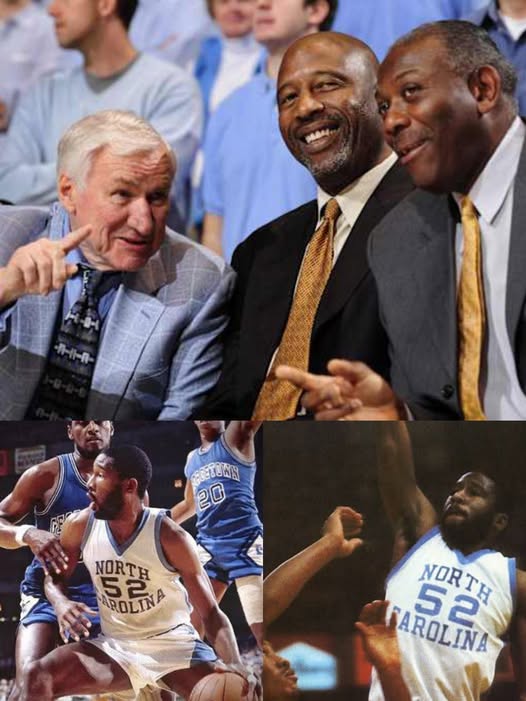
James Worthy’s place in the mythology of North Carolina basketball is at once obvious and strangely contested. Obvious because his imprint on the program—his dominance, his efficiency, his poise in the biggest moments—is carved into the very era that made Dean Smith a national champion. Contested because the pantheon of Tar Heel legends is impossibly crowded, because the standard at UNC is excellence layered upon excellence, and because Worthy himself carried a quiet, almost reluctant superstardom that never lent itself to loud self-promotion. Yet when tracing Dean Smith’s ascendance from perennial power to national champion, and when considering the lineage that begins in Gastonia and ends in the rafters of the Dean Dome, it becomes increasingly hard to argue that anyone played a more essential role during the most defining stretch of Smith’s career than James Ager Worthy.
Born in Gastonia, North Carolina, Worthy emerged from a town that has produced more than its share of hardwood legends, but his path was marked by a particular mixture of grace and resolve. His high school career at Ashbrook High made him one of the most coveted recruits in the country, a 6-foot-9 forward with an unusual blend of smoothness and explosiveness. When Dean Smith landed Worthy, it was a major statement—a signal that UNC, already loaded with tradition, was entering a period of talent acquisition that would fundamentally reshape the program. Worthy arrived in Chapel Hill raw but ready, a player with instincts too good to be taught and a body that seemed engineered for Smith’s disciplined, possession-oriented system.
His freshman year was interrupted by a broken ankle, but even then, Worthy displayed the same quiet intensity and attention to detail that would later make him a star. He never complained, and he immersed himself in learning the intricacies of Smith’s system—the defensive principles, the secondary break, the spacing, the unselfishness. When he returned the following season, he returned not as a prospect but as a force. His leap from promising to elite was swift, and it occurred precisely when Smith needed it most. The early 1980s were a time when the national conversation revolved around whether Dean Smith could win “the big one,” whether all the ACC titles and Final Four appearances meant anything without a championship. What Smith needed was a player capable of taking over a game without ever stepping outside the boundaries of team basketball, a star who excelled within the structure.
He needed James Worthy.
In 1981, Worthy, alongside Al Wood and a young Michael Jordan, propelled UNC to the national championship game, where they fell to Isiah Thomas’s Indiana Hoosiers. The loss intensified the pressure on Smith. Yet the way Worthy played—confident but calm, dominant but understated—marked him as the engine of a team on the brink. By the start of the 1981–82 season, he had become the central figure in what would become one of the most celebrated teams in college basketball history.
That 1982 season is where Worthy’s legend crystallizes. It was, in many ways, a perfect convergence of factors: Smith’s maturity as a coach, the presence of Jordan as a freshman, the leadership of Sam Perkins, and the overall balance of a roster that understood how close they had come the year before. But Worthy was the bridge between promise and fulfillment. He scored efficiently, rebounded with tenacity, and defended with a sense of anticipation that made everything around him easier. He did not have to dominate the ball because he dominated the floor. His movements—cuts to the rim, mid-range jumpers, transition sprints—defined the geometry of UNC’s offense.
And then came the moment that forever made him the “Silent Assassin.”
The 1982 NCAA championship game against Georgetown is most often associated with Michael Jordan’s go-ahead jumper. The shot is replayed endlessly, a perfect stitch in the tapestry of basketball history. But the true heartbeat of that game belonged to Worthy. He scored 28 points on 13-for-17 shooting, a performance that towered over everyone else on the court. Georgetown’s defense, known for its physicality and interior dominance, simply had no answer. Worthy’s footwork was too precise, his touch too soft, his confidence too steady. And when the final sequence unfolded—Fred Brown’s mistaken pass, Worthy’s steal, the sprint to daylight—it was Worthy who sealed the championship that had eluded Dean Smith for nearly two decades.
In that instant, Worthy was no longer just a star; he was a champion who changed the trajectory of a coaching legacy. He became the first great UNC forward to carry Smith across the finish line, the prototype for what the position would mean in Carolina’s system for generations. Without James Worthy’s brilliance that night, Smith’s narrative—and UNC’s modern basketball identity—would look different. That is not revisionist hero-making; it is the truth embedded in the game film, in the box score, and in the sigh of relief exhaled by a coach who had finally answered his critics.
Worthy’s decision to leave for the NBA Draft after that season marked the end of a short but seismic college career. He was the first pick in the draft, launching a professional career that would eventually land him in the Hall of Fame. But his impact on UNC did not dissipate when he donned a Lakers jersey. His style of play—unselfish, intelligent, efficient—became a blueprint. His success reinforced UNC’s recruiting power. His championship gave Smith’s program the legitimacy that would attract generations of talent. His name joined the pantheon, but his influence continued to ripple through the program’s DNA.
The question of where Worthy ranks among Carolina’s greatest remains a heated one, often shaped by personal memory, generational loyalty, or the gravitational pull of later stars such as Jordan, Vince Carter, Tyler Hansbrough, and Antawn Jamison. But the argument for Worthy’s place near—if not at—the top is grounded in more than nostalgia. His accomplishments form a rare combination of peak performance, historical impact, and championship significance.
Jordan became the greatest player in basketball history, but his UNC career, while excellent, was not as dominant or as essential to a specific championship run as Worthy’s was in 1982. Hansbrough became the program’s most decorated player, breaking records and embodying relentless competitiveness, but he never had a singular championship performance like Worthy’s. Carter dazzled, Jamison dominated, Phil Ford mesmerized—each carving a unique legacy. Yet none occupied the precise intersection of necessity and excellence that Worthy did at the moment North Carolina climbed to the mountaintop.
Among fans, Worthy is often described as underrated—not because people fail to recognize his greatness, but because his game was quiet, elegant, devoid of flash or ego. He did not campaign for the spotlight. The spotlight found him only when the stakes demanded it. That quietness can sometimes cause younger fans to underestimate his significance, especially in an age where highlight reels shape reputations. But Worthy’s greatness is not hidden; it is simply understated, much like the man himself.
His journey from Gastonia to Carolina is also emblematic of something deeper in UNC’s culture—a commitment to recruiting not merely talent, but character. Worthy arrived with humility and left with grace. Dean Smith admired him not simply for his skill but for the way he carried himself, the way he translated coaching into action, the way he made everyone around him better. In many ways, he was the ideal Dean Smith player: selfless, intelligent, fundamentally sound, and capable of transcending the system only when necessary.
The continued discussion about Worthy’s ranking among UNC legends is, at its core, a tribute. It means his impact is still felt, still debated, still alive. Fans revisit the 1982 game not only because it introduced Jordan’s iconic jumper, but because it immortalized Worthy’s peak. They look to the rafters and see his number hanging beside fellow giants, and they ask where he fits—not to diminish others, but to honor the enormity of his contribution.
So did James Worthy play the most important role in Dean Smith’s winning era? There is a strong, perhaps irresistible, case to be made that he did. He was the player who bridged the gap between promise and championship fulfillment, who delivered when Smith’s legacy most needed a crowning moment, who played with a level of efficiency and consistency that elevated those around him. Others contributed. Others dazzled. Others dominated. But Worthy was the one who embody the turning point.
His silent assassin persona, his Gastonia-to-Chapel-Hill journey, his transformative 1982 performance, and his legacy in the years that followed all combine to place him in a uniquely significant position. Whether fans rank him first, second, or somewhere in the top tier almost doesn’t matter. What matters is that when Carolina basketball made its historic leap into the realm of champions, James Worthy was the one who led the way—quietly, decisively, and forever.