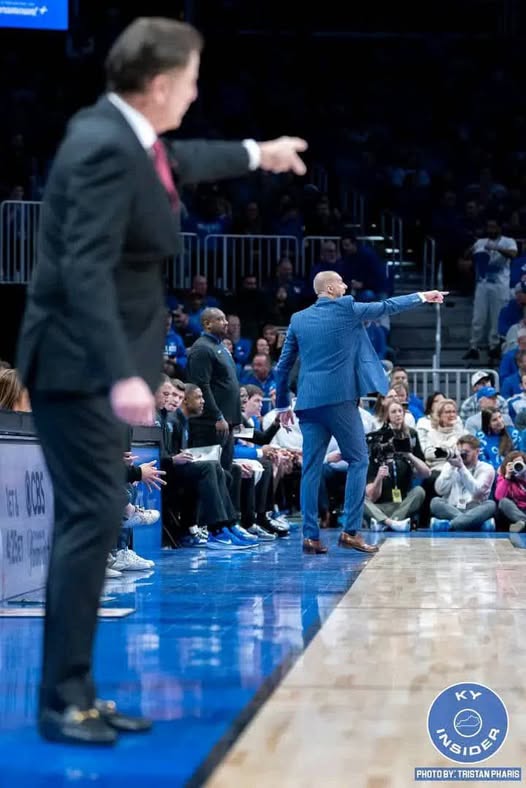
Kentucky’s victory over St. John’s did not feel like a referendum in the loud, declarative way college basketball often delivers them. There was no chest-thumping, no pointed quote designed to circulate on social media, no thinly veiled jab aimed across the court at Rick Pitino. And yet, when the final horn sounded and the Wildcats walked off with a win that required real problem-solving and emotional control, Mark Pope had quietly dismantled one of the longest-running narratives attached to Kentucky basketball in the post-Calipari transition era. He did it not with words, but with decisions, timing, and an understanding of what the moment required.
For years, Pitino has been one of the most influential voices shaping how the basketball world talks about Kentucky. Sometimes it’s been complimentary, sometimes dismissive, but it has almost always carried an underlying assumption: that Kentucky’s success is tied overwhelmingly to talent accumulation and less to tactical nuance, adaptability, or grit. The idea that Kentucky wins because it overwhelms, not because it outthinks or outlasts, has lingered even as the program has evolved. Pope’s performance against St. John’s didn’t attack that belief head-on. Instead, it exposed how outdated it has become.
This was not a game Kentucky won by simply rolling the ball out and letting superior athletes do the work. St. John’s brought pressure, physicality, and a clear plan to disrupt rhythm. Pitino-coached teams always do. They test your poise, your spacing, your willingness to execute when things get uncomfortable. For stretches, Kentucky looked exactly as Pitino would want an opponent to look: rushed, forced into contested shots, momentarily unsure of how to respond to the chaos. In past years, that’s where the narrative would have written itself. Kentucky tightens up, the opponent controls the tempo, and the game turns into a grind that favors experience and structure over raw ability.
What changed in this game was not the absence of adversity, but Kentucky’s response to it. Pope didn’t panic when St. John’s made its runs. He didn’t stubbornly stick to a script that wasn’t working. Instead, he adjusted lineups, tweaked defensive coverages, and allowed the game to breathe without losing control of it. Those adjustments weren’t flashy enough to dominate postgame discussion, but they were precise. They reflected preparation rather than improvisation, confidence rather than hope.
That’s where the subtle disproof of Pitino’s narrative lives. Pitino has long implied, sometimes directly and sometimes through implication, that Kentucky’s ceiling is capped by its reliance on talent over teaching. The idea suggests that when the game turns into a chess match, Kentucky is at a disadvantage against coaches who pride themselves on system and discipline. Against St. John’s, Kentucky didn’t win the game in spite of coaching. It won because of it.
There was a patience to Pope’s approach that felt intentional. Kentucky didn’t rush to reclaim momentum the instant it slipped away. Instead, Pope trusted that the game would come back to them if they stayed connected. That trust filtered down to the players. You could see it in the way they continued to make extra passes even after a few possessions went sideways, in the way defensive rotations tightened rather than loosened under pressure. Those are habits, not instincts, and habits are built by coaching.
Equally important was how Pope managed the emotional temperature of the game. A matchup with Pitino always carries extra weight, especially for a Kentucky fan base that remembers history and context perhaps better than anyone in college basketball. It would have been easy for that emotion to spill into rushed decisions or unnecessary aggression. Instead, Kentucky looked grounded. Competitive, yes, but not reckless. That balance is difficult to strike, particularly for a roster still defining its collective identity. Pope’s sideline demeanor mirrored that balance, reinforcing it without ever needing to announce it.
The win also challenged the idea that Kentucky can’t win ugly when it has to. There were possessions that weren’t clean. Shots didn’t always fall. The game demanded toughness more than elegance. In previous seasons, critics often pointed to those kinds of moments as proof that Kentucky lacked the mental resilience to navigate games that didn’t play to its strengths. Against St. John’s, Kentucky leaned into the discomfort. They defended, rebounded, and valued possessions in ways that don’t show up on highlight reels but absolutely decide outcomes.
This is where the result resonated so deeply with Big Blue Nation. Fans weren’t just celebrating a win over a notable opponent. They were recognizing a shift in identity. The satisfaction came from seeing Kentucky answer a familiar challenge with a different response. Instead of being rattled by pressure, they absorbed it. Instead of being outmaneuvered, they adjusted. Instead of relying solely on talent to bail them out, they relied on structure.
Pope’s background plays into this evolution. As someone who understands Kentucky’s culture from the inside but also appreciates the demands of modern coaching, he bridges two worlds. He respects the tradition that expects excellence, but he also understands that excellence now requires adaptability. Against St. John’s, that adaptability was on full display. Kentucky didn’t abandon what it does well, but it wasn’t enslaved by it either.
The contrast with Pitino, in this context, is fascinating. Pitino has always been a master of imposing his will on games. His teams often force opponents to play a style they’re uncomfortable with. In this matchup, St. John’s did exactly that for stretches, but Kentucky didn’t crumble under it. Instead, they bent without breaking and then gradually reclaimed control. That reclamation wasn’t sudden or dramatic. It was incremental, built possession by possession, adjustment by adjustment.
There’s also something symbolic in the way Pope let the game unfold without trying to “win the moment” too early. He seemed content to let his team learn in real time, to experience the stress of a close game against a disciplined opponent and figure it out collectively. That approach speaks to confidence in preparation and belief in growth. It suggests a long-term vision rather than a short-term fixation on optics.
For all of Pitino’s accomplishments and influence, his critiques of Kentucky have often been rooted in a version of the program that no longer fully exists. College basketball has changed, and so has Kentucky. NIL, roster continuity, and strategic flexibility have reshaped what successful programs look like. Pope’s Kentucky reflects that evolution. The win over St. John’s didn’t announce it loudly, but it confirmed it quietly.
What made the victory especially meaningful was that it didn’t require Kentucky to be perfect. It required them to be responsive. That distinction matters. Perfect games are rare and often opponent-dependent. Responsive teams, on the other hand, can survive and thrive in a variety of contexts. Against St. John’s, Kentucky showed it could respond to pressure, to physicality, and to tactical challenges without losing itself.
In the days following the game, the box score and final margin will fade into the background. What will linger for those paying close attention is how the game was won. Not by overwhelming dominance, but by steady competence. Not by silencing criticism with rhetoric, but by rendering it less relevant through performance.
Mark Pope didn’t need to disprove Rick Pitino with a quote or a storyline. He let the game do it for him. In a sport where narratives often outpace reality, this was a reminder that the most meaningful statements are sometimes the quietest ones. Kentucky didn’t just beat St. John’s. It demonstrated a maturity and adaptability that suggests its identity is no longer defined by what it supposedly can’t do. And for Big Blue Nation, that realization might be as satisfying as the win itself.