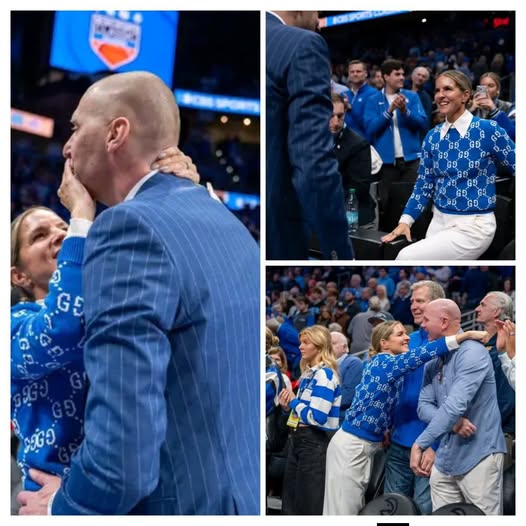
The words came quietly from Mark Pope in the aftermath of Kentucky’s win over St. John’s, but they landed with a weight that lingered far beyond the box score or the immediate excitement of the victory. In a profession that often celebrates individual brilliance, tactical genius, and visible leadership, Pope’s reflection cut in a different direction. It pulled back the curtain on a reality that rarely receives sustained attention in college basketball: the unseen, unglamorous, and deeply human support system that makes success possible. At the center of that system, Pope made clear, is his wife, Lee Anne.
For those who have followed Mark Pope’s journey—from national champion player to rising coach and now the man entrusted with one of the most demanding jobs in college sports—Lee Anne’s presence has been constant, even when it has gone largely unnoticed by the public. She has not been a sideline fixture seeking attention or a public spokesperson for her husband’s career. Instead, her influence has existed in the quieter spaces: the long drives between jobs, the difficult conversations after losses, the emotional recalibration that comes with constant pressure, and the personal grounding required to lead young athletes in a high-stakes environment.
Coaching at Kentucky is not simply a job. It is an identity, a public responsibility, and an emotional marathon. Every decision is scrutinized, every loss magnified, and every win quickly folded into the expectation of the next one. For Mark Pope, stepping into that role meant returning to a place deeply intertwined with his past, his legacy as a player, and the emotional expectations of an entire fan base. Navigating that reality requires more than basketball acumen. It requires stability, perspective, and trust—qualities that Lee Anne has helped provide for decades.
Their relationship predates the spotlight that now follows them. Long before press conferences and national broadcasts, Lee Anne was present during the formative years of Pope’s life in basketball, when the future was uncertain and the rewards far from guaranteed. Coaching careers are built on risk: low-paying assistant jobs, frequent moves, uprooting family life, and accepting instability as the price of ambition. Through each stage, Lee Anne was not simply along for the ride; she was an active partner in the decisions that shaped their path.
That partnership has mattered deeply as Pope has grown into his identity as a coach. Those who know him well often point to his emotional intelligence, his ability to connect with players, and his emphasis on culture as defining traits. Those qualities do not appear out of nowhere. They are reinforced daily by the environment he returns to after practices end and arenas empty. Lee Anne has been a stabilizing force in those moments, helping Pope process disappointment without losing confidence and success without losing humility.
After the St. John’s win, Pope could have focused on strategy, execution, or the performance of his players. Instead, he chose to center his gratitude on his wife. That choice revealed how intertwined his professional confidence is with his personal foundation. When he said, “I don’t do any of this without her,” he wasn’t offering a polite acknowledgment. He was articulating a truth about dependence, trust, and shared sacrifice.
Lee Anne’s support extends beyond emotional reassurance. Coaching at the highest level often means being consumed by the job, and maintaining balance becomes a challenge. The ability to step away, even briefly, to reconnect with family or regain clarity can determine whether a coach burns out or endures. Lee Anne has helped Pope maintain that balance, reminding him of who he is beyond the role and why he began this journey in the first place.
There is also the matter of credibility and authenticity. Players are remarkably perceptive. They sense when a coach’s message aligns with his life, when values preached in the locker room are reinforced at home. Pope’s emphasis on trust, accountability, and unity is not theoretical. It is lived. Lee Anne’s presence in his life reinforces that authenticity, making his leadership more believable and his relationships with players more durable.
In the aftermath of the St. John’s game, Pope’s comment resonated because it acknowledged something rarely spoken aloud in such a competitive space: success is communal. Behind every coach standing at the podium is a network of people who absorb stress, offer perspective, and carry emotional weight without recognition. By naming Lee Anne publicly, Pope shifted the narrative from individual accomplishment to shared effort.
That acknowledgment also reflects confidence. Coaches under intense scrutiny sometimes feel compelled to project self-sufficiency, as if admitting reliance on others might signal weakness. Pope’s willingness to do the opposite—to openly credit his wife—suggests a leader comfortable in his own skin. It sends a message to players and fans alike that strength does not come from isolation, but from connection.
Lee Anne’s role becomes even more significant when considering the personal toll of high-profile coaching. Losses follow coaches home. Criticism seeps into private spaces. Public pressure can distort self-perception. Having someone who understands those pressures without being consumed by them is invaluable. Lee Anne has served as both shield and anchor, helping Pope navigate emotional extremes without losing equilibrium.
As Kentucky continues its season and expectations remain sky-high, Lee Anne’s presence will not show up in stat lines or postgame analysis. Yet her influence will remain woven into every decision Pope makes. Whether it’s the patience to develop a struggling player, the calm to weather criticism, or the courage to stay true to his vision, the support she provides will continue to shape outcomes in subtle but profound ways.
The St. John’s win will eventually become one data point in a long season, remembered primarily by fans for what it meant in the standings or in March implications. Pope’s words afterward, however, may endure longer than the final score. They offered a glimpse into the human reality behind the job, reminding observers that leadership is sustained not just by tactics and talent, but by relationships that exist away from the noise.
Lee Anne Pope may not seek the spotlight, but in that quiet moment of acknowledgment, her impact became visible. Not because she stood beside her husband on the court, but because he chose to stand beside her in his words. In a profession defined by relentless competition, that recognition revealed something enduring and deeply grounding: behind Mark Pope’s success at Kentucky is a partnership built on trust, sacrifice, and unwavering support, one that continues to shape not just wins and losses, but the kind of leader he strives to be every day.