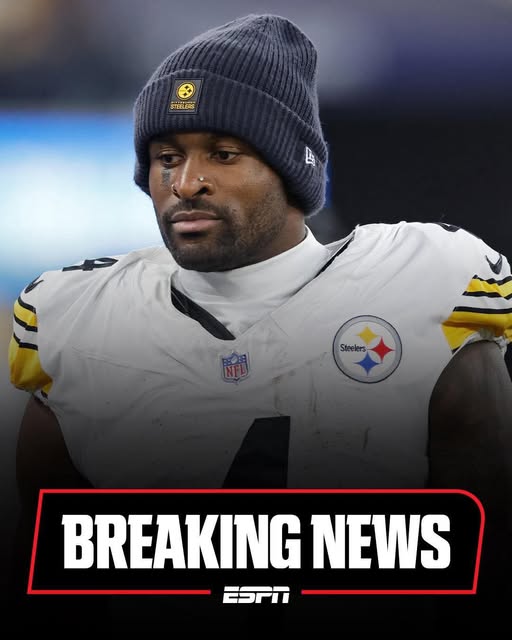
Reports circulating around the league say the NFL has suspended Steelers wide receiver D.K. Metcalf for two games following an incident in which he swiped at a fan during Sunday’s game in Detroit, a decision that immediately reignited long-standing debates about player conduct, fan behavior, and where the league draws its lines when emotions boil over on game day. According to those reports, Metcalf retains the right to appeal the suspension, but as it stands he would miss the Steelers’ upcoming matchups against the Browns and the Ravens, games that could carry serious weight in a tightly contested division race. Whether the suspension ultimately stands or is reduced, the situation has become another flashpoint in the NFL’s ongoing effort to balance intensity on the field with accountability beyond the sidelines.
The league’s reasoning is rooted in a clearly stated policy that leaves little room for interpretation. NFL rules specify that players may not enter the stands or confront fans at any time on game day, and that any unnecessary physical contact with a fan that constitutes unsportsmanlike conduct or presents crowd-control concerns and risk of injury will result in discipline. That language has existed for years, refined through incidents involving players across teams and eras, and it reflects the league’s consistent emphasis on maintaining a clear boundary between participants and spectators. From the NFL’s perspective, the issue is less about the force or outcome of a single act and more about the precedent it sets if players are allowed to respond physically to provocation from the stands.
In Metcalf’s case, the reported swipe toward a fan immediately placed the league in a familiar position. The NFL has long taken the stance that players are held to a higher standard because of their visibility, influence, and physical presence. Even in moments where fans may taunt, insult, or otherwise provoke players, the expectation is that athletes disengage and allow stadium security and officials to handle the situation. The league argues that once a player crosses that line, the risk escalates quickly, potentially endangering fans, players, and staff while creating chaos in environments that already involve tens of thousands of people.
The timing of the suspension only heightens its impact. For the Steelers, losing a top wide receiver for games against the Browns and Ravens would be a significant blow, especially given how those matchups often shape the AFC North standings. Division games are notoriously physical and emotional, and teams frequently rely on their most dynamic playmakers to create separation in tightly contested contests. Even if Metcalf ultimately appeals and sees the penalty reduced, the uncertainty itself forces the Steelers to prepare as though he may not be available, altering game plans, rotations, and offensive strategies.
From the player’s perspective, an appeal is a critical part of the process. The NFL’s disciplinary system allows players to present their version of events, argue mitigating circumstances, and challenge the length or severity of the punishment. Appeals can hinge on factors such as intent, provocation, and whether the contact was incidental or deliberate. In past cases, players have successfully had suspensions reduced or converted to fines when arbitrators determined that the league’s initial discipline exceeded precedent. For Metcalf, an appeal could focus on context, arguing that the action was brief, non-injurious, or provoked in a way that merits leniency, though the league’s strict language regarding fan contact sets a high bar.
Public reaction to the reported suspension has followed predictable lines. Some fans argue that players are human beings operating under intense pressure and should be afforded some leeway when confronted with abusive or hostile spectators. They point out that fans are rarely disciplined publicly, even when their behavior crosses lines of decency, and suggest that the league places too much responsibility on players to absorb verbal abuse without response. Others counter that players are professionals, compensated accordingly, and must be able to control their reactions regardless of provocation. From that viewpoint, any physical gesture toward a fan undermines safety and risks encouraging copycat behavior, making firm discipline not only justified but necessary.
The NFL’s emphasis on crowd control cannot be overstated. Stadiums are complex environments where security relies on predictable behavior and clear authority structures. When a player engages a fan physically, even briefly, it complicates security responses and can embolden others in the crowd. The league has repeatedly stated that it disciplines these actions not just to punish the individual player, but to deter situations that could spiral into broader confrontations. In that sense, the two-game suspension functions as a warning as much as a penalty, signaling that the league will act swiftly when boundaries are crossed.
Historically, the NFL has issued a range of punishments for similar incidents, from fines to multi-game suspensions, depending on the circumstances. Players who have entered the stands, made contact with fans, or instigated confrontations have often faced harsher penalties than those involved in on-field altercations with opponents. The distinction underscores how seriously the league views the player-fan divide. On-field conflicts are seen as part of the competitive environment, governed by rules and officiating, while off-field or crowd-related incidents introduce variables that the league is eager to minimize.
For the Steelers, the situation also raises questions about internal accountability and messaging. Teams often emphasize composure and discipline, particularly for star players whose actions draw outsized attention. Coaches and front offices may use moments like this to reinforce expectations, not just for the individual involved but for the entire roster. How the organization publicly supports Metcalf while acknowledging the seriousness of the league’s concerns can influence locker-room dynamics and public perception alike.
There is also a broader conversation about fan behavior that tends to resurface whenever these incidents occur. While the league policy focuses on player actions, many observers argue that the NFL should do more to address fans who cross lines. Enhanced enforcement of stadium codes of conduct, clearer reporting mechanisms, and more visible consequences for abusive behavior are often cited as ways to reduce confrontations before they escalate. The league and its teams have taken steps in this direction in recent years, but critics contend that enforcement remains inconsistent.
Metcalf’s potential absence against the Browns and Ravens adds another layer of intrigue, particularly given how closely watched those games are. Rivalries in the AFC North are fueled by history, physicality, and high stakes, and any change to a team’s lineup can shift expectations. Analysts and fans alike will speculate about how the Steelers might adjust, whether younger receivers will step into larger roles, and how opposing defenses might capitalize on Metcalf’s absence if the suspension holds.
Ultimately, the reported suspension serves as a reminder of the fine line NFL players walk between passion and professionalism. The league markets emotion, intensity, and personality, encouraging players to bring energy and edge to the field. At the same time, it enforces strict boundaries designed to protect everyone involved in the spectacle. When those forces collide, as they appear to have in this case, the result is often controversy and debate rather than consensus.
As the appeal process unfolds, the focus will remain on whether the punishment aligns with precedent and whether any mitigating factors come to light. Regardless of the outcome, the incident reinforces the NFL’s stance that interactions with fans are off-limits, no matter the circumstances. For players, teams, and fans, it is another chapter in the ongoing negotiation of responsibility and restraint in one of the most emotionally charged environments in professional sports.